
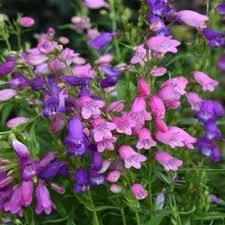
Penstemon (also called Beard Tongue) is the genus name for a beautiful and resilient North American native wildflower. It is
said that there is a penstemon for every garden. These long-blooming perennials have low water requirements. They bloom in your garden in early summer, after your spring bloomers have faded. Penstemons are a source of real "flower power" in the garden in mid-summer. They love a hot, dry growing season. They can bloom all the way into September and October.
Penstemons look much like the spikey and dramatic foxglove plant, and flower colors range from hot pinks and lavenders to fiery reds and stunning blues. They also come in shades from soft pinks through salmon and peach to deep rose, lilac, dark purple, white, and rarely, yellow. In addition to the colors, Penstemon "cultivars" (short for "cultivated varieties") come in a wide range of different shapes and sizes, from dwarf varieties to waist-high prairie-style plants.
Penstemons are of great interest to Central Valley gardeners because of the low water requirement feature of these plants. While they are known for their overall hardiness, they do need fast-draining soil and are sensitive to stagnant water and overly wet soil. Penstemon plants are fairly short-lived, only 3-4 years. Also, in learning about penstemons, gardeners should know that "hybrids" ("the cross between two different plants") tend to be easier to grow alongside regular garden plants; wild species may die quickly if planted in soil that is too rich or if they are given too much water. Sometimes penstemons will not bloom until the second growing season. Gardening patience is needed.
Before learning more about the care and planting of penstemons, gardeners will be interested in some basic information. Penstemon is the largest genus of flowering plants indigenous to North America, representing about 280 species, more than 100 of which are native to California. While penstemons mostly grow from northern Canada to Central America, they can be found all over the continent. The plants are known for their bushy shape and tubular, two-lipped flowers. Inside each bloom, there's a sterile stamen, along with four fertile stamens. The sterile stamen inside each blossom looks like a tiny hairy tongue, and the tongue seems to be "sticking out" at you. That is the origin of the secondary name "beard tongue" for penstemons.
EXTERNAL IMAGE
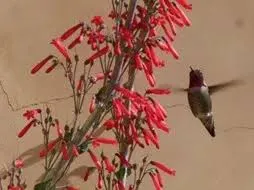
Deciding to plant, either from seed or established plants, will make your garden pollinators very happy. These nectar-rich plants attract native bees, honey bees, bumble bees, butterflies, and hummingbirds. Carpenter bees (a type of native bee) find penstemons particularly irresistible. Another positive characteristic of penstemons is that they are deer-resistant. There can be an occasional problem with aphids, but the plants are overall fairly trouble-free. Penstemons are not considered weedy or invasive. Through the ages, Native Americans used them in many remedies. Modern herbalists don't use penstemons much, but the plant is highly valued for its beauty.And here are a few more helpful hints about penstemons before it's time to plant. As long as they are planted where they get full sun for 6-8 hours daily, a small amount of shade can usually be tolerated. Penstemons will mostly come back from dormancy every year.
Prune them back to about 1/3 in March. If you want more blooms during the growing season, deadhead them. Toward fall, stop deadheading penstemon plants to allow for reseeding. Birds will also feast on the seed. Penstemon cuttings root easily in water within 3-6 weeks. For cuttings, choose 4-6-inch soft-wood stems during the summer growing season. Remove excess leaves from the stems and place the stems in a container of water in indirect light. Refresh the water regularly. Once the cuttings develop 2–3-inch roots, they can be transplanted into small pots. (Cuttings can also be planted directly into soil pots, using a root hormone.)
If gardeners choose to sow penstemon seeds, the seeds should be planted during the late fall or early winter months so they'll naturally germinate just in time for the growing season in late spring or early summer. Remember to choose a sunny spot in well-draining soil. Bury the seeds no more than ½ inch below the soil's surface and keep them moist while they germinate. Remember that some penstemons might not flower the first year. But don't forget that they are well worth the wait.
If you prefer a penstemon plant, fall is the best time to plant so that penstemons can get established over winter. However, early spring (February-March) is the second-best option and works well, too. Avoid mid-summer planting. A popular independent nursery in the Visalia area sells penstemon plants in gallon-sized pots at a reasonable price.
To give gardeners a sample of the local nursery offerings, the following penstemons are at the top of their list. Penstemon pseudospectabilis or 'Canyon Penstemon' has a deep, almost electric blue color that causes admirers to stop and stare because it almost doesn't look real. Penstemon heterophyllus, or Foothill Penstemon, ranges from reddish purple to deep blue. Remarkable among these penstemons is 'Margarita BOP', the penstemon with the very fun and funny name. Margarita BOP is dependable and long-blooming with sky blue flowers that fade to purple.
'Margarita BOP' doesn't refer to the same "Bop" dance which dominated the Rock n Roll scene in the 50s and 60s. This very popular cultivar was discovered as a chance seedling in the early 1980's…. where it grew truly at the "bottom of the porch" (BOP) at Las Pilitas Nursery in Santa Margarita, California.
Hopefully, the reader has gathered enough information and interest to add this stunning plant, with incredible texture, dimension, and color, to your hot summer valley garden. Go find yourself a perfect penstemon, and get started.