
Youth are an asset in our community which are often under-utilized – they’re a formidable and able group in communities who bring their own unique value to conversation and decisions. Choosing to intentionally include youth in leadership and decision making can be challenging, yet extremely rewarding for all involved, as well as for the community or organization.
One way to involve youth in decision making is to engage in youth-adult partnerships, which may also be called youth voice, youth in governance, or youth empowerment in some groups. Youth-adult partnerships provide youth with opportunities to learn new skills, contribute to their communities, and take on real-life leadership roles where they are valued as equals. Youth-adult partnerships are “the practice of: (a) multiple youth and multiple adults deliberating and acting together, (b) in a collective [democratic] fashion (c) over a sustained period of time, (d) through shared work, (e) intended to promote social justice, strengthen an organization and/or affirmatively address a community issue”[1]. All these components are what make it a true youth-adult partnership.
There are six elements that can help promote successful youth-adult partnerships: relationships, understanding differences, goals, balance, relevance, and recognition[2].
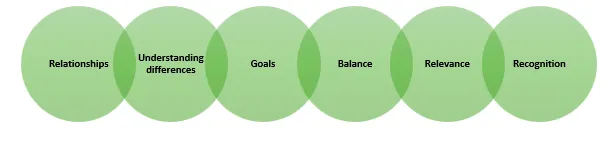
Relationships: Taking the time to get to know one another is essential. Trust between youth and adults who are working on a project or activity together is a must!
Understanding differences: Youth and adults are different – and that’s what makes a youth-adult partnership so amazing. Each person brings their own set of strengths and talents. As you learn about each other, take some time to set the expectations for each other. Learn what the youth needs from you and what you need from the youth to make this collaborative effort work.
Goals: Finding common ground can be a helpful way to make a youth-adult partnership successful. What are the shared goals for this project? What do the youth hope to get from this project? What do the adults hope to gain from this project? As you determine what the goals are, find the common ground and focus on it.
Balance: Working together requires balance – balance in numbers and balance in responsibilities. Try to keep an equal number of youth and adults in the project team. Additionally, make sure the responsibilities split between the youth and adults are balanced – this includes making sure youth are active decision makers for the project alongside the adults.
Relevance: When youth and adults work together, the work needs to be relevant and matter to the youth. Relevant and real experiences will be more meaningful and engaging for the youth.
Recognition: As a team, consider how to recognize each other and celebrate each person’s contributions. Recognition goes a long way in keeping both youth and adults engaged and feeling positive about the experience.
These six elements of successful youth-adult partnerships are not linear – they don’t have to be implemented in any specific order and can overlap as you plan and work together.
Youth-adult partnerships can be a rewarding experience for youth, adults, organizations, and communities. Like all good things, they take time, intentional effort, and good will. The 4-H Youth Development Program has experts who can help provide best practices in implementing youth-adult partnerships and there are trainings available for how to work with youth leaders. Contact your local UC 4-H Cooperative Extension office to find out about available trainings!
[1]Zeldin, S., Christens, B., & Powers, C. (2013). The psychology and practice of youth-dult partnership: Bridging generations for youth development and community change. American Journal of Community Psychology, 51, 385–397. doi: 10.1007/s10464-012-9558-y
[2]Marshall-Wheeler, N., Miner, G., Worker, S.M., Espinoza, D., Miller, J. & Kok, C.M. (2023). UC 4-H volunteer educators' guide: For those facilitating educational experiences. UC ANR Publications [8724]. https://doi.org/10.3733/ucanr.8724