
We have about 1600 native bee species in California, but the honeybee is not one of them. The European honeybee is an important part of agriculture, the beekeeping hobby, and home gardens. Honeybees are easy to hold captive and move around, and the species produces honey, but it is not the most efficient pollinator. Native wild bees get that honor, and to have a healthy garden, crop, and natural world, we need all kinds of our bee allies.
Do native bees sting?
In general, native bees are not likely to sting. When people are stung, it is usually by a wasp (including yellow jackets) or by a European honeybee.
Most native bees do not live in colonies or hives but instead have developed to live solitary lives. For most wild bees, the males only have one purpose: to mate. In some species, males hardly or never even eat, and they are short-lived. It is the females that you will mostly see buzzing around, eating nectar, and collecting pollen. If the males are around, they are generally only looking for females. Females of many native bee species live for two years, although there is a variety of life spans in our wild bees.
Types of native bees:
Here are the types of native bees we are most likely to see in our area. Each of these types of bees may have more than one species. Native bees can be big or small, resemble wasps or flies, prefer one type of flower, or be "generalists." They nest in a variety of locations depending on the type. Nests are used for eggs and larvae, not for sleeping. Bees don't "hang out" and rarely rest. They have important work to do and relatively short lives to do it, so you have to go out early in the morning or in the dark to see them sleeping alone or in small groups in flowers, in tree leaves, or under bunches of grass like our native deer grass.
Valley Carpenter Bee:
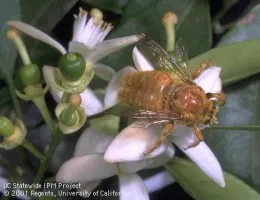
One of the most common and easily identifiable of our native bees because of its large size and shiny black color. Because they are social bees, we often see several in the same area. Female carpenter bees are the big shiny black ones of the species. They can be "nectar robbers," piercing the base of tubular flowers to drink nectar, but like most bees, they are more interested in pollen to feed their young. Male carpenter bees are called "Teddy Bear" bees because they are covered with golden hairs, and when they are hovering around flowers, they are mostly looking for a female bee. Although Carpenter bees have a bad reputation for making holes in wood structures, they prefer softer decaying wood and untreated wood, so you might consider providing a small old wood structure or a few untreated fence posts to support them. Consider it garden art and ecology in one and get creative!
Mason Bee:
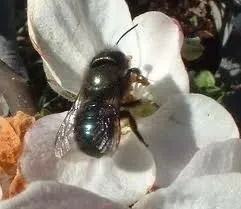
Blue or green mason bees, also called orchard bees, are smaller than honeybees but are sometimes mistaken for them because they are striped. Mason bees carry pollen on their undersides instead of their legs. They are efficient pollinators and are sometimes encouraged to nest near fruit and nut tree orchards for that reason, as they can even increase the efficiency of honeybees through their activity. They have been tried as a replacement for honeybees in almonds and other crops, but due to their wild nature and the fact that they are not hive bees, they have not proven to be an economical substitute.
They are solitary nesters and lay their eggs in pre-existing tubular cavities, using mud to make walls between eggs. These are the types of bees that are most likely to use human-made bee nesting houses. A typical cycle is that the female bee is mated, the male dies, the female searches for a series of cavities and starts building her nest, and eventually lays her eggs in one to ten (generally, depending on the depth of the cavity and other factors) cavities, creating several mud-walled "rooms" in each tubular cavity and capping it off with more mud. Once her work is done, she dies. The larvae hatch sometime in the winter, eat a pollen plug the female has left in their room for them, and grow until spring, when each bee, starting with the outside one and working backward, eats their way out of their room. They are very tiny at this point, and immediately they start looking for food. They continue to eat and grow for a year and are finally mature enough to start the cycle over again.
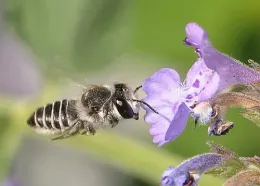
Leafcutter Bee:
These medium-sized bees are slow fliers with thick legs. They are also solitary nesters in pre-made cavities, but instead of mud, they use leaf pieces to partition their egg chambers. If you see round cuts in your rose, redbud, or other plant leaves, it is likely the work of leafcutter bees.
Sweat Bee:
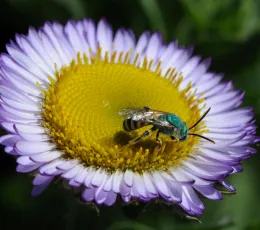
You are most likely to see the ultra-green sweat bee, as the females are shiny metallic green. Sweat bees like the salt in human sweat so that they can land on our skin, but rarely sting unless seriously threatened. They nest in soil, and besides sweat, they like plants in the daisy family, including our native California aster, as well as parsley and dill flowers.
Bumble Bee:
Many bumble bee species are in decline. The Western bumblebee of our Sierra foothills is considered Endangered. The Yellow-Faced Bumble Bee is probably the most common in our area, and they are important pollinators for tomatoes and a variety of ornamental
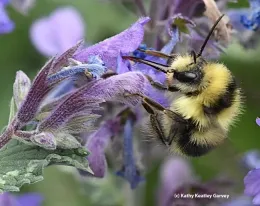
plants. If the bee is large and has yellow patches, stripes, or bands, it is most likely a bumblebee and not a carpenter bee. Some bumblebee species form small colonies; others are solitary nesters. Bumble bees often nest at the base of ornamental bunch grasses like our native deer grass (Muhlenbergia rigens) or in fields that are not mowed or heavily grazed.
Support native bees!
The best way to support and encourage native bees in your garden is to provide a variety of native plants. Try to have at least a dozen different flower species at all times. That's easy in the springtime, but requires some intentional garden design for summer, fall, and early spring flowers. You are doing an important activity by reading this article, since understanding where and how they nest is important to creating a successful habitat. Rather than trying to have one bee species over another, try to create a garden that encourages diversity. Plants that have the widest usefulness to several native bee species include native buckwheat (Eriogonum), California poppies, lupine, native bunch grasses, lavender, and plants in the daisy family.
The biggest threat to native bees is habitat loss, so creating a backyard habitat can help, as well as supporting flowers and diverse planting areas in our parks and other spaces. Avoid using pesticides, including herbicides, as much as possible. One of the pesticides most harmful to bees is a class called neonicotinoids. In California, these insecticides are no longer used for ornamental and home garden outdoor plants, but they are still used in commercial agriculture. We can support bees and other pollinators by supporting organic farming and the use of hedgerows along crops. Look for bee activity before digging up soil or spraying anything, especially in the spring nesting season. Tolerate damage by leaf-cutting bees (your plants do). Shallow dishes, bird baths, ponds, and drip emitters can all be good water sources for native bees. Leave a little bare dirt if you can, for both ground nesters and for cavity nesters who need access to mud.
Many of the things we do in our garden to support other pollinators also support our native bees. Continue to help educate others that there are bees beyond the European honeybee. The Xerces Society (Xerces.org) and the UC IPM program have more information, including links to videos and good photos to help identify individual bee species in our gardens. One place to start is the UC Davis "Beyond the Honeybee" page: Beyond the honey bee: Learn more about California native bees.