
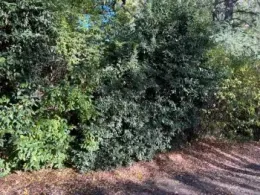
When is a group of plants a hedgerow instead of just a planting bed?
A hedgerow is mostly defined by its purpose, more than by the types of plants or even the shape of the planting area. The word comes from the Old English word "hegg," meaning boundary, generally formed by plants that are close together to create a barrier, enclosure, or boundary around an area. Most of the time, the trees, shrubs, perennials, and grasses that make up a hedgerow are planted in a row, but not always.
Why Have a Hedgerow?
Beyond its physical definition, the purpose of a hedgerow is to support and attract pollinators and other beneficial wildlife, to provide a windbreak, a sound barrier, a buffer from dust and pesticide drift, for erosion control, water filtration, as living fences, and for aesthetic (view) reasons. That's a lot of possibilities, and most of the time, a hedgerow will serve more than one function. If you have a small or large farm or a rural field or pasture, a large residential lot, or a medium to large vegetable garden or orchard, a hedgerow is a valuable feature.
Even in a small garden, using some of the principles of a hedgerow can increase the value of the landscape and make your garden more productive and ecologically balanced. Attracting and supporting native wildlife means less dependence on pesticides and other "inputs," which, besides being better for the environment, can save you money.
Plants that are native to the region or even to the site are used to support native wildlife. We don't want to introduce invasive species, nor do we want to increase our maintenance tasks. Planned and planted well, hedgerows require very little upkeep. Depending on where and how they are planted, you may need to provide supplemental water in the summer, and you may need to control unwanted plants (weeds) for at least the initial establishment. But you shouldn't think of a hedgerow as something you prune or "hedge." Part of the benefit for wildlife is to leave it as untended as possible. Choose your plant species based on this idea and avoid any that you don't have space for or that you just cannot stand the appearance of. Ideally, you want the plants to be untouched during their lifetimes to provide the maximum benefit to wildlife and for the maximum weed control benefits. As a hedgerow matures, a thinning of dead material may be done, but not annually.
A hedgerow is not a single species planted in a long line. To be a hedgerow, your planting scheme must include diversity. This is where you really can plant "one of each" or do groupings of a few of each plant, alternating along a row or in an area.
Plant Selection
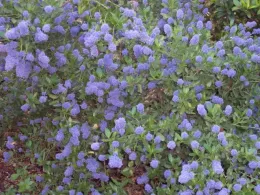
Some of the most common hedgerow plants that you might use in the San Joaquin Valley are native ornamental buckwheat (Eriogonum sp.), California lilac (Ceanothus), four-wing saltbush (Atriplex canescens), quailbush (Atriplex lentiformis), toyon (Heteromeles arbutifolia), milkweed (Asclepias), deer grass (Muhlenbergia rigens), western goldenrod (Solidago velutina), coffeeberry (Frangula sp.), western elderberry (Sambucus mexicana), and western yarrow (Achillea millefolium). Where natural water and abundant space are available, even native willow (Salix sp.) can be a foundational plant.
Choose plants with a variety of bloom seasons to provide nectar and pollen to a range of pollinators and other beneficial insects and birds. Choose plants that will match your microclimate, soil type, and water availability. Once you have your foundational plants chosen, a hedgerow can also include annual native wildflowers and even sunflowers or other favorite non-native (but not invasive) cut flower species. In order to be a hedgerow, however, with year-round usefulness, the main plants should be trees, shrubs, and perennials rather than annuals.
As with all planting plans, it's fine to start small and simple and add to your hedgerow. Space your plants the same way you would in your home garden, or you can crowd the plants if you prefer. It's better, in fact, to overplant rather than space them out too far apart to control more weeds.
Hedgerow Care
Once you have planted your hedgerow, keep the plants well-watered until they establish, just as you would in your home garden. In the home garden, your hedgerow can be watered the same as your annual vegetables, but you can have the hedgerow on its own system if you like, especially if you use low-water-use species.
Using these principles, you can at least mimic a hedgerow in your backyard edible garden or small orchard. Choose an area that you are comfortable allowing to grow more naturally, with minimal management, choose your foundational species, set up your watering system, and plant. It's that simple. Within a few months, you shouldn't be surprised to see more butterflies, moths, native bees, and other wildlife activity in and around your hedgerow.
The University of California Agriculture and Natural Resources (UC ANR) program has detailed instructions and advice in several IPM publications. Search the IPM website at the IPM "Home and Landscape" page for more information.