


More than 60 years ago, a teenage butterfly researcher in Philadelphia conceived of a genomics research project involving the genus Colias, the sulfur butterfly. It never came to fruition because DNA genomics had not yet been invented.
Fast forward to today. The research project that the teen envisioned now appears in a newly published paper, “Temporal Dynamics of Color Polymorphism and Hybridization in Colias Butterflies,” in Evolution, the international journal of organic evolution.
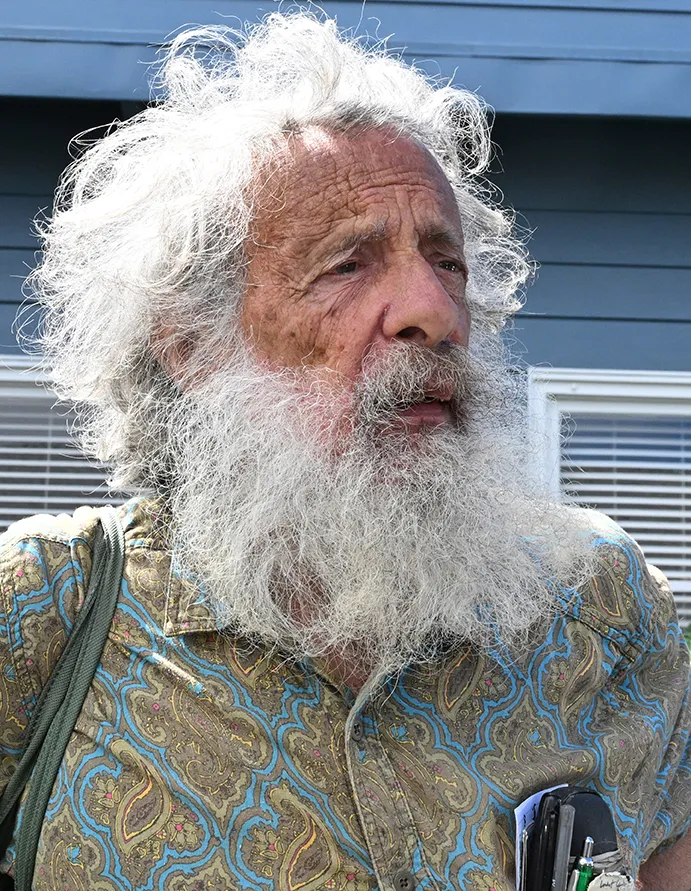
That boy, now 80, is UC Davis Distinguished Professor Emeritus Art Shapiro. “I never thought I’d see this in my lifetime,” he said.
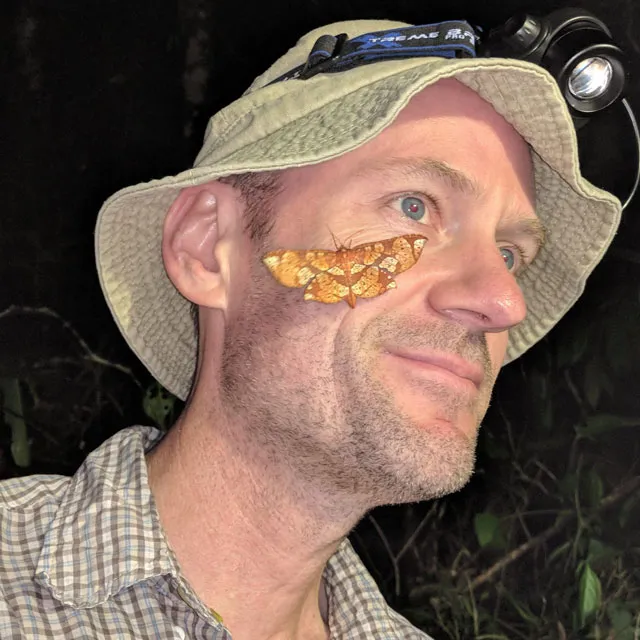
The work was mostly done in the lab of Shapiro’s former doctoral student, Matthew Forister, the Trevor J. McMinn Endowed Research Professor in Biology, University of Nevada, Reno.
The nine-author team includes Shapiro. “As is traditional in such cases, I am listed as the last author, the éminence grise position,” he quipped. “And I did live to see my high-school dream realized. How many researchers can make that claim?”
“The research contributes to our understanding of an evolutionary phenomenon --- introgressive hybridization--that at least superficially seems to defy theoretical expectations,” Shapiro said. “It's gratifying to get far enough below the surface as to be able to see what is really going on, and that's what motivates basic research, after all. We are curious by nature--like cats.”
Corresponded with Charles Remington
It all came about when Art, as a high school student fascinated with butterflies, corresponded with Charles Remington of Yale, then the foremost butterfly researcher in the United States. “He guided me into the Colias system, which had already been studied by John Gerould of Dartmouth College, New Hampshire, and William Hovanitz of California (who became a biology professor at California State University at Los Angeles). I did genetic research that propelled me to victory in the Delaware Valley and national science fairs and to a Westinghouse Science Talent Search full scholarship that enabled me to go to the University of Pennsylvania for my bachelor’s degree in biology (1966), a life-changing experience.” Shapiro went on to receive his doctorate in entomology in 1970 from Cornell University. UC Davis successfully recruited him to its faculty in 1971.
Art credits two books that he read as teenager as sparking his Colias project: Julian Huxley’s “Evolution: The Modern Synthesis” and Ernst Mayr’s landmark book, "Animal Species and Evolution," which proposed that new species arise when populations become geographically or reproductively isolated, leading to the accumulation of different traits.
“All of this led me to design the definitive study I wanted to do on Colias, Shapiro said. “But I couldn't do it. In fact, NO ONE could do it because DNA genomics had not yet been invented--because there were no tools to do it! So, although I kept up my interest in Colias throughout my career and several of my students worked on it, THE study hung fire until we had the tools to do it.”
'I Could Only Hope'
“I had been collecting samples over decades in full faith that it would be done--I could only hope, in my lifetime,” he said.
Shapiro praised Remington (1922-2007) for “turning me on to the problem by providing me with photocopies of the Colias papers by John Gerould at Dartmouth and William Hovanitz of Southern California.”
“The basic problem,” Shapiro explained, “dealt with the phenotypes, the orange and yellow eastern sulphurs Colias eurytheme and philodice. In the West, philodice was replaced by an entity called eriphyle. It was hybridized everywhere it co-occurred. Eurytheme spread northward in response to the planting of a preferred host plant, alfalfa.”
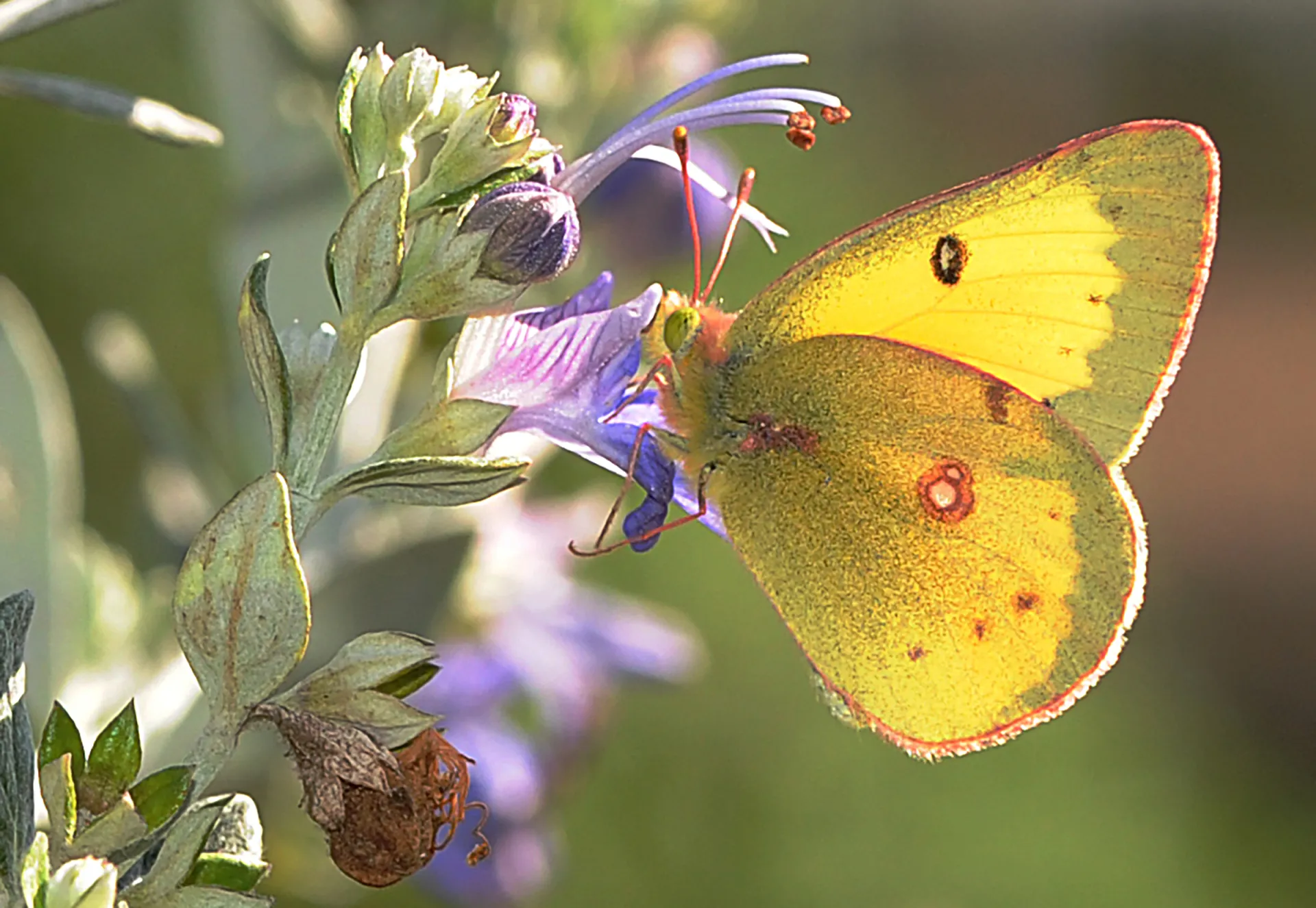
“But although apparent hybrids occurred at high frequencies, the species refused to merge--they remained distinct! I knew from the books that this was a problem that needed a solution; it went against theoretical expectations. I wanted to solve it! To do so would require actual quantitative knowledge of the amount of gene flow--introgressive hybridization--going on and the degree of randomness vs. selectivity in mating. Thus, was the project conceived.”
“I began by doing breeding to work out the Mendelian genetics of wing color. That was the project that gained me entry to the elite science fair circuit and then to Westinghouse Science Talent Search, which ultimately paid for my education at Penn.” He drew inspiration from Penn genetics professor Conway Zirkle “but mainly at Penn, I developed a serious interest in community and population ecology.”
Shapiro has studied other North American Colias “but only superficially, and also with South American ones, mainly the Argentine Colias lesbia and the Chilean C. vauthierii, and green Colias from the high Andes in both northern Argentina and Peru.
Interest in Colias Never Waned
His interest in Colias never waned. In fact, his very first publication addressed Colias seasonality (phenology) in Pennsylvania. Decades later he published the first description of the early stages of one of the green Peruvian-Andean Colias.
“So my interest was always there,” Shapiro mused. “Now that molecular genomics is a reality, the way was open to actually DO what I had wanted to do in high school.” He teamed with Forister and his crew “who had the facilities to do such work and we did it.”
“It was a bit late for me as an old goat to get into the molecular-genomics business!” he added.
He’s been asked: “Why didn’t you do your dissertation on Colias?”
“As a college senior, I corresponded with Paul Ehrlich at Stanford about it--he was by then the leading American butterfly guy. We discussed it in some detail, but it was evident that there still was not--and would not be in the foreseeable future--a way to really get at the problem. One needed molecular genomics! I went to Cornell and worked on the genetics of insect-host plant relationships instead. And never regretted it.”
Shapiro pointed out that the only Colias in the Central Valley is eurytheme. Eriphyle occurs only on the east slope of the Sierra and in the Great Basin and Rockies.
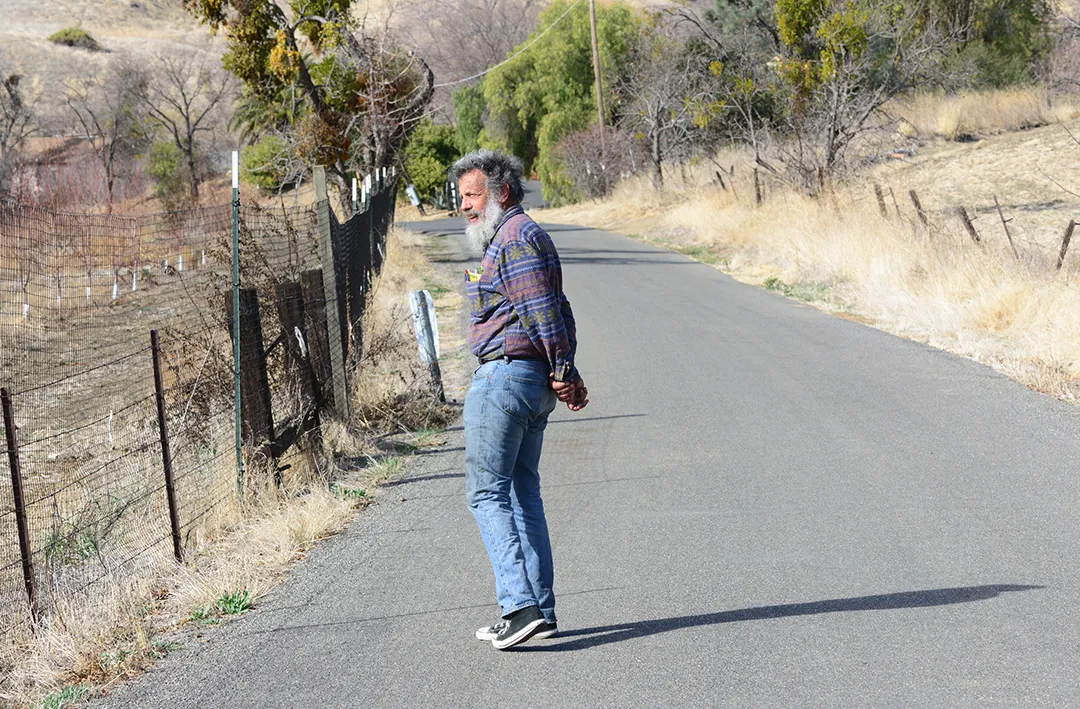
Internationally renowned for his longterm data research, Shapiro has monitored the butterfly populations in central and northern California, encompassing some 115 species, since 1972. His work, known as the largest butterfly monitoring data set in North America and one of the largest in the world, runs parallel to Interstate 80, with 10 sites distributed from the inner Coast Range, across the Sacramento Valley and the Sierra Nevada, to the western edge of the Great Basin. His sites span a wide range of climates and vegetations, from sea level to treeline at 9000 feet. His research appears on his website, “Art’s Butterfly World,” at https://butterfly.ucdavis.edu/.
Research Paper

The abstract of the research paper: “Investigations into the genetic basis of color polymorphism have played a key role in our understanding of genetic architecture and the evolution of mating systems,” the authors wrote in the abstract. “Sulfur butterflies (Colias) have been models in this field, but also contain unsolved puzzles with respect to species boundaries and hybridization. We surveyed genomic variation across 5 years in a location where phenotypic intermediates between Colias eurytheme and C. eriphyle are observed, but ancestry variation of potential hybrids has not been quantified. Our results reveal individuals with hybrid ancestry roughly in proportion to the frequency of individuals of intermediate phenotype recorded in the wild. Individuals with hybrid ancestry were predominantly those with intermediate morphologies, but morphologically intermediate individuals were not always of hybrid origin, which raises alternative possibilities for the origin and maintenance of color variation in the system. Genomic regions differentiated between species are largely located on the Z chromosome, and we find more candidates on autosomes than in another Colias contact zone. The dynamics of hybridization in this system are highly variable through time, suggesting fertile avenues for future study into the maintenance of species boundaries in the face of temporally variable, climatically influenced, and pervasive hybridization.”