
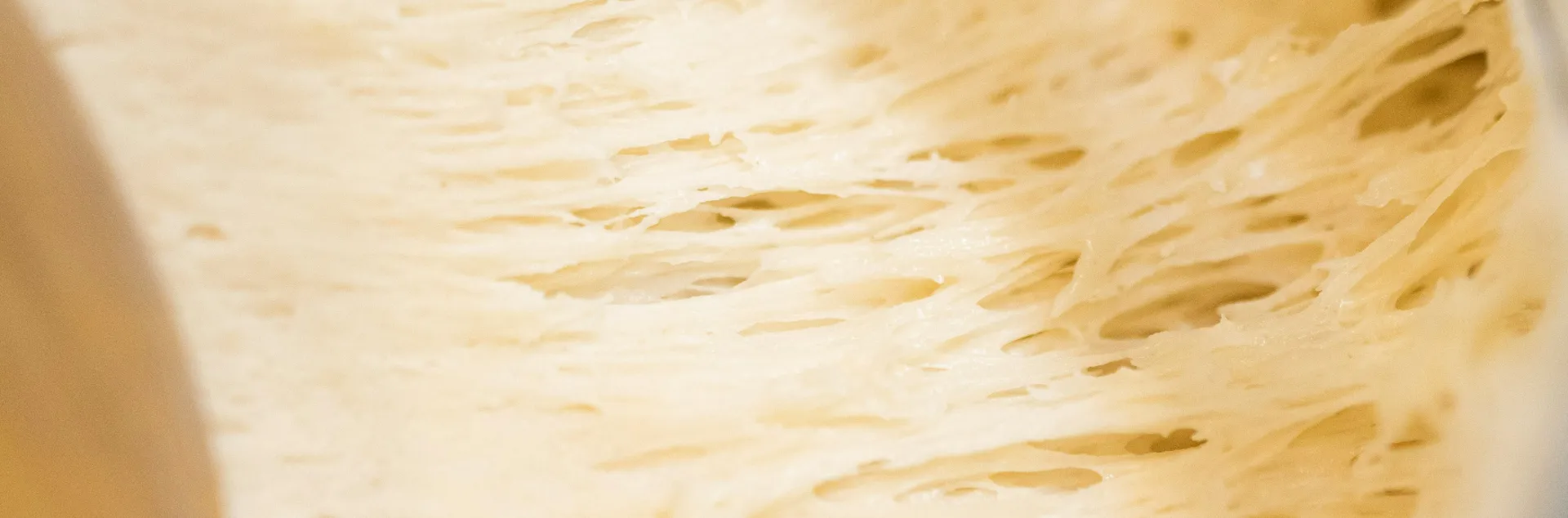
Flour is the main ingredient and is especially important in making a gluten-free starter. Use a whole grain gluten-free flour like brown rice, buckwheat, sorghum or millet flour. While gluten-free flour blends can be substituted successfully in most baking recipes, they are not recommended for making sourdough starter as they contain starches and gums that produce a less than desirable texture. For best results use a scale to measure ingredients.
Yield: Enough to maintain in a quart jar
Prep: ~ 7 days for starter to be ready
Processing: Not required
INGREDIENTS (SEE TIPS BELOW):
• Whole-grain gluten-free flour such as brown rice,
buckwheat, sorghum or millet
• Filtered water (room temperature)
DIRECTIONS:
Prep:
• Day 1: In a medium ceramic or glass bowl, whisk
together 1 cup (140g) flour and ¾ cup (170g) water until the mixture forms a pourable
paste. Cover the bowl with a clean linen towel and set aside at room temperature for 16
to 24 hours, until you see some small bubbles from on the surface. Ideally the room
should be around 75°F.
• Day 2: Add 1/3 cup (45g) flour and ¼ cup (55 grams) water to the bowl and whisk to
combine. Cover again with the towel and set aside at room temperature for another 16 to
24 hours.
• Day 3: By now the mixture should bubble up slightly and smell sour, like yogurt. Discard
¼ cup (75g) of the starter, then add 1/3 cup (45g) flour and ¼ cup (55g) water, whisk, re-
cover, and set aside at room temperature. As the starter becomes more active and
larger in volume, it will eat through its food much faster, so you might have to feed it
sooner than 16 to 24 hours. Check it after 12 hours and then every 2 hours from then on.
When it bubbles up really nicely and begins to deflate, feed it, otherwise it will become
watery.
• Day 4: Discard another ¼ cup (75g) of the starter. Whisk in 1/3 cup (45g) flour and ¼
cup (55g) water, re-cover, and set aside at room temperature again until it bubbles and
puffs up. Because it might be ready for a feeding sooner than 16 to 24 hours, depending
on the environment, keep an eye on it. As before check it after 12 hours and then every
2 hours from then on.
• Day 5: For the 5th and final feeding, discard ½ cup (150g) of the starter. Whisk in ½ cup
(70g) flour and 1/3 cup (85g) water, cover with a clean linen towel, and set aside at room
temperature until it bubbles up nicely. This can take anywhere from 6 to 12 hours, At
this point you have enough established starter to begin making recipes. Store in a
lidded, 1-quart mason jar and keep it in the refrigerator until ready to use.
Other/Tips:
• For greatest accuracy and best results, we suggest you use a scale to weigh your
ingredients – preferably one that measures in grams.
• Use a whole grain gluten-free flour like brown rice, buckwheat, sorghum or millet flour.
• Do NOT use a gluten-free flour blend.
• As for water, unless your tap water is so heavily treated that you can smell the chemicals,
there’s no need to use bottled water; tap water is fine. For best results, use room-
temperature water, 68°F to 70°F. If your house is chilly, use lukewarm water, if it’s hot,
use cool water.
• Glass, crockery, stainless steel or food-grade plastic all work fine for this. Make sure the
container is large enough to hold your starter as it grows – we recommend at least 1-
quart capacity.
• The colder the environment, the more slowly your starter will grow, If the normal
temperature in your home is below 68°F, we suggest finding a warmer spot to develop
your starter. For instance, try setting the starter atop your water heater, refrigerator, or
another appliance that may generate ambient heat. Your turned-off oven – with the light
on – is also a good choice.
• Place the jar or container on a tea towel or trivet – kitchen counters can be chilly!
• Why discard so much starter? Unless you discard starter at some point, you’ll quickly
end up with a very large container of starter. Also, keeping the volume down offers the
yeast more food to eat each time you feed it.
• You don’t have to discard starter if you don’t want to once it’s fully developed. You can
give it to a friend or use it to bake.
Source:
https://food52.com/recipes/87166-gluten-free-sourdough-starter-recipe