It was delightful hearing UC Davis nutritionist and fitness expert Liz Applegate extol the virtues of honey at the 31st annual Western Apicultural Society (WAS) conference, held recently in Healdsburg. Like many of you, we've always loved honey.
Call it the "Mournful Dusky-Wing" or the "Sad Dusky-Wing." Call it what you will, but the Erynnis tristis, a member of the skipper butterfly family (Hesperiidae), is neither mournful nor sad when it's nectaring lavender.
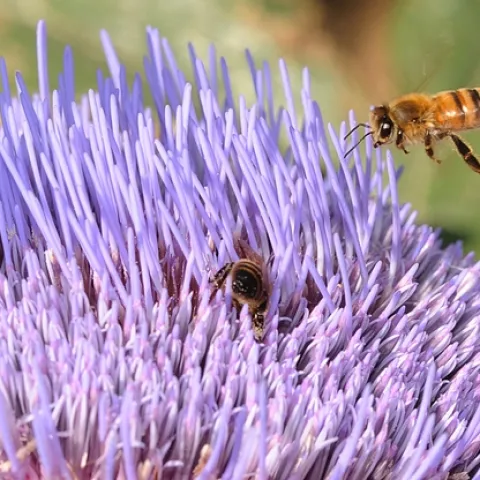
It's no secret that bees like sedum. The Autumn Joy sedum (family Crassulaceae) growing in our garden is still a tight cluster of broccoli-like buds--not ready for prime time. But don't tell the honey bees that.
Oo-laa! Ookow! What a treat to see the Western Tiger Swallowtail (Papilio rutullus) gliding into a patch of ookow (Dichelostemma congestum), also known as wild hyacinth. A recent outing to Healdsburg, Sonoma County, found the tiger on the ookow.
A tip of the bee veil to Susan Cobey. Cobey, bee breeder-geneticist and manager of the Harry H. Laidlaw Jr. Honey Bee Research Facility at the University of California, Davis, has won the 2009 Outstanding Service to Beekeeping award from the Western Apicultural Society (WAS).
What's causing colony collapse disorder (CCD)? Are we any closer to determining the cause? CCD, the mysterious malady characterized by bees abandoning the hive, leaving behind the brood and food storage, continues to be of great concern--and rightfully so.
Squatters' rights. A dandelion poking through the rocks near Nick's Cove on Tomales Bay, in Marshall, Sonoma County, seemed an unlikely host for squatters' rights. It first drew a tiny bee, barely a quarter-inch long.
All hail the honey bee. Tomorrow (Saturday, Aug. 22) is the first-ever National Honey Bee Awareness Day, as proclaimed by U.S. Agriculture Secretary Tom Vilsack. It's "hive time" this insect has its own day.
Gleanings from the Western Apicultural Society's 31st annual conference, being held in Healdsburg this week under the direction of president Eric Mussen, Extension apiculturist and member of the UC Davis Department of Entomology faculty: Honey bees can fly a distance of about two to two-and-a-half m...