
Nutsedge is a common weed that can be found in lawns, gardens, and flower beds of the Central Valley and throughout California. It is sometimes referred to as nut grass, although it is not a grass. The saying "sedges have edges" will help you differentiate between a grass and a sedge.
Description
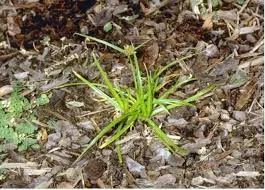
Nutsedges are aggressive and persistent weeds with thick, stiff leaves. The leaves of sedges are arranged in groups of three at the base, while grass leaves grow across from each other in sets of two. Each leaf forms a triangle in cross-section, which creates its edges. The term nutgrass is derived from the fact that there are little swollen tubers on their roots that look like small bulbs (or nuts). The tubers are produced on rhizomes, which are underground runners. The rhizomes with the tubers grow as deep as 8 to 14 inches. They sprout new plants as they grow and can form patches as large as 10 feet across. If you pull the plant up, the tuber will most likely break off, and the new plant will grow almost before you can put your weeding tools away!
Nutsedges thrive in poorly drained, water-logged soil, often in a low spot. They are easy to spot in turf grass and flower beds because they grow faster than grass and are usually taller and thicker-leaved.
There are two common species of nutsedge in California. They are Cyperus esculentus (yellow sedge) and Cyperus rotundus (purple sedge). Both can be found in the Central Valley. Yellow nutsedge has light brown flowers and seeds, while purple nutsedge flowers have a reddish tinge, and the seeds are dark brown or black.
Another characteristic that distinguishes the two species of nutsedge (besides the color of the flower) is the color and arrangement of the tubers on the rhizomes. Yellow nutsedge produces brown or black tubers, one per rhizome. The purple nutsedge produces reddish-colored tubers in chains on each rhizome.
Yellow and purple nutsedge are perennial plants. Their leaves and flowers die back in the fall. But the tubers and rhizomes remain alive in the soil and will sprout the following spring.
Management
Nutsedges are a problem because they detract from the looks of a turf lawn. They grow faster, are taller and more upright, making the lawn look nonuniform. They are also difficult to control because of the tubers breaking off and sprouting new plants. Without management, nutsedge can easily overtake a lawn—and while it would still be green, it would have to be mowed two to three times a week. Plus, the "edges" of sedges can be sharp and not pleasant to walk upon.
Prevention
The easiest way to control the problem of nutsedges is to prevent their establishment. Because of their growth habit and formation of rhizomes, they are difficult to control once established. Avoid overwatering, which creates poor drainage.
Removing plants and tubers
Remove small plants as they appear. If you pull nutsedge when it is small, it possibly hasn't begun to produce tubers. Without tubers, it won't spread as easily. The best way to remove small plants is to hand-pull or hand-hoe them before they have 5 to 6 leaves. Monitor the area and continue pulling them up as they reappear. It will take constant monitoring and work, but eventually, you will win!
If you find nutsedge in a patch on your turf, dig out the patch down to at least 8 inches deep, refill with soil, and then seed or sod the patch. Be sure to monitor the area through the spring and summer and remove any new nutsedge plants that emerge.
Mulching
Black or clear polyethylene plastic mulches don't control yellow or purple nutsedge because the sharp points at the ends of their leaves can penetrate the plastic. Landscape fabrics made from polypropylene polymers are available that effectively suppresses nutsedge growth and have the added benefit of being water and air-permeable. Lay down landscape fabric and then cover it with mulch to suppress nutsedge growth. You will still need to monitor and remove new growth, especially along the edges of the weed cloth.
Chemical Control
There are only a few herbicides available to the home gardener that will control nutsedge. UCANR has a helpful Pest Note #7432 on nutsedge that lists the chemicals effective against nutsedge: UC IPM Pest Notes, Publication 7432 Nutsedge
Note the difference between preemergent and post-emergent herbicides. Most of the herbicides do not carry down to the tubers, so they must be reapplied as new plants develop.
Exercise caution in using herbicides and remember to read the label. Some can harm turf grass and other ornaments.
Similar Weeds
One weed that is often confused for yellow or purple sedge is Cyperus eragrostis, or tall flatsedge. It has tall stems with long, pointed leaves that radiate out from the center. The flower forms within tough, rounded spikes. It is dormant in the winter. It does not have tubers, but it does have rhizomes. It reproduces from seeds and can be spread by mowing if it has gone to seed. Another weed often mistaken for nutsedge is green kyllinga. It also reproduces by seed and is dormant in the winter.
Nutsedge can easily take over your lawn, so vigilance and persistence are key to its removal.