
Whether you bought a new home or are taking on chores for a relative, suddenly you are expected to tend intimidating rose bushes. In reality, roses are more resilient than you would expect, and resources to help are readily available. Spending an early morning in the rose garden just puttering around is very meditative and pleasant.
The Master Gardener website has a wealth of information on roses. Roses are a topic in a box on the left of our main screen. UC Gardening, also reached from the main screen, covers rose care practices for plant health, identifying pests and diseases with guidance for management, UC Master Gardeners of Tulare/Kings County website
Start by determining what type of rose bush you have
Shrub roses are a low-growing flowering shrub about 2-3 feet in height. Floribunda roses have blooms in little "bouquets" of abundant flowers. Hybrid tea roses have a root stock with a desired variety of rose bush grafted to the root stock and produce single flowers per cane. Tree roses have a strong cane, like a small tree trunk, with the rose bush and blooms on top. Miniature roses have small flowers and leaves, but the plant may be miniature-sized or a fair-sized shrub. Climbing roses have long, strong canes and bloom best when the canes are horizontal and supported by a trellis or arbor.
Can you find out the specific name of the rose?
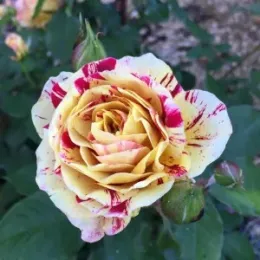
It can be as easy as locating a metal tag attached to the canes at the base of the plant, but often the tag has been lost over time. Look at all the details of the plant: bloom size and shape, fragrance, leaf shape, type of thorns, how it grows (climber, shrub, or bush), and the size/shape of the plant. The American Rose Society and the Jackson & Perkins sites online have rose categories, specific rose varieties, and many pictures for comparison. Visiting a local nursery with pictures of the plant and its blooms is often the most informative, as they can give you tips on the care of the plant, as well. A walk around your neighborhood looking for healthy, blooming roses can be very helpful. People love to hear that you are impressed with their garden and will share information.
Is the rose bush healthy?
The rose bush should have green, healthy leaves in the warmer months. (It is normal if it becomes more sparse and drops leaves as the weather cools.) If the leaves are yellowish, spotted, or sticky to the touch, check for disease, pest, or care problems under UC IPM on our website. They have pictures of leaf issues and how to remedy the problem. If the leaves have half-moon-shaped "bites" on the edges, it is usually a leaf-cutter bee and just a cosmetic issue. If you see obvious insects on the plant or bloom, UC IPM can identify the critter and recommend actions to take. Some pests are seasonal and will move on in weeks (Hoplia beetle), many can be hosed off and left for beneficial insects to come to your aid (aphids). Some leaf discoloration can be from a lack of nutrients, insufficient water, or herbicide overspray.
How is the rose bush watered?
Check for a drip irrigation tubing under the mulch around the plant. Drip irrigation is recommended for roses to give a deep watering to the roots of the plant and to keep the leaves from remaining wet, which can lead to fungal leaf diseases. Roses need about an inch of water per week during warmer months. If an irrigation system isn't in place, a soaker hose placed at least 6 inches from the base of the plant can supply water evenly, and it is easiest if used with a hose timer. A layer of mulch around the plant (just not right at the base of the plant) keeps the moisture from evaporating and keeps down weeds.
What about rose pruning?
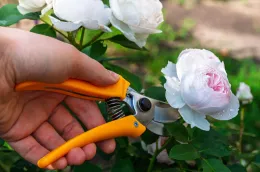
In the Central Valley, roses are pruned in the winter months when they are somewhat dormant. On the Master Gardener website, there is a guideline, "Ten Steps to Beautiful Roses," which outlines the process. There are scientific techniques, but there is also an art to pruning for shape, location, and aesthetic of the plant. This can be a challenge if the plant has not been pruned for years. Pruning is not random hacking, but it removes plant parts for a reason. These include eliminating dead canes, those that cross, thick woody old canes, and dense growth in the center of the plant. Can you skip pruning? The plant will live, but will not be as healthy, will produce fewer/smaller blooms, not be as attractive, and will be more prone to pests and diseases. Shrub roses only require some shaping and removal of dead blooms or canes. Climbing roses need removal of suckers (growth from the root stock below the graft union) and pruning of dead or weak canes. The Master Gardeners will be at the Tulare County Courthouse on Saturday, January 17, from 9 am until noon, demonstrating rose pruning for the public.
Is it worth keeping an old rose bush?
The average lifespan of a hybrid tea rose bush is 35 years, longer if it receives good care. Some newer varieties may be best at 10-15 years, depending on whether they are grafted onto other rootstock or are growing from their own roots and the care they have received. Some climbing roses only bloom once a year and do best with a climbing structure, as the canes bloom best when horizontal. Roses in our area have an abundant spring bloom; during the summer heat, they may be less vigorous, then have a fall flush of blooms. They will look sparse and drop leaves in the colder months; this is normal during their semi-dormancy. The only real reason to remove a rose bush is if it is truly dead or in a location unsuitable for the plant (such as deep shade) or hazardous to running children.
Rose care basics
The "Ten Steps to Beautiful Roses" on our website has rose care by the month. Most of the year, roses need the removal of dead blooms (dead-heading), checking irrigation, and looking for pest or disease issues. Tools you will need include a bypass pruner, a lopper for larger canes, a sharpener for the tools, a cleaner for the tools, and definitely gloves. If the tools are not sharp, they are harder to use and crush the cane instead of making a clean cut. In addition to using a sharpening stone, I clean my tools using 70% alcohol, which helps them operate smoothly and avoids spreading diseases between plants. Heavy gloves, especially covering the forearm, keep thorns at bay.
Roses are a very rewarding plant in the garden and do not require as much care as you might have heard. Especially if you are helping a relative or the garden reminds you of a dear person, the effort is certainly time well spent. Learning more about the rose variety will guide you in its care and disease resistance, so you can have the best blooms and a healthy plant.