
I can think of nothing more endearing than seeing birds in my garden, unless it’s my dogs. Birds are some of the most interesting, varied, and resourceful creatures on earth, and they get a bum rap on intelligence sometimes.
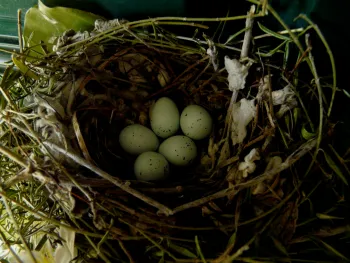
Bewick’s Wrens nest around my garden, from my trellises to my neighbor’s acacia jungle, and sometimes even in the little bird houses. The babies gather on my deck to play and test out their wings. As bug eaters, they must enjoy the insect bounty of the large native toyon (Heteromeles arbutifolia), which produces tasty red berries. Since I’m not a tidy gardener, there are always lots of spider webs around to supply insect eaters.
I have a palm tree, likely a Mexican Fan Palm (Washingtonia robusta), that’s grown from under six feet when I moved here 28 years ago to very tall today. It should really be removed, but it harbors so much life that I resist culling it. Hooded Orioles have nested in their dead fronds, until the crows stole their babies one spring and they moved to safer housing nearby…I hate the food chain at times like this.
I don’t see mockingbirds in my garden, but there’s one who greets me around the corner where it lives in the cotoneaster, pyracantha, ivy, and echium copse. It likely has cozy nesting spots in the shelter of these invasive plants. If you’re wondering who’s singing at o’dark thirty, it would be the mockingbird.
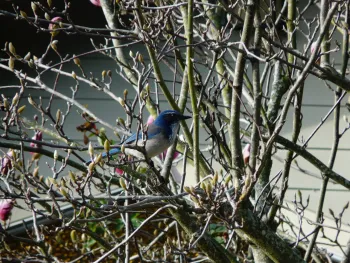
There are a couple of crows in the neighborhood who patrol, looking for mischief… they’re omnivores and among our smartest birds…I saw a crow funeral one time, though scientists surmise that it’s a way for them to learn about potential threats. Scrub Jays are also in the corvid family, and they’re great acorn planters, helping to distribute new oaks within a large radius of each tree. It took me a while to figure out who was planting acorns in my pots around the garden…perfectly planted with a nice taproot.
Flocks of Cedar Waxwings, charming little songbirds with a black mask and waxy red wingtips, show up for the fall berry crop. I used to see them roost by the hundreds in a neighbor’s large elm tree, but lately I only see their flocks flying throughout the neighborhood. If you’re lucky enough to have a madrone tree (Arbutus menziesii) they might come to your garden to eat the red berries, though other berries appeal to them as well.
You might attract quail by creating some brush piles to protect these ground-dwellers from predators and to provide food. These days, I only occasionally see a few in my neighborhood, though they were common not so long ago.
Hummingbirds are ubiquitous in many gardens, especially those with tubular red flowers such as fuchsias or our native California fuchsia (Epilobium canum). Manzanita (Arctostaphylos sp.) flowers, native black sage (Salvia mellifera), sticky monkey (Mimulus aurantiacus & cardinalis), and hummingbird sage (S. spathacea) are all favored. The list goes on. The Anna’s Hummingbird is here year-round, the Allen’s is a summer resident, and the Rufous migrates through western states from Alaska to Mexico. These bold little birds are so much fun to watch and make getting outside to work a pleasure.
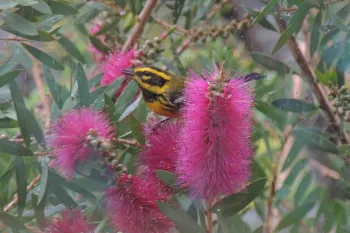
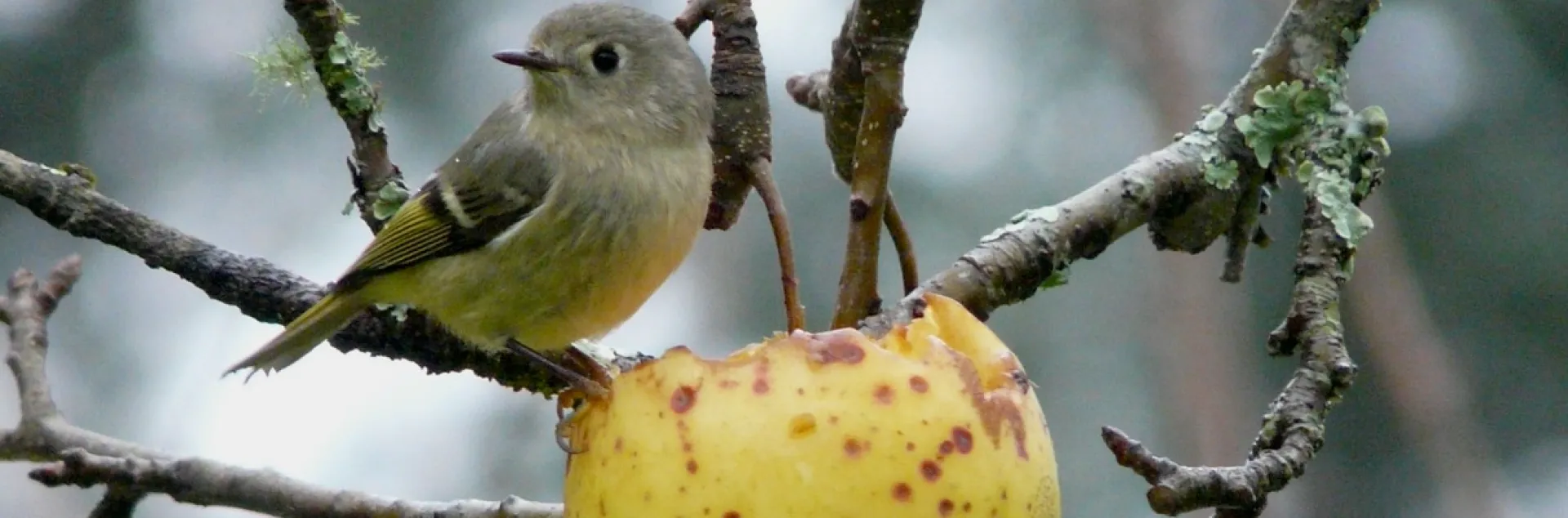
Some winters, a Townsend’s Warbler will hang out briefly in a bottlebrush tree (Callistemon spp.) outside my sunroom. These tiny migratory birds eat primarily insects. Some years we get flocks of robins that gather in the stream-bed, along with their cousin, the Varied Thrush. I hear Great Horned Owls at night… they are part of the rat patrol along with other raptors. The Ruby Crown Kinglet appears every so often and puffs up his ruby crown for me to see.
Consider planting some berry-producing plants, especially natives such as toyon, one of the best habitat plants to attract birds to your garden. Cultivars are available with red or yellow berries.
By Diane Lynch, January 31, 2026