
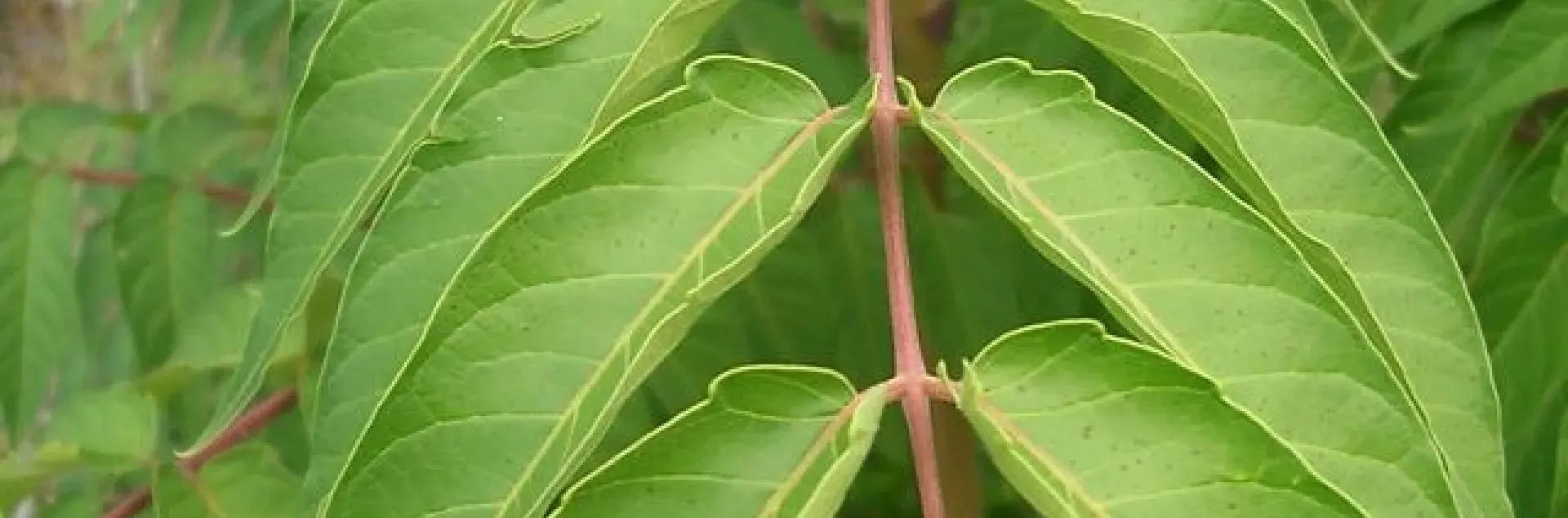
If you have a tree of heaven in your yard, you may be familiar with unwanted seedlings sprouting across your yard and seemingly from every nearby crack. The tree of heaven was originally brought to the United States from China in the 1800s and quickly became a fast-growing and popular ornamental shade tree.
Today we know, however, that the tree has become a problem across the globe as it disrupts habitats. It reproduces aggressively through dense root suckers and wind-blown seed. A mature tree, 40 to 60 feet tall, can produce 325,000 seeds in a single year, while its roots damage sidewalks, foundations, and sewers.
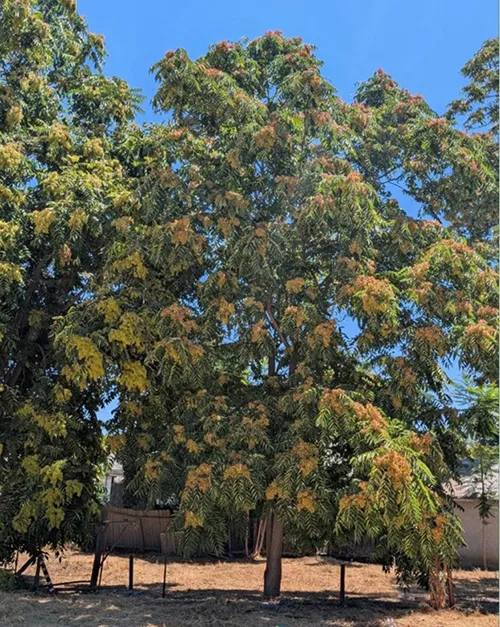
In addition to being classed as an invasive species itself, the tree of heaven is also host to the invasive Spotted Lantern Fly. This pest is causing millions of dollars in damage yearly to farms, and in particular to vineyards.
How You Can Help
You can help to stop the spread of the tree of heaven by removing seedlings when you see them. The parent tree has several distinctive characteristics:
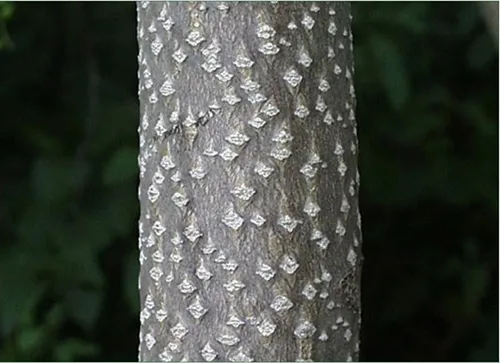
● Grey bark with diamond-shaped fissures
● Large leaves, up to 3 feet long, with 10 to 27 pairs of dark green opposing leaflets. The leaflets are smooth except for two notches, or teeth, at the base.
● Flowers are small, pale yellow-green, in upright clusters
● Seed clusters are 1 to 2 inches long and can be green, yellow, red, or brown.
Tree of Heaven has a distinctive bark pattern.
Controlling Tree of Heaven Seedlings
It’s very difficult to eliminate tree of heaven seedlings. The best control is to hand pull them before their tap roots become established. For slightly larger saplings, tools like a weed wrench can be used, but you need to be careful to get the entire root. Hand pulling works best in the spring when the soil is still moist.
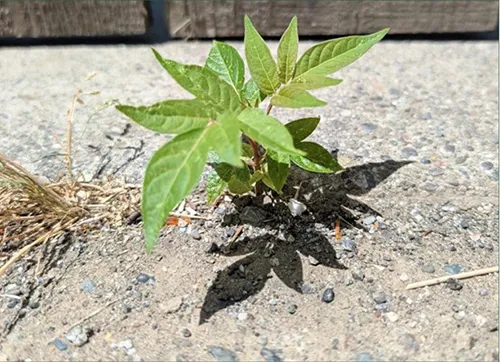
As the soil dries out and hand pulling becomes more difficult, chemical control can be used on root suckers. The best time to control tree of heaven with an herbicide is in mid-summer to early fall when the tree is moving nutrients to the roots. Herbicides should be applied to leaves or cuts in the stem. While some resources suggest cutting the stem and painting it with the herbicide, this method may lead to more root suckering, according to research done in Pennsylvania.
There are several post-emergence herbicides that are available to residents. Others are available only to licensed professionals. Products containing glyphosate or triclopyr (or both) are most effective against tree of heaven. You can find a list of these products in the herbicide chart in the link below, along with instructions on how to apply them. (Look for the Stem Injection section.)
When you use an herbicide (or any pesticide), make sure you follow all label instructions and safety precautions.
Woody Weed Management: https://ipm.ucanr.edu/PMG/PESTNOTES/pn74142.html