
Many environmentally minded gardeners are looking for simpler pest-control solutions. These gardeners are turning to soaps and detergents for insect and disease control; it’s cheap, it’s handy, and it seems to do the job. Gardeners have been adding a few drops of “soap” to liquid pest spray for years; this acts as a surfactant, helping the spray stick to the plant’s surface. Some gardeners use a soap/detergent mixture, hoping to control a host of pests and diseases.
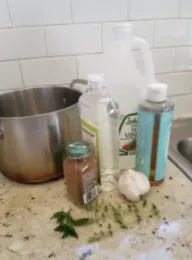
While we applaud the desire to be gentle on the environment, protect our pollinators and use low-impact strategies, we also have an obligation to give accurate information.
As UC Master Gardeners, we need to help our clients understand that there is a significant difference between soap and detergent; they are not interchangeable. Many products labeled dish soap, dishwashing soap and laundry soap contain little or NO actual soap.
Soap is one of humanity’s oldest chemical reactions; it has been around for thousands of years. Soap is made by combining a natural fat or oil with a strong alkaline substance. Our forefathers used lye, a combination of wood ash and water. When lye and fats are mixed, a chemical reaction forms soap, a process called saponification: “sapo” (soap) & “facere” (to make).
Detergents are a more recent creation developed during World War I. Oils and fats used for making soap were in short supply, so scientists turned to the lab to formulate a cleaning agent that did not rely on plant-based oils. Most detergents are made from synthetic materials; many are petroleum derivatives. Detergents are synthetically produced and chemically designed to be powerful cleaners.
Soaps and detergents share some similarities and some differences:
- Both soap and detergent do the same job: they clean, though they are formulated to do so in different ways.
- Soap is biodegradable; most detergents are not.
- Soaps and detergents are not formulated for use on plants; they are formulated for cleaning.
Research shows that when soap or detergent is diluted correctly, it can be effective in controlling small, soft-bodied insects by disrupting their breathing, effectively smothering them.

However, detergents pose a problem: they are formulated to break down and disperse oils and waxes. This is why they work so well to remove oil and grease in the kitchen. When detergents are sprayed on plants, in addition to smothering the insect, they break down the oily, waxy coating on leaves, which protects leaf tissue. Detergents, even if properly diluted, can be phytotoxic to plants.
While soap sprays are less likely to cause phytotoxicity than detergents, they come with their own set of limitations and problems. Soap sprays work as contact sprays; the insect must be present and completely coated with the soap mixture for them to be effective. Soap sprays have no preventative effect, nor do they have any residual effect.
If a client plans to use a soap product, advise them to use pure soap, not a detergent. Pure soap products include vegetable-based soaps, castile-based products and glycerin-based products. If clients insist on using soap sprays, a 2% solution of soap & water is the safe dilution. A 2% solution would be four teaspoons of soap to 1 quart of water.
Simply put, our clients need to be aware of the reason we advise against using detergent spray and why we discourage using soap spray for insect control:
- Detergent spray can cause serious phytotoxicity in plants.
- Soap spray can accumulate, potentially causing leaf damage.
- Soap, when mixed with hard water, results in a high level of residual soap scum, which damages leaf tissue and reduces the effectiveness of insect control.
The SAFEST approach for small-bodied insect control would be to use a plant-based insecticide, such as insecticidal soap. The benefit of this product is:
- It is formulated for use on plants while minimizing injury to leaf tissue
- It is specifically formulated for insect control
- It is evaluated by the Environmental Protection Agency (EPA)
- The label contains directions for use and precautionary statements
- The label includes instructions for storage and disposal
- Relevant environmental and physical warnings are listed
- Chemical hazard warnings are listed
I encourage you to share the difference between soap and detergent when this subject comes up with clients. Encourage the use of insecticidal soap instead of household soap. If a client insists on using a soap spray, reinforce that it must thoroughly saturate the insect to be effective. In addition, clients can reduce potential damage to plant tissue by washing the plant down as soon as the soap spray dries. This action will dilute or eliminate soap residue, reducing the risk of plant damage.
< Previous Articles Next >
Go to: Current Issue UCANR Home CoCoMGHub