
Information in this document is not meant to replace the expert advice of a qualified poison specialist or physician. In the event of a poison emergency call the Poison Control Center (800) 222-1222, available 24 hours a day.
Introduction
Many plants may contain significant amounts of natural toxins to some extent, but with care can be safely planted and maintained in the home garden. According to Gupta (2018) a poisonous or toxic plant is defined as a plant that when touched or ingested in sufficient quantity may be harmful or even fatal to people or animals or any plant capable of evoking a toxic and/or fatal reaction.
While it is not necessary to eliminate all toxic plants from the home garden, you should be prepared to identify any plant on your property and have some knowledge of adverse symptoms associated with poisonous plants.
Some of the most beautiful trees, shrubs, vegetables, and vines are poisonous. They may provide shade, colorful flowers, or food, but parts of the plant (sap, leaves, seeds, flowers, stems) may also cause skin rashes, serious illness, or death. More than 500 species of poisonous plants grow in the United States.
Skin rashes are the most common health complaints due to handling poisonous plants, but fatalities can occur when toxin-containing plants or plant parts are ingested. Each year over 100,000 people in the United States call Poison Control Centers about potential plant and mushroom exposure.
Children are usually more susceptible to the effects of plant poison than adults; suggestions for keeping children safe in the garden are presented later in this document. Do not assume a plant is nontoxic because birds or wildlife can consume it without harmful effects. Be safe and know your plants (see suggestions below for safety in the garden).
Levels of Toxicity
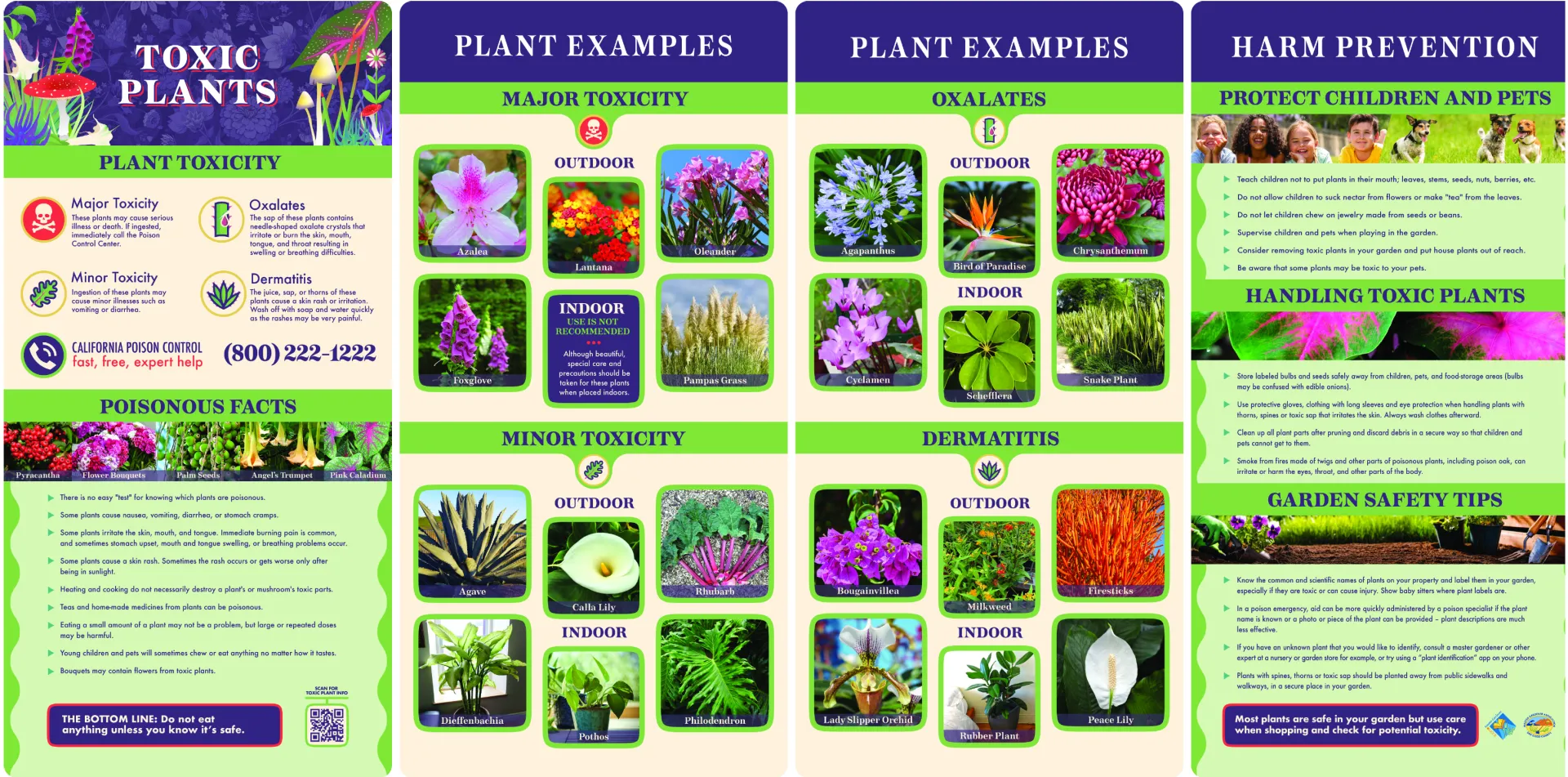
Poisonous or toxic plants are categorized based on the possible result of exposure as follows:
Level One
- Major Toxicity: Ingestion of these plants may cause serious illness or death. If ingested, immediately call the Poison Control Center -- (800) 222-1222 -- or your doctor.
Level Two
- Minor Toxicity: Ingestion of these plants may cause minor illnesses such as vomiting or diarrhea. If ingested, call the Poison Control Center or your doctor.
Level Three
- Oxalates: The juice or sap of these plants contains oxalate crystals. These needle-shaped crystals can irritate the skin, mouth, tongue, and throat, resulting in throat swelling, breathing difficulties, burning pain, and stomach upset. Call the Poison Control Center or your doctor if any of these symptoms appear following ingestion of plants.
Level Four
- Dermatitis: The juice, sap, or prickles of these plants may cause a skin rash or irritation. This is the most common injury following an exposure to a toxic plant and may cause an inflammation or swelling of the skin accompanied by redness, itching and tenderness. Wash the affected area of skin with soap and water as soon as possible after contact. The rashes may be very serious and painful. Call the Poison Control Center or your doctor if symptoms appear following contact with the plants.
What Makes a Plant Poisonous?
Most toxic plants have cyanide (a poisonous chemical) or oxalates (crystals of oxalic acid) in them. Oxalic acid is a very poisonous chemical. Some poisonous plants may have a fungus or chemicals in them to make them toxic or poisonous.
What Part of a Plant is Toxic?
Often toxic plants will have parts that are poisonous and other parts that are not. Apple trees, peach trees, apricot trees, avocado trees and even tomato plants give us delicious things to eat. But the leaves of these plants have cyanide in them, as do the seeds of apples, so don’t swallow them.
Potatoes are a very popular food in the nightshade plant family, but don’t eat the tops of a potato (the green part that grows on top of the ground) OR a potato with green flesh or skin. These green potato parts contain solanine. Solanine is a poisonous substance that can kill you very quickly if you eat it. Other food crops in the nightshade (Solanaceae) family include peppers, eggplants, and tomatoes.
Rhubarb leaves are also very poisonous. NEVER eat the leaves, only eat the stalks—the red part.
It is impossible to tell if a plant is toxic just by its appearance; be sure to know that what you're eating is safe before you eat it.
For a list of Safe and Poisonous Garden Plants go to: https://ucanr.edu/sites/default/files/2017-10/272541.pdf
Mushrooms
- Eating any mushrooms collected outdoors should be considered dangerous. Call the Poison Control Center even if you only think that someone has eaten one. Even after a serious poisoning, symptoms may not appear until many hours later. Do not wait until symptoms appear.
- Symptoms of severe mushroom poisoning can include intense vomiting and diarrhea and can lead to liver failure and death.
- Eating mushrooms collected outdoors can be very risky because many poisonous mushrooms look and taste like ones that are safe to eat. There is no easy way to tell the difference between safe and unsafe mushrooms.
- This is important for people who come to California from other areas of the world. California has extremely poisonous mushrooms that may look similar to "safe" mushrooms found in other areas.
- Teach children never to touch or taste outdoor mushrooms.
Preventing Poisoning Exposures
Label Plants
- Before buying a plant, have the store label it with both the common and scientific name. Research potential plant purchases for possibility toxicity – know before you buy.
- Create a file called “Plants Identification” which contains a list of plants you have in and around your home. Keep it in a safe place, with other important papers so you will be better prepared if a plant poisoning emergency occurs. Include the number for Poison Control 1 (800) 222-1222 on the front of the file.
- Keep identification tags from the plants you buy and put them directly into your plant identification file.
- To identify plants already in your home, consult resources such as The Sunset Western Garden Book or a certified nursery professional.
- Show grandparents and babysitters where the plant label file is. It is very hard for poison specialists to identify plants from a description given on the phone. Know the names of your plants before a poisoning happens. Taking a picture of the plant and leaves can help the specialist identify the plant.
Children
- If you have small children or curious pets, consider removing toxic plants from your garden and house. House plants should be placed out of reach of the very young.
- Teach children not to put any part of a plant in the mouth. This means leaves, stems, bark, seeds, nuts, berries, and bulbs. Do not allow children to suck nectar from flowers or make "tea" from the leaves. Never chew, or let children chew, on jewelry made from seeds or beans.
- Always supervise children when playing in the yard.
Pets
- A surprisingly large number of common garden and household plants are toxic to pets, and reactions to toxicity range from mild to life-threatening. Pets, like young children, explore the world with their senses, and they are therefore vulnerable to accidental poisoning. Many plants make wonderful additions to the garden, but it's important to know which plants are toxic. Avoid planting these where pets (or children) will have frequent unsupervised access to the plants. The website below contains lists of common plants that have been reported as having systemic effects on dogs, cats, and horses. Be advised that the consumption of any plant material may cause vomiting and gastrointestinal upset for dogs and cats.
- https://www.aspca.org/pet-care/animal-poison-control/toxic-and-non-toxic-plants
Handling Toxic Plants
- Store labeled bulbs and seeds safely away from children, pets, and food-storage areas. Avoid confusing bulbs with edible onions.
- Use protective gloves and clothing when handling plants that may be irritating to the skin. Wash clothes afterwards.
- Harmful plants including ones with spines, thorns or toxic sap should be placed away from public sidewalks or walkways.
- Discard plant leaves and flowers in a safe way so that children and pets cannot get to them.
- Smoke from fires made of twigs and other parts of poisonous plants, including poison oak, can irritate or harm the eyes, throat, and other parts of the body.
Other Information
Be prepared for an emergency by keeping an ounce or more of syrup of ipecac on hand to induce vomiting if indicated. Signs of poisoning may not appear for as long as 6 to 15 hours after exposure.
What to Do for a Plant Poisoning
If the victim is choking and cannot breathe, call 9-1-1.
Treatment for Exposure:
Call the Poison Control Center: (800) 222-1222
- Mouth: Remove any parts of the plant or mushroom from the patient's mouth and clean out the mouth.
- Skin: Wash the area exposed to the plant with soap and cool water as soon as possible.
- Eyes: Flush eyes with lukewarm water for 10 to 15 minutes. Be very gentle, as vigorous, or prolonged rinsing can hurt the eyes.
If you are advised to go to an emergency room, take the plant or a part of it with you (take more than a single leaf or berry). Take the label, too, if you have it. The correct name can result in the proper treatment if the plant is poisonous. If the plant is not dangerous, knowing the name can prevent needless treatment and worry.
References:
ASPCA (2026). Poisonous Plants. Toxic and Non-Toxic Plants List. https://www.aspca.org/pet-care/animal-poison-control/toxic-and-non-toxic-plants
Gupta, P. K. (2018). Illustrated toxicology: With study questions (1st ed.). Academic Press.
Pittenger, Dennis R., (2004). California Master Gardener Handbook. University of California, Agriculture and Natural Resources Communication Services.
University of California Agriculture and Natural Resources. Publication 3382, UC Davis Veterinary Medicine Center for Companion Animal Health. https://ccah.vetmed.ucdavis.edu