
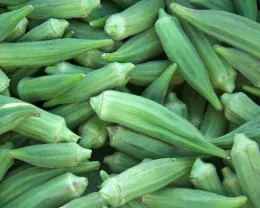
Okra grows on tall, bushy plants with ornamental leaves and flowers. The red varieties are particularly dramatic in the garden. Both the air temperature and the ground must be warm for this heat lover to thrive. Tall varieties may need to be staked. Okra prefers high heat and humidity, so performance can sometimes be marginal in Santa Clara County.
Planting
- Transplant 12 to 18 inches apart in June to July, possibly May depending on weather and local conditions.
- Direct seed in June, possibly May depending on weather and local conditions. Thin to 12 to 18 inches apart.
- To aid with germination, soak the seeds overnight or scarify (nick or slightly abrade) the seeds.
- If growing your own seedlings, start the seeds 4 weeks before you want to plant.
- Okra is very sensitive to cold. For best results, wait until daytime temperatures are regularly over 80°F and the soil temperature over 70°F.
Harvesting
- The first pods will mature in approximately 50 to 60 days.
- Plants will produce through September to October.
- Pods can become overmature quickly, so harvest every 2 to 3 days for tender pods. The tip of the pod should be flexible.
- Remove any overmature pods. Leaving them on the plant will cause it to stop bearing.
Pest management
Pests of okra, North Carolina State Extension
More links
Video: Varieties of Okra You Can Grow [6:47]
Recommended varieties for Santa Clara County
We have no specific varieties to recommended for Santa Clara County. The UC Davis, Vegetable Research and Information Center has recommended Clemson Spineless and Blondy (compact plants with whitish pods) varieties, both with AAS disease resistance.