

Monthly tips are categorized by To-Dos, What to Plant, or Pests and Diseases. Scroll through the list to see items in each category. Also, refer to our list of tips useful for any month.
To-Dos: February
Bare Root Roses
Bolting Lettuces
Certified Arborists
Citrus Fertilizing
Dormant Rose Pruning
Fertilizing Fruit Trees
Flowering Vines
Frost Dates
Fruit Tree Grafting
Fruit Tree Pruning
Growing Vegetables in Containers
Harvesting Oranges
Houseplants Repotting
Inspect Roots When Planting
Leafy Salad Plants
Mushrooms
New Trees Staking
Overgrown Shrubs
Peach Leaf Curl Preventive Care
Perennials and Bunch Grasses
Poison Oak
Prune Apple Trees
Pruning California Natives
Pruning Fuchsias
Pruning Large Limbs
Pruning Tools Maintenance
Save the Worms
Stinkhorn Mushroom
Support Your Vegetables
Transplanting Vegetables
Weed Management
Weed Spotlight - Common Fumitory
Wet Soil
Why You Should Test Your Soil
Winter Irrigation
Worm Composting
Yellow Leaves on Citrus Trees
Pests and Diseases: February
Armillaria Root Rot
Citrus Leafminer
Dormant Oil Spraying
Fruit Damage
Gray Mold (Botrytis)
Peach Leaf Curl Preventive Care
Plum Bud Gall Mite
Rat Management
Slime Molds
Snails and Slugs
What to Plant: February
Asian Vegetables
Bare Root Plants
Bare Root Roses
California Natives
Camellias
Carrot Culture
Chayote
Chill Hours
Fresh Cut Flowers from Your Garden
Growing Purple Carrots
Growing Transplants from Seeds
Peas
Plant Asparagus Crowns
Plant Cool Season Vegetables again
Plant Garlic & Shallots
Seed Viability
Selecting Seeds
Sweet Peas
Trees for Patios and Small Spaces
Vegetable Planting Chart
When to Start Summer Vegetables from Seed
Armillaria Root Rot

Mushrooms at the base of a tree could signal a problem with the tree. Armillaria is a fungus that can live in the soil for many years. It can rot the roots and cause leaves and branches to die and can eventually kill a plant. Another common term is Oak Root Fungus, although it affects many different species of trees and even some herbaceous plants. Often by the time the fruiting bodies (mushrooms) are visible, much damage has already been done. It feeds on both live and decaying wood. Cutting back a small section of bark can reveal white fan-shaped or black stringy fungus which aids in diagnosis. Keeping the plant healthy provides some defense. Fungi thrive in moist conditions, so do not overwater the area. Also, keep mulch and other plants away from the trunks of trees so as not to hold moisture against the crown (base). The best defense against this disease is to plant resistant varieties.
For information: Armillaria Root Rot
Months: January February December
Tags: Abiotic Disorders Disease IPM Pests and Diseases
Asian Vegetables

You can easily grow some vegetables used in different types of Asian cuisine and found in Asian markets. They are not necessarily native to Asia but have found their way into various cuisines. One way to decide which food to grow yourself is to choose varieties that aren't readily available or are more expensive in your local markets. It’s also fun to impress your family, friends, and neighbors with something they may not have seen growing before. Possibilities include sesame seeds, bitter melon, opo, sigua (loofah) in summer and bok choy, napa cabbage, daikon radishes, gai choy in spring or winter.
More Information: Vegetable planting chart in English | Chinese
Months: February March April May June September October
Tags: Vegetables What to Plant
Bare Root Plants

Bare root plants are sold without any soil clinging to the roots making them easier and less expensive to transport; they'll do just fine in the garden as long as you don't let them dry out before planting. Because you can see the roots and can control how they're placed in the soil, it helps reduce the chances of root girdling problems later. Buy and plant early in the month while roots are still fresh.
The bare roots should be soaked from an hour to overnight (large plants) in a bucket of water before planting. Trim roots of broken, dead, or spongy bits and carefully pull the roots apart. Dig a hole that is fairly shallow and wide. Spread the roots out sideways and have the crown of the plant several inches above the soil level. This is necessary as the plant will settle down over time. Water in well but wait to fertilize until you see new shoots growing. Be sure to water regularly if the rains are sparse. Staking may not be necessary.
Trees aren't the only plants that are sold bare root. You can also plant bare-root asparagus, artichokes, rhubarb, berries, kiwifruit, horseradish, rhubarb, grapes, roses, strawberries, and iris in January.
More information: Planting Bare-Root Fruit Trees
Months: January February March
Tags: Best Practices Fruits & Nuts Garden Basics Ornamental Plants Techniques Trees & Shrubs What to Plant
Bare Root Roses
January and February are ideal for planting bare root roses. When you choose roses, the American Rose Society can help you navigate the 150 species and thousands of hybrids. Besides color and growth form, you may also consider the balance between scent and appearance. Many of the older roses are highly fragrant, while many newer roses are bred for beauty and large blooms. Consider the susceptibility of roses to many diseases when choosing a spot in your garden. They do best with six hours of sun, in well-drained soil, with good air circulation, and without overhead watering. When planting, mix organic material with native soil in the planting hole. Make sure the base of the plant remains an inch or two above the surrounding soil so that water doesn’t accumulate around the crown. Water thoroughly immediately after planting.
More Information: Selecting and Planting Bare Root Roses
Months: January February
Tags: Garden Basics Ornamental Plants Techniques To-Dos What to Plant
Bolting Lettuces

In garden terms, bolting means sending up a flower stalk, not desirable unless you plan to save seeds. Seed packets say lettuce matures in 60–80 days, but the timing also depends on the weather. In warm weather, lettuce matures and bolts much faster. In cool temperatures, seedlings grow more slowly but will still mature and bolt eventually. If the center of the lettuce starts to push upwards, that’s a clue that it’s starting to bolt. Another clue is if you tear a leaf and see milky sap instead of clear juices. Harvest as soon as you notice, before the leaves become unpleasantly bitter.
More information: Growing Lettuce
Months: January February March November December
Tags: Best Practices Vegetables To-Dos
California Natives

Thinking of adding native California plants to your yard? New natives respond best to wet winter weather, which promotes the extensive root development needed for spring growth and the hot dry summer months ahead. Your next question may be what to plant. That depends on your planting site and the individual cultural requirements of the plant. To help, the California Native Plant Society has created a database where you can enter your address and find which plants do best in your neighborhood for the conditions in your yard, like sun or shade. The website even lists nurseries that carry California natives.
More Information:
Months: January February March December
Tags: Ornamental Plants Waterwise Plants What to Plant
Camellias

Camellias can be planted in fall through spring. Since they bloom in winter, choosing a plant now will ensure that you know the color, shape, and size of the flowers with which you will live for many years. Camellias are not native to our area so may need some extra attention in order to grow successfully. Our native clay soil does not drain well so it must be amended for camellias. Our alkaline soil needs to be acidified, and sulfur pellets are one way to achieve this. The plants need some shade and need to be kept moist. Mulch helps hold in moisture, and pine needles, redwood bark, and coffee grounds are all good organic materials that will break down over time and help improve the soil. Pick up flowers as soon as they fall to the ground to avoid the spreading of a disease called Camellia petal blight.
More information: Camellia Pests
Months: January February March April May September October November December
Tags: Ornamental Plants Trees & Shrubs What to Plant
Carrot Culture

If you have a light fluffy soil, perhaps in a raised bed, you can grow those long beautiful carrots you see in the grocery store. However most of us have a heavy clay soil and it is best to grow the shorter varieties. Adding organic material such as compost rather than manure is good. The seeds are very tiny and mixing sand with them will help you not over-seed. Plant no more than 1/2 inch deep. Carrots are slow to germinate and could take as long as 3 weeks. Keep the soil moist until they're up. Thin to 2 or 3 inches apart. Plant every few weeks for a continuous crop. If you have limited space, try growing in among your ornamentals, their feathery tops can look quite pretty. They can also be grown in a container. Some common problems are twisted roots from planting too close together, forked or deformed roots from clods and rocks in the soil, hairy root from too much nitrogen and splitting from too much water.
Months: February March April September
Tags: Techniques Vegetables What to Plant
Certified Arborists
Whether you prune your own trees or hire someone, it’s important that whoever does the job knows at least a little about tree anatomy, plant health, and the purpose of the plant (shade? privacy? fruit?). Knowing the difference between heading cuts and thinning cuts, how to locate a node to direct growth, and how to open up a tree for air circulation are all part of good tree pruning. An improper pruning job can stress the tree, spread disease, invite pests, and promote weak branching. These can lead to breakage, damage, and injury. The cheapest bid may end up costing more in the long run due to damage repair, lawsuits, and additional fix-it pruning. Take a class or read tree pruning guides if you want to do a good job yourself. If you hire someone, it is strongly recommended that you choose a certified arborist who has been specially trained and is insured. The International Society of Arboriculture can help you find a certified arborist in your area.
More Information: Tree Pruning Guide
Months: January February March December
Tags: Best Practices Garden Basics Trees & Shrubs To-Dos
Chayote

This mild, green, pear-shaped squash grows on a vine that can produce prolifically for several years. Although it is often recommended to plant it in the spring, some cultures traditionally plant it on Día de la Candelaria, February 2. The seed inside is very soft, so the way to start a new plant is from a whole chayote. Leave the chayote on the counter for a new vine to sprout from the seed within. Then plant it in the ground at a 45-degree angle with the large end pointing downward. The roots will grow from the same end as the shoot. It does best in a sunny location with well-drained soil. Provide strong vertical support from the start because the vine will grow very tall.
More information: How to grow chayote video
Months: February March April
Tags: Vegetables What to Plant
Chill Hours
Many fruit varieties require a certain amount of winter cold, measured in chill hours, in order to produce a good crop. Since we can’t change the weather, it’s important to select new fruit trees by considering their chill hour requirements. See our chill hours page for more discussion and links to low chill varieties.
Months: January February December
Tags: Fruits & Nuts What to Plant
Citrus Fertilizing

In California, most soils contain adequate nutrients for citrus growth, except nitrogen. Nitrogen is the primary nutrient required by the trees, and there are commercial fertilizers balanced specifically for citrus. One-year-old trees will need 1/10 of a pound of nitrogen, while mature trees need approximately 1-1/2 pounds. These amounts should be divided into two to three applications.
Blood meal without all the fillers is an excellent source of nitrogen, or you can purchase a balanced product that contains zinc. Spread the fertilizer evenly over the entire root area and water in.
For more information, refer to the UC Pest Note on Fertilizing Citrus, and Questions and Answers to Citrus Management from the UC Davis Home Orchard website.
Months: January February May June
Tags: Fruits & Nuts To-Dos
Citrus Leafminer

What causes young, healthy citrus leaves to become gnarled and disfigured and what can be done about it? This damage is due to the citrus leafminer moth that lays eggs on new citrus leaves. Its larvae burrow into the leaf and leave tunnels as they feed, visible as meandering serpentine mines. Our advice: don’t worry about it. Leafminers can slow the growth of young trees but even heavily damaged trees are unlikely to die. Leafminers only attack young leaves — the tough leaves of mature plants resist infestation and fruit is not affected. Damaged leaves still produce food for the tree, so don’t cut them off. If you do, it will stimulate the tree to produce more new leaves — which will attract more leafminers!
More information: Citrus Leafminer
Months: January February March April May September October November December
Tags: Fruits & Nuts Invertebrates Pests and Diseases
Dormant Oil Spraying

Deciduous fruit trees lose their leaves seasonally, usually in the autumn. They enter a period of dormancy when they are not actively growing and there is little activity within the plant. This is the time to apply dormant oil sprays to smother soft-bodied insects such as scale, aphids, and mites. First, do any needed pruning so that you will not be spraying branches that will soon be removed. Then inspect for pests that are overwintering on the trees, or remember pest and disease problems you noticed during the growing season. Although dormant oils may count as organic, it is still best to use them only if pest problems have been observed.
Mix the horticultural oil in a sprayer and apply it according to directions on the packaging. Never use more than what is prescribed. Make sure to complete the spraying before the trees start to bud and blossom so as not to damage developing flowers and fruit.
More Information: Calendar of Backyard Gardening Operations for Selected Fruit and Nut Trees and Winter Pest Management
Months: January February March
Tags: Best Practices Fruits & Nuts IPM Invertebrates Pests and Diseases
Dormant Rose Pruning

Winter is the best time to prune roses even if they haven’t gone completely dormant. The old advice was to cut the canes down drastically, but that isn’t necessary for our climate. Instead, just cut back about one-third to one-half of the total height. In other words, take a 4-foot bush down to about 2–3 feet. When cutting back a cane, make the cut at an angle just above an outward pointing bud. Take out any dead or diseased canes, remove suckers below the graft union, and branches that are crossing or growing towards the middle of the plant to improve airflow. Clean up old leaves on the plant and ground to reduce rust and black spot.
More Information: Rose Care
Months: January February December
Tags: Ornamental Plants Techniques Trees & Shrubs To-Dos
Fertilizing Fruit Trees
As fruit starts to develop, trees and vines use nutrients to help with this energy-intensive task. This is a good time to plan a strategy for fertilizing your trees.
In the first year, a very light application of nitrogen (N) is desirable for most soils. Do not make first year applications before six to eight inches of new growth occurs. Split applications are safest, one or two months apart, so one application might be made this month.
After the first year: research indicates that summer fertilizer applications (August to mid-September) are more efficient than late winter (traditional) applications.
Fully mature fruit trees may not need fertilizing. The UC Integrated Pest Management fruit tree pages have more information.
Months: February August
Tags: Best Practices Fruits & Nuts To-Dos
Flowering Vines

Vines are plants that climb or sprawl and can easily outgrow their spaces if not pruned annually or more often. Many are pruned in the winter when they are dormant. This reduces shock to the plant and allows you to better see the structure when pruning. If the vines are flowering, wait until after the blooms have finished. Some vines get cut back almost to the ground to renew them. Some are cut back to the beginning of the herbaceous growth, leaving the woody vines. Others are pruned simply for shape or size. The UC Davis Arboretum All-Stars brochure includes several flowering vines. All-Stars are plants that have been tested and proven to thrive in California. The brochure lists pruning needs. It also has photos, characteristics, and requirements of the plants if you are looking for new plants.
More Information:
Months: January February March
Tags: Best Practices Garden Basics Ornamental Plants Techniques To-Dos
Fresh Cut Flowers from Your Garden

We have a webpage to help you choose and grow beautiful cut flowers for your home or to give away. The Cut Flower Planting Chart lists ornamentals we’ve grown successfully. We selected these for their hardiness, appeal to pollinators, and production of good cutting flowers. The chart tells you when to start these flowers from seeds or when to transplant, plus when you can expect to see blossoms.
More information: Tips on planting a cut flower garden
Months: January February March April May June Any Month
Tags: Garden Basics Ornamental Plants What to Plant
Frost Dates
The approximate first and last frost dates for Santa Clara County, depending on your location, are November 15 and March 15. These are important dates for gardeners to remember.
First frost date—this is the earliest date you should expect frost to occur. If you have plants that need to be brought in for the winter, or crops you need to pick before frost, this date will be important to you.
Last frost date—after this date, you wouldn't expect any more frosts. It's generally used as a milestone when pruning frost-sensitive plants (such as citrus where you don't want to stimulate delicate new growth until the danger of frost is past).
For our climate, the last frost date is not a reliable metric for when to transplant summer vegetables. Daytime temperatures and soil temperatures are more important. See entries for individual vegetables for specific recommendations.
Also see: Frost—Avoidance and Dealing with Damage
Months: January February March November December
Tags: Garden Basics To-Dos
Fruit Damage
If your fruits are ready to pick and you don't get to them first, there are critters that will let you know when they are ripe. For example, for citrus, snails leave little holes in the outside peel, rats hollow out the fruit and squirrels carry them off, often leaving partly eaten fruit on a nearby fence.
To determine what’s eating your fruit - start by narrowing down the list of possible pests in your area. Check the damage to determine whether it is likely caused by insects, birds, or rodents. Determine what time of day the damage happens. Squirrels are active during the daytime, and rats are mainly active at night. Look for other signs, such as placement of the damaged fruits, tracks, and possibly droppings, and compare that to the habits of the pest you suspect. When you are sure what the pest is, you can take appropriate action to protect your fruits.
Resources:
Months: February July Any Month
Tags: Best Practices Fruits & Nuts IPM Pests and Diseases
Fruit Tree Grafting
When pruning dormant fruit trees, you may want to save cuttings (scions) for later grafting onto other fruit trees. Grafting is a technique that allows you to have multiple varieties of compatible fruit on one tree and is a great space saver. It works by joining the vascular tissues of a shoot (scion) from one tree to a different tree that provides the root system. If the graft is successful, the scion will continue to grow and maintain the characteristics and fruit of the scion plant. Fruit trees can have new varieties grafted to them when they are dormant in January and February.
Scions are available in January or February at the California Rare Fruit Growers (CRFG scion exchange). Their January event also includes training classes. Check the CRFG - Santa Clara blog for the date.
More information on grafting can be found at:
Months: January February December
Tags: Best Practices Fruits & Nuts Techniques To-Dos
Fruit Tree Pruning

Winter is the best time to prune most deciduous fruit trees because the tree structure is easily seen once the leaves drop. Start by removing crossing branches, broken branches, and diseased wood. Clean out suckers, and light branches. Trim the branches that grow vertically. Then make cuts to produce the desired height and shape and to allow sunlight into the center of the tree. Not sure about the shape? UC has more information in Publication 8057, Fruit Trees: Training and Pruning Deciduous Trees. View a pruning video using the link below or refer to Fruit Tree Pruning.
If you properly prune and care for fruit trees you will get the highest yield of fruit. A good rule of thumb is to prune plum, pluot, apple, and pear trees 15-20%; and peaches 50%.
A reminder: since apricot and cherry trees are susceptible to Eutypa fungus, they should be pruned in late summer to allow pruning cuts to harden before winter rain.
More information: Winter Fruit Tree Pruning Talk
Months: January February December
Tags: Fruits & Nuts Techniques To-Dos
Gray Mold (Botrytis)
Botrytis is gray or brownish fuzzy mold that can attack a wide variety of plants. It likes flower petals, ripening fruits and vegetables, as well as leaves and stems. The spores are spread through the air. It is most severe when there's high humidity and may start forming on decaying matter. According to the UC Pest Note on Botrytis Blight, it is important to remove debris and prunings from the ground. You may even have to pick up flowers daily. Avoid overhead watering.
UC also has information about Gray Mold on Strawberries.
Months: February
Tags: Disease Fruits & Nuts IPM Ornamental Plants Vegetables Pests and Diseases
Growing Purple Carrots

If you only buy carrots at the supermarket, you may think that they are all orange. It is believed that carrots were originally purple, with orange becoming popular through Dutch breeding. Several colors are now available at Farmers’ Markets and by growing your own. Springtime is a good time to start carrots from seed. Transplanting is not advised because you can easily damage the roots which are the relevant plant part. Loose soil is important so that the carrots will grow straight.
Scatter the seeds over the soil with as thin a covering as possible, keep moist until germination, and harvest when the tops expand to a good size. The Master Gardeners have done germination and growing experiments with different varieties and soil blends. Covering seeds with a thin layer of vermiculite yielded the fastest and highest rate of germination. Carrots are slow to germinate and could take as long as 3 weeks. Thin to 2 or 3 inches apart. For growing, a soil blend of 1/3 compost and 2/3 soil produced higher-weight carrots than blends with half of the soil replaced with either sand or perlite.
Some common problems are twisted roots from planting too close together, forked or deformed roots from clods and rocks in the soil, a hairy root from too much nitrogen and splitting from too much water.
More Information: Growing Carrots
Months: February March April September
Tags: Techniques Vegetables What to Plant
Growing Transplants from Seeds
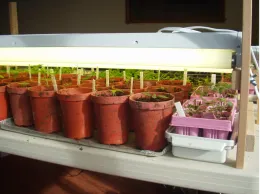
Many summer vegetables can be started now from seed indoors or in a greenhouse. The ground is still too cold for summer seeds to germinate or for the plants to go into the ground. Depending on the weather we get this spring, it will likely be May or June before the soil is warm enough. The soil in containers or raised beds will warm up earlier in the season.
Starting plants in pots will give them time to get stronger before putting them near potential pests. It will also allow you to continue enjoying current cool-season vegetables.
Information found on the seed packages will show which conditions are best for germination. Peppers in particular germinate best with high soil temperature. Using a heating pad is one way that this can be done indoors.
Be sure to provide light once the seeds germinate if the seedlings are not in natural sunlight. Seedlings with insufficient light will grow tall and thin and leggy and will not be as strong.
When reusing pots for seed starting, prevent the spread of plant diseases by making sure they are clean. Remove any remaining soil and cobwebs; then clean with a 10% bleach solution: 1 part bleach to 9 parts water.
If they are growing too large for the pots they are in, transplant them into larger pots. The same can be done for seedlings purchased from a nursery. Transplant them on the ground as suggested under "when to plant" for each vegetable tomatoes, peppers, cucumbers, squash, and melons.
This video provides more details on raising your own seedlings.
Months: February March April
Tags: Vegetables What to Plant
Growing Vegetables in Containers

Container grown vegetables can be decorative as well as good to eat. Almost any vegetable can be grown in a container if given the proper care. Eggplant, peppers, tomatoes, lettuce, onions, carrots, cucumbers and herbs do well. Use our Vegetable Planting Chart to decide when to plant.
One of the biggest problems is that containers dry out very fast and nutrients wash away. Both are solvable. Do not use clay pots, which dry out quickly. Plastic, composite or wooden half-barrels are good, but avoid dark colors that can absorb heat. Vegetables like a roomy container.
There must be drainage holes in the bottom but it is not recommended that you put pebbles or broken crockery in the bottom. Use a good commercial potting mix, not planter or planting mix. Group the containers together so they will shade one another.
The hot summer sun can heat the soil to unhealthy levels. Water whenever the soil is dry. You can test by digging your fingers into the dirt. You may have to water more than once a day. A simple drip system is easy to install and will make your container garden almost foolproof. Fertilize every week with a water-soluble fertilizer.
More Information: Edibles in Containers
Months: February March April October November
Tags: Techniques To-Dos
Harvesting Oranges
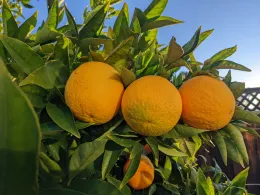
There’s a simple way to know whether your citrus fruit is ripe: taste it! Citrus varieties differ in when they first ripen and how long the fruit holds on the tree. Harvest dates depend on the variety and the climate. For example, the normal fruit season is winter for Navel orange, and summer for Valencia orange. Until you are familiar with your particular tree, sample a fruit periodically to see if it suits your taste. Allow fruit to ripen fully on the tree, as citrus does not continue to ripen once it’s picked.
More information: Harvesting and storing citrus
Months: January February July August September October November
Tags: Fruits & Nuts Techniques To-Dos
Houseplants Repotting

If you’ve noticed the soil in your houseplants is drying out quickly, or leaves are turning yellow, check whether the plant is rootbound. The most obvious clue is roots growing from a drainage hole or on top of the soil. Especially vigorous roots can break pots! UC scientists recommend choosing a new container no more than 2 inches larger in diameter, with drainage holes. Don’t add stones to the bottom – they hinder drainage, causing root rot. Use new potting soil, not garden soil that may harbor diseases or pests. Unwind and trim roots that circle the pot. Add soil to the container, keep the root ball an inch below the rim, and water well.
More information: Repotting Houseplants
Months: January February December Any Month
Tags: Garden Basics To-Dos
Inspect Roots When Planting

If you’re adding plants to your garden this spring, check the roots before putting them into the ground. Two things are particularly important. First, look for circling roots, which can eventually strangle the plant. Straighten them out as much as possible and consider pruning them if they’re too big to spread. Second, note where the roots start growing and plant at that depth, or slightly higher to allow for some settling. If planted too deeply, plant roots cannot get enough oxygen to grow and may suffocate and die. Planting too shallow can result in root damage from exposure and excessive drying.
More Information: Fix Those Roots Before You Plant
Months: February March April May September October November
Tags: Best Practices Garden Basics Techniques To-Dos
Leafy Salad Plants

Harvest your leafy vegetables early and often. Many leafy vegetables will bolt (go to flower) quickly if not harvested. When you harvest lettuce or similar greens, remove only the outer, older leaves. New leaves will continue to grow from the center, and you'll be able to eat salads all winter. Harvest head lettuce all at once when the head is full and firm. Watch for signs that plants are getting ready to bolt. That’s the signal it’s time to harvest the entire plant.
More Information: Growing lettuce in Santa Clara County
Months: January February March November December
Tags: Best Practices Vegetables To-Dos
Mushrooms

Sometimes it seems like there are mushrooms all over: mushrooms in the lawn; mushrooms on the trees; mushrooms in fertilizer; mushrooms in the woods; there is even mushroom compost available. How do you know which mushrooms are desirable and which are not? This can be a life or death determination, both for you and for your plants. Mushrooms are the fruiting bodies we see of fungi which can be widespread and hidden underground or inside plants. Fungi play a beneficial role in decomposition and in providing nutrients to garden plants. Mushrooms in the lawn can be a sign of overwatering, so check the irrigation and drainage. You don't need to remove the mushrooms except to protect young children and pets from eating them. If cultivating or harvesting mushrooms to eat, be sure that you know it is not a poisonous variety.
More information: Mushrooms in lawns
Months: January February December
Tags: Irrigation To-Dos
New Trees Staking

Not all new trees even need to be staked. Only stake if necessary for protection, anchorage, or support. Don't place the stakes too close to the trunk of the tree. Place stakes on opposite sides of the tree, outside the root ball. Make sure the stakes don’t rub on the trunk or branches. Ties should be added no higher than necessary to support the trunk. This allows as much freedom to move as possible, and movement builds trunk strength. Inspect the tree regularly to make sure there’s no damage. Remove the ties and stakes when the tree can stand on its own, generally after a year or so.
More Information: Tree Staking
Months: January February March April
Tags: Best Practices Fruits & Nuts Techniques Trees & Shrubs To-Dos
Overgrown Shrubs
If your shrubs have become too large for their allotted space, you may be able to resize them rather than replace them. Many woody shrubs can be cut back to within a few inches of the ground. These include Buddleia (butterfly bush), Artemisia (wormwood), and Salvia leucantha (Mexican sage). Maybe worth a try before replacing the plant!
Months: February
Tags: Best Practices Techniques Trees & Shrubs To-Dos
Peach Leaf Curl Preventive Care

Have your peach or nectarine leaves ever looked like this? These puckered leaves are a classic springtime symptom of peach leaf curl. Severe cases can substantially reduce fruit production. Prevent this disease by applying a copper-based fungicide shortly after the leaves drop. Use a second application in late winter if there’s a lot of winter rain. Once the blossoms open and leaves appear, it’s too late to do anything. Spraying during the growing season won’t help. If you haven’t seen this on your tree, you may have a resistant variety. If so, there’s no need to spray.
More information: Pear Leaf Curl
Months: January February November December
Tags: Disease Fruits & Nuts IPM Pests and Diseases To-Dos
Peas

An old American tradition says that planting peas on St. Patrick’s Day will bring good luck at harvest time. But the best planting date actually depends on the climate where you live. Planting on St. Patrick’s Day in the northeast may lead to a second planting weeks later when frost gets the first batch. Yet in warmer climates like ours, we can plant weeks earlier and may even be eating peas from the garden on St. Patrick’s Day. (We can also plant them here in the fall.) You may want to soak the seeds overnight to help get them ready to germinate. They can be planted directly in the ground, about half an inch deep. Keep the seeds evenly moist until they start to sprout. Provide a trellis or some kind of support for the vertical vines if you are growing pole peas; bush peas can stand on their own.
More Information: Peas
Months: February March August September
Tags: Techniques Vegetables What to Plant
Perennials and Bunch Grasses

Winter is a good time to cut back and divide perennials and bunch grasses. You can cut back some perennials all the way to the ground. These include yarrow, hummingbird sage, goldenrod, California aster, and most kinds of California fuchsia. You can divide other perennials at this time, such as Douglas iris, alum root, seaside daisy, woodland and beach strawberry, yarrow, yerba buena, daylilies, and chrysanthemums.
To cut back bunch grasses, first check to see if they are warm-season or cool-season grasses. For warm-season grasses that are under 3 feet tall, prune down to 3 inches, and for taller plants, prune down to 6 inches. For cool-season grasses, do not remove more than two-thirds of the plant, as cutting too much may be harmful.
You can propagate bunch grasses, sedges, and rushes by division this time of year. Examples of bunch grasses are purple needle grass (state grass of California), fescues, blue grama, leafy reed, oat, and deer grass. Some sedges are the meadow, clustered field, and San Diego sedge. Rushes include the common rush and the California gray rush.
Months: January February December
Tags: Best Practices Ornamental Plants Techniques To-Dos
Plant Asparagus Crowns
Asparagus crowns should be planted in the winter months. Dig a trench eight to twelve inches deep, mix in fertilizer at the bottom and cover with two inches of soil. Set the roots in the trench about 18 inches apart, and cover with two inches of soil. Gradually fill in the trench as the plants start to grow. Asparagus is a perennial vegetable that will produce for several years. It's best to wait until the second year to harvest to let a strong root system develop for long term production. For more information, read UC's Cultural Tips for Growing Asparagus.
Months: January February March
Tags: Techniques Vegetables What to Plant
Plant Cool Season Vegetables again

Salad greens, carrots, beets, fennel, broccoli, and bok choy are just a few of the vegetables that you can plant now. The warming weather and longer days will help them mature quickly. By the time they’re done, it will be warm enough to plant summer vegetables like tomatoes and peppers. You can direct seed into the garden or get a head start by transplanting seedlings. Use our vegetable planting chart for a full list of suggestions.
Months: February March April
Tags: Garden Basics Vegetables What to Plant
Plant Garlic & Shallots

The time to plant most garlic and shallots is mid-October through the end of November. Fast-growing Dutch Red shallots can mature in just 90 days, so can be planted again in late winter or early spring. Specialty growers guarantee disease-free stock and offer many more garlic varieties than you see at the grocery store, from beefy Chopaka Mountain to beautiful Rose de Lautrec.
Choose the largest cloves and leave the natural papery wrappers on them. Plant them in moist, well-drained soil in a sunny location with the pointy tips up, about one inch deep. Space cloves about four inches apart to leave room for large heads to develop.
More information: How to Grow Garlic | How to Grow Shallots
Months: February March October November
Tags: Vegetables What to Plant
Plum Bud Gall Mite

Plum bud gall mites are tiny and you won’t be able to see them without magnification. Their feeding causes the galls to form on the tree. These galls are made up of different chambers and these chambers can be filled with a large population of mites. The mites are primarily dispersed by wind but can be spread by insects, birds, and infected budwood. Heavy infestation can weaken trees and in some cases cause the death of the tree. If you suspect that your tree is affected by these mites, you should avoid moving budwood off your property to keep from spreading the pest. Because they are a new pest, options for managing them are still being developed. See Plum Bud Gall Mite for further information.
Months: February
Tags: Fruits & Nuts IPM Invertebrates Pests and Diseases
Poison Oak
Poison oak is a California native plant that provides shelter and food for many native birds and other creatures. The downside is that at least 75% of us develop allergic contact dermatitis to the plant. Unwanted poison oak can be pulled or dug up by allergy-resistant friends, remove plants in early spring or late fall when the soil is moist and it is easier to dislodge rootstocks.
A complete list of management options, including herbicide control, is contained in the UC Pest Note on Poison Oak. Under no circumstances should poison oak be burned.
Months: February March April November
Tags: Disease IPM Trees & Shrubs To-Dos
Prune Apple Trees
Once your apple tree loses its leaves, it's time to think about pruning. Apple trees produce fruit terminally on spurs located on wood 2 yrs. to 8 yrs. old. Weak and unproductive branches should be thinned out to allow the sunlight into the tree for good spur development. Older spurs can be rejuvenated by cutting back, especially following a light crop year. Tree height is maintained by cutting back upper branches to shorter laterals. Excessive pruning of a bearing tree can negatively affect its vigor and fruit. Consult our Fruit Tree Pruning page for more information.
Months: January February December
Tags: Fruits & Nuts To-Dos
Pruning California Natives
If your landscape includes California native plants, you may wonder if you should prune them. It depends. Some don’t respond well to shaping or shearing to control size. But they do like careful pruning at the proper time, which is when they are dormant. That could be either summer or mid-winter. Natives that do well with winter trimming include California buckeye (Aesculus californica), honeysuckle (Lonicera hispidula), and salvia species. California fuchsia (Epilobium canum) and lilac verbena (Verbena lilacina) can be cut almost to the ground. But wait until summer for grasses, broadleaf evergreen shrubs, and trees.
More information: How to Prune California Native Plants
Months: January February
Tags: Ornamental Plants To-Dos
Pruning Fuchsias
The time to prune fuchsias is early spring, after the chance of frost is past. If there is frost damage prune it out and take off some of last summer's growth. Leave at least two or three healthy leaf buds on each branch. Fuchsias have a tendency to get leggy. Frequently pinch the tips of the branches during the spring and summer to force side growth, making the fuchsia bushier. Pick off flowers as they fade.
More information: UC IPM list of common pests and disorders of fuchsias.
Months: February March April
Tags: Ornamental Plants Techniques To-Dos
Pruning Large Limbs
When cutting large limbs, take special care to prevent ripping of the limbs and trunk since a clean cut heals faster. Use a three-cut method for branches larger than 1" diameter. Step 1: make a cut halfway through the underside of the branch, a little past where you want the final cut. Step 2: move the saw to the top of the branch, a little further out on the branch, and cut the branch off. Step 3: make the final pruning cut close to the connecting branch or trunk, just outside the bark collar. For more helpful information view UCCE Tips for Pruning Citrus.
Months: February Any Month
Tags: Best Practices Techniques To-Dos
Pruning Tools Maintenance

Remember to keep your pruners and loppers clean and sharp. Read our tool care tips webpage for advice about cleaning, sharpening, and sterilizing your tools.
Months: January February December Any Month
Tags: Best Practices To-Dos
Rat Management

Have you found a hollowed-out orange or other sour fruit like Meyer lemons with no skins, tomatoes with bite marks, fruit with holes gnawed in them, or grape skins or cherry tomato skins scattered around? It is the work of a roof rat.
Rats show up when your citrus, tomato, or fruit first starts to ripen. Rats are agile climbers and usually live and nest in shrubs, trees, and dense ground cover like ivy. One management strategy is to prevent access to the tree by cutting branches away from fences or other trees, leaving a gap of at least 2–3 feet, good sanitation is required. Garbage and garden debris should be eliminated. Use tight-fitting lids on garbage cans. Thin out dense vegetation to make the habitat less desirable. Mow ivy once a year to the ground. Climbing ivies on fences or buildings should be removed.
Per the UC pest note (linked below), trapping is the safest and easiest method for controlling rats. Read the pest note for other management strategies as well.
More information: Rat Management
Months: January February March April July August September Any Month
Tags: Best Practices Disease Fruits & Nuts IPM Vegetables Pests and Diseases
Save the Worms
Worms aerate the soil with their tunneling, break down organic material such as fallen leaves and make the nutrients available to plants, and they excrete nice rich fertilizer in the process. They help create a sustainable system in your garden and do a lot of your garden chores for you. If you see them on the sidewalk during heavy rains, rescue them and take them to a safe place in your yard.
Months: January February
Tags: Best Practices To-Dos
Seed Viability

Seed packets have a “packed for” date on the back. Yet seeds can still be viable for years beyond that date if stored correctly. Ideal storage conditions are cool and dry. The older the seeds are, the lower the germination rate will be. So plant more of the older seeds than the number of plants you ultimately want. You can do a germination test by putting seeds on a damp paper towel and enclosing them in plastic to keep them uniformly moist. Do this right before planting time so you can transplant the ones that successfully germinate. Or you can take your chances and just plant them directly and see what comes up. If you are saving your own seeds, make sure to choose seeds from the healthiest plants.
Whenever it's hard to find flower seedlings, if you have some old flower seed packets, you can scatter the seeds randomly in a section of your yard and enjoy whatever flowers.
More Information: Vegetable Seed Viability
Months: January February March April May August September October
Tags: Ornamental Plants Techniques Vegetables What to Plant
Selecting Seeds

While curled up inside the warm, dry house poring through seed catalogs, how do you decide among all the delightful descriptions? First, be clear on the purpose of your garden. Are you trying to grow exotic food? Do you want to attract native butterflies? Are you interested in flowers you can cut and bring inside? Next, think about the conditions of your site. Is it warm and sunny or is there a lot of shade? Do you have heavy clay soil? Choosing seeds that do well in your area makes for healthier plants with less work. At this point, you have the parameters within which to choose what tickles your fancy. If you would like to save seeds in the future, then choose open-pollinated seeds, including heirlooms. Heirlooms are open-pollinated seeds that have been around for multiple generations. Otherwise, you can plant hybrids that have the best traits of their parent plants but will not reproduce true to type from saved seeds. Follow planting directions on the packet for the best results.
More Information: Seed Saving
Months: January February March May June July August October
Tags: Best Practices Garden Basics Ornamental Plants Techniques Vegetables What to Plant
Slime Molds
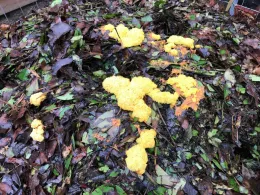
Slime molds come in a variety of colors and shapes. They often appear suddenly and look worrisome. According to the Mississippi State Extension, “when slime molds find something to eat, they surround their food and then swallow it. Slime molds may feed indirectly on dissolved substances escaping from organic matter, but they usually feed on microorganisms such as bacteria.” In general, no action is needed. They need moisture to grow and will disappear when the area dries out. Just enjoy this marvel of nature while it’s there.
Months: January February March April October November December Any Month
Tags: Best Practices Pests and Diseases
Snails and Slugs
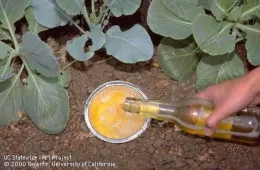
Escargot may sound good on a plate, which is where the French who brought this delicacy to California in the 1850s intended for the ingredients to stay, but they escaped into gardens where they became pests. Brown garden snails are the most common ones we see (or don’t see) eating our plants. Signs of their presence include holes in fruit rinds and leaves, not necessarily at the edges, and slime trails. They tend to hide in dark damp places during the day and come out mostly at night. The best times to find them are at night with a flashlight, early in the morning, or during and right after heavy rain. They can be hand-picked and crushed or put in a bucket of soapy water. Gloves are recommended, especially with the shell-less slugs. Creating hiding places, such as laying a wooden board over a section of the garden, will draw them to that location so you can find and dispatch them in the morning. Copper barriers and beer traps are other options. If you do use snail bait, those made with iron phosphate are not toxic to pets and wildlife.
More information: Snails and Slugs
Months: January February March April December
Tags: Best Practices IPM Invertebrates Pests and Diseases
Stinkhorn Mushroom

You might find stinkhorn mushrooms growing out of a lawn or a pile of mulch. They come in many colors, shapes, and sizes. They can grow as fast as four to six inches per hour. Stinkhorns get their name from their foul odor, described by some people as a rotting meat smell. The smell attracts insects, which then spread the mushroom spores. While the smell is unappealing, stinkhorns are short-lived, and they help break down organic matter into the soil. They are most likely to appear in cool, wet weather. UC has management advice for mushrooms and other nuisance fungi in lawns.
More information: Stinkhorn Mushroom
Months: January February March October November December
Tags: Best Practices To-Dos
Support Your Vegetables

Save garden space by providing good support systems for climbing or vining vegetables like tomatoes, pole beans, and cucumbers. Growing vertically also keeps plants healthier by improving air circulation, increasing sun exposure, and keeping fruits off the ground. Even shorter plants like peppers and eggplants benefit from support since heavy fruits can cause unsupported branches to break. There are many possible choices, from commercial cages and stakes to creative reuse solutions. It’s best to install the supports at planting time to avoid damaging the roots or breaking the stems of your new plants.
More Information: Trellising, Staking, and Caging
Months: February March April May June
Tags: Best Practices Techniques Vegetables To-Dos
Sweet Peas
You have probably heard people use the "sweet peas" term incorrectly. In garden terminology, sweet peas are flowers. They are not edible and are poisonous. Edible peas, even if sweet in taste, are not correctly called sweet peas. Sweet peas are incredibly fragrant vining flowers that come in a variety of colors, mostly pastels. They are an annual flower so they must be planted again every year. You can sow seeds anytime during the winter for spring bloom. The seeds are hard and it can be helpful to nick them slightly before putting them in the ground. Sweet peas do best in full sun or light shade. The plants will decline when it gets hot outside and they will need to be removed. Remember, you cannot eat sweet peas.
Months: February March
Tags: Ornamental Plants Techniques What to Plant
Transplanting Vegetables

As vegetable seedlings start to outgrow their pots, you can transplant them into larger pots, raised beds, or the ground. Make sure the seedling is well-watered before moving it. To remove the plant, either turn the pot upside down — with your other hand positioned to catch it! — or pull the entire root ball out with a fork or other utensil. Be sure never to handle the seedling by the stem, with its vascular tissue that conducts water and food. If the roots are packed together or circling, gently pull them apart. Then gently move the plant to its new home, lightly packing the soil around it. Make sure the soil is at the same level on the stem as in its original pot, except for tomatoes and peppers which can be planted deep. Immediately water thoroughly. A little fertilizer can also be added when transplanting. Transplant shock can be minimized by not changing too many conditions at once, e.g., temperature, wind, or sun exposure.
More information: Vegetable Planting Handbook (Los Angeles Master Gardeners)
Months: February March April May June July August September October
Tags: Techniques To-Dos
Trees for Patios and Small Spaces
Non-aggressive root systems, no messy fruit, small size, relatively free from pests and attractiveness are some of the things to look for. Some examples are Japanese Maple, Chinese Pistachio (male), White or Pink Hybrid Crape Myrtle, Tollenson's Weeping Juniper, Flax-leaved Paperbark, Strawberry tree and Canadian Redbud. The Cal Poly SelecTree website lets you search for trees based on characteristics including size.
Months: February
Tags: Best Practices What to Plant
Vegetable Planting Chart
Wondering what vegetables can be planted now? To get the best success—whether planting from seed or transplants—refer to our Santa Clara County Vegetable Planting Chart. It's based on our own garden experiences.
Months: February March May June July August October Any Month
Tags: Best Practices Garden Basics Herbs Techniques Vegetables What to Plant
Weed Management

While some weeds are edible (purslane, nettles, dandelions, miner's lettuce), many are a nuisance and compete with your chosen plants for water and nutrients.
Whichever variation of “One year’s seeds makes seven years’ weeds” you prefer, the truth remains: a key part of weed control is not letting them go to seed. For best results, work on removing weeds before they are able to propagate. Hand pulling and hoeing are effective methods for killing many common weeds.
Knowing what kind of weeds you have and how it propagates can be helpful in choosing the best management method. If they propagate by seed, pull or hoe them before they flower and go to seed. If they re-grow from roots, pull up as much of the root as possible. Many weeds, like Bermuda grass, have multiple ways of multiplying. Only non-propagating parts are advisable to throw in the compost bin.
More Information: UC Quick Tips on Weeds in Landscapes
Months: January February March Any Month
Tags: Best Practices IPM Weeds To-Dos
Weed Spotlight - Common Fumitory

Have you noticed this feathery weed popping up here and there in your yard? It’s called fumitory, Fumaria spp., for its smoke-like appearance. This delicate annual plant forms pretty, little, pinkish-white flowers with maroon lips. But beware, those flowers make many seeds that can sprout in the tiniest cracks. While the plants are easy to pull, the seeds can be quite persistent. The little seedlings can hide under larger plants, so check carefully if you want to head off an infestation.
Months: February March April
Tags: Best Practices Weeds To-Dos
Wet Soil
The clay soils which dominate our area are particularly susceptible to compaction, especially when they have received a lot of rain. These soils are characterized by small mineral particles. Hence squeezing out the air spaces makes it more difficult for plant roots and soil organisms to get the oxygen they need to flourish. Try to avoid walking on or using heavy equipment on soil that is wet. Digging in wet soil can also destroy the structure, breaking up useful soil aggregates and earthworm tunnels. Try to wait until the soil is moist, not wet or dry, for easiest tillage. If you must walk or stand on the soil, use a board to distribute your weight over a broader area. Mulch can also create a bit of a cushion and help minimize compaction.
Months: February March December
Tags: Soil To-Dos
When to Start Summer Vegetables from Seed

If you start your seedlings too soon, they can get leggy and overgrown before it’s time to plant them. Tomatoes reach transplant size in 6 weeks, peppers take 8–10 weeks, and cucumbers take just 4 weeks. Plan when you want to transplant into the garden, then calculate backward to figure out when to start seeds. Our vegetable planting chart recommends transplanting tomatoes in May, so start seeds 6–8 weeks before, in March to early April. The hottest varieties of peppers need a long growing season for the pods to ripen. Start peppers earlier, mid-February to mid-March. Wait until May to start heat lovers like cucumbers and melons.
More Information: Growing Transplants from Seed
Months: February March April
Tags: Best Practices Garden Basics Vegetables What to Plant
Why You Should Test Your Soil
Before adding fertilizer or soil amendments to your garden, first find out what your soil really needs by conducting a soil test. Knowing your soil’s pH value is important in determining which plants will thrive or struggle in your soil. Understanding the levels of nitrogen, phosphorous, and potassium in your soil will tell you which nutrients are abundant and which are lacking. Don’t overfertilize – excess nutrients can pollute local waterways. Commercial soil testing labs provide the most thorough results, but several home kits can give you a good baseline. Test soon and be ready for spring planting.
Months: January February March
Tags: Soil To-Dos
Winter Irrigation
Depending on the fall weather and rain frequency, you will likely set your sprinklers to water less frequently or even turn them off for a while. It's still important to check outdoor plants to ensure they have enough water. While they need less water when it's cool, it's important to make sure they don't dry out. If you have a lawn and rains haven't come, irrigate the lawn once or twice this month.
If it has been raining, the soil may be saturated, so be careful if you have to walk on it to not compact it. Also, if the soil is waterlogged, vital space for air needed for plants and worms, and excess water can drown beneficial soil organisms and contribute to rotting roots.
Months: January February December
Tags: Irrigation Lawns Ornamental Plants Vegetables To-Dos
Worm Composting
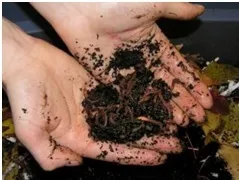
Worm composting, also called vermiculture or vermicomposting, is a convenient way to decompose kitchen waste and provide nutrient-rich soil amendments for your vegetable garden.
The Santa Clara County Home Composting Education Program offers:
Months: February June September
Tags: Soil To-Dos
Yellow Leaves on Citrus Trees

While there are several possible causes for yellow citrus leaves, the most likely one in winter/early spring is that citrus roots do not absorb nitrogen efficiently from cold, wet soils. There may be adequate nitrogen in the soil, but the roots aren’t able to take it up. However, if the tree doesn’t green up when the weather warms, give it some nitrogen fertilizer, up to 1 lb of N per year for a mature, full-size tree. Dwarf trees or ones in containers require less fertilizer, 1/2 lb of N or less. Do not overfertilize since that may cause other problems.
More information: Growing Great Citrus, Diseases and Disorders of Leaves and Twigs
Months: January February March April
Tags: Techniques Trees & Shrubs To-Dos