Bug Squad Logo

Bug Squad

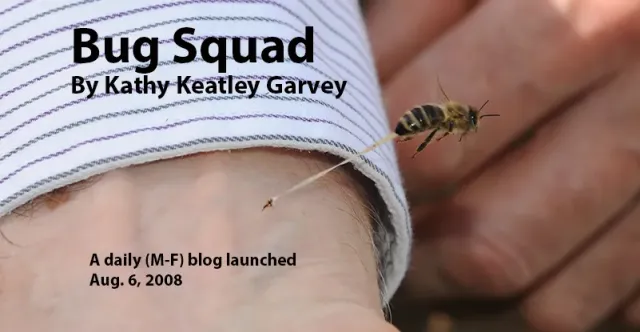
Bug Squad blog image depicts a honey bee sting in action.

Welcome to the Bug Squad blog! The Bug Squad blog was launched Aug. 6, 2008 and is a daily blog (Monday through Friday). It showcases entomologists and the work they do.  The blog focuses on scientists in the UC Davis Department of Entomology and Nematology, the Bohart Museum of Entomology, Harry H. Laidlaw Jr. Honey Bee Research Facility, the UC Davis Bee Haven, and assorted campuswide events, including UC Davis Picnic Day, UC Davis Biodiversity Museum Day, and Bohart Museum open houses. The blog spotlights insects, including bees, butterflies, dragonflies, and praying mantises, as well as arachnids such as jumping spiders and crab spiders. Author and photographer is Kathy Keatley Garvey, communications specialist, UC Davis Department of Entomology and Nematology, and a longtime journalist and community scientist with two degrees from Washington State University.  She is a member of the Entomological Society of America (ESA) and the Association for Communication Excellence (ACE). Her blog posts and images have won international awards from ACE and ESA and appeared on journal and magazine covers. She shoots primarily with a Nikon Z-8 mirrorless camera, a Nikon D500 and Nikon 800, with assorted macro lenses. Feedspot lists it as one of the top entomology blogs on the Internet. 

Primary Image
A honey bee begins cleaning her proboscis (tongue) before landing on a blossoming artichoke. (Photo by Kathy Keatley Garvey)

Retractable Landing Gear: Bee Approaches an Artichoke

July 30, 2021
By Kathy Keatley Garvey
When you're a honey bee and you're packing pollen and approaching your landing--an artichoke thistle--it's a good idea to clean your proboscis (tongue) first. Caught in flight: a honey bee doing a little grooming.
View Article
Primary Image
Assorted elm leaf beetles and larvae. (Photo by Kathy Keatley Garvey)

These Beetles Don't Want to Hold Your Hand

July 29, 2021
By Kathy Keatley Garvey
The Beatles sang "I Want to Hold Your Hand." The elm leaf beetles and their larvae don't want to hold your hand--unless perhaps you're holding a elm leaf that they can eat. A recent walk down the 200 block of Buck Avenue, Vacaville, California, revealed the damage this pest does.
View Article
Primary Image
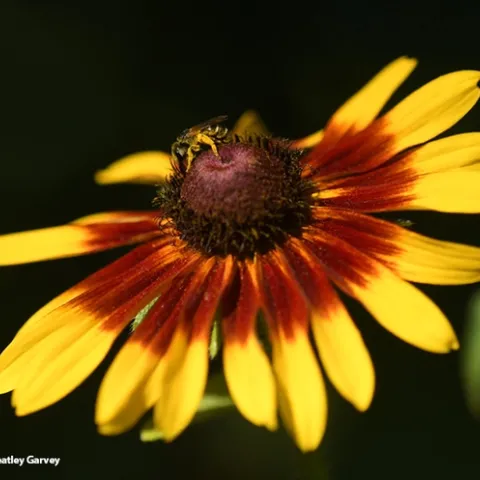
A sweat bee, Halictus ligatus, foraging on a Black-Eyed Susan in a Vacaville, Calif. pollinator garden. (Photo by Kathy Keatley Garvey)

Just a Sweat Bee Foraging on a Black-Eyed Susan

July 28, 2021
By Kathy Keatley Garvey
"Sweat bees have earned their common name from the tendency, especially of the smaller species,to alight on one's skin and lap up perspiration for both its moisture and salt content.
View Article
Primary Image
An alfalfa looper moth, Autographa californica, foraging on mustard. Moth identified by Art Shapiro of UC Davis. (Photo by Kathy Keatley Garvey)

Do Moths Usually Land with Their Wings Down?

July 27, 2021
By Kathy Keatley Garvey
National Moth Week ended last Sunday, July 25, but questions linger. A reader asked: "A friend was just telling me that butterflies and moths land differently. She couldn't remember if it was a moth that landed with its wings up or down. It looks like they land with their wings down.
View Article