
Chandra Richards, who began as director in November, looks to grow partnerships
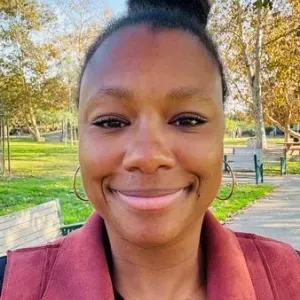
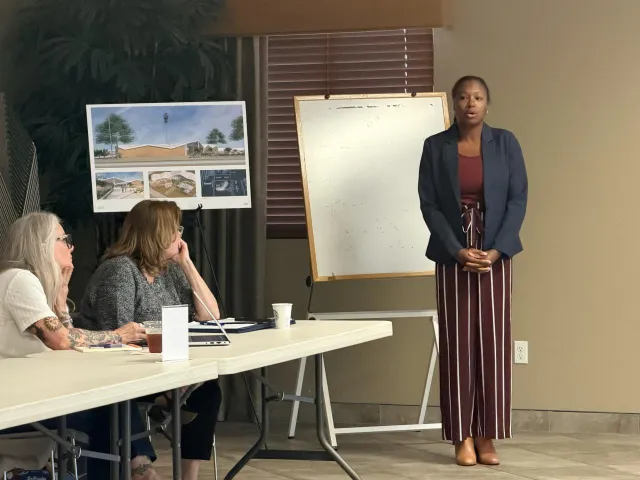
Chandra Richards is returning to her roots in her new role as University of California Cooperative Extension area director for San Diego and Imperial counties.
Richards vividly remembers running among orange groves and picking fruit at her family’s farm in Jamaica during childhood visits to the Caribbean country.
Now, Richards will be supporting citrus growers – and other farmers and community members in the agriculture, natural resources, community health and youth development spaces – across Southern California. She started as UCCE area director in November.
Given global uncertainties and the spread of misinformation, Richards said her team of locally based UC Cooperative Extension advisors and staff can play a stabilizing role. They are instrumental in sharing the latest science and research with residents so people are equipped to live better and more prosperous lives.
“I want to continue supporting our community and ensuring that they at least feel informed,” Richards explained. “Being informed is something that we have power and control over – if we can provide them with information so that they can make decisions on their behalf and on behalf of their operations or businesses, I feel like then we have succeeded.”
‘Unique academic journey’ cultivated Richards’ knowledge and skills
Educating people is in Richards’ genes. Her grandmother was a teacher in Jamaica, and her father and mother were both professors at universities on the East Coast, where Richards grew up. Richards – who recalls sitting, as a youngster, among college students taking her mother’s astronomy classes – jokes that she was “born to be an academic.”
“It just feels like a natural progression of my life to carry that torch,” she said.
After receiving her bachelor’s degrees in chemistry and mathematics at Pennsylvania State University, Richards started in graduate school at UC Berkeley, where she discovered a passion for a relatively small niche of academia.
“Soil science feels very grounded to me, pun intended,” Richards said. “Soil is something that you can touch and feel and connect with and utilize to grow things.”
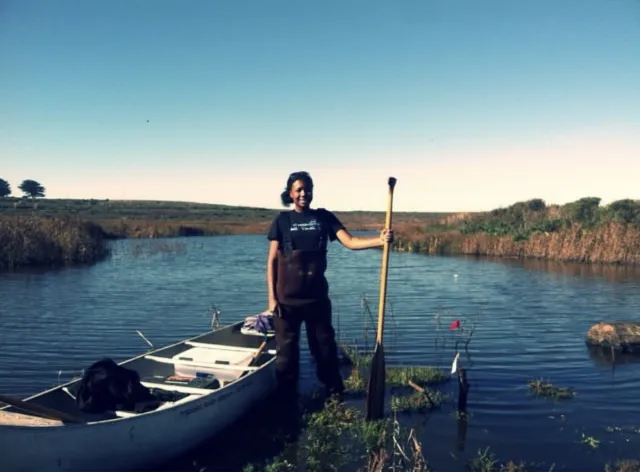
Under UC Berkeley soil scientist Céline Pallud, Richards wrote her dissertation on how soil dynamics impact fish mortality in the Pescadero estuary, south of Half Moon Bay.
“One of Chandra’s strengths is her unique academic journey,” Pallud said, “in which she started with a focus on fundamental mathematics and chemistry, before moving toward more applied research centered around environmental problems affecting coastal wetlands, at the interface of biogeochemistry and ecology.”
After earning her Ph.D., Richards brought that uncommon blend of knowledge and skill to the Resource Conservation District of Greater San Diego County, where she built up the RCD’s agriculture and conservation programs.
While providing technical assistance to farmers and ranchers, she also brought in grant money to support forest health and habitat restoration work – and worked on public health issues such as hepatitis A in the San Diego River.
In her RCD role, Richards met Jan Gonzales of the UCCE San Diego office. Gonzales told her about the unique job opening that brought Richards into the University of California Agriculture and Natural Resources community.
Connecting with historically under-engaged communities
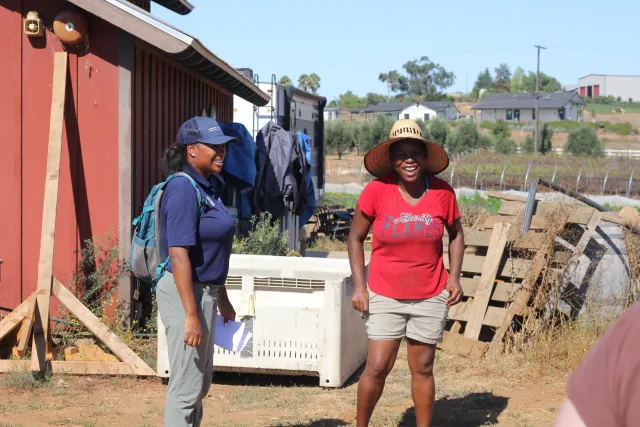
Richards began at UC ANR in 2021 as an agricultural land acquisitions academic coordinator for San Diego, San Bernardino and Riverside counties. One major aspect of that position was helping potential grantees obtain funding from the Sustainable Agricultural Lands Conservation (SALC) program. Those grants support the development of plans to protect farmland from conversion to non-agricultural uses.
Richards said her work with the Cold Springs Rancheria of Mono Indians of California was especially gratifying. Although she had to communicate virtually because of the pandemic, Richards convened multiple sessions with tribal representatives to learn their history, hopes, struggles and vision. She partnered with them to craft a compelling proposal – and the tribe was later awarded a SALC planning grant.
“They are incredibly excited to support their tribal initiatives, work towards ‘land back’ [a movement to return land to Native peoples] and ensure that their community has a food system space that could be cultivated using their traditional ecological knowledge practices,” said Richards, who noted the tribe’s efforts could be a model for others across California.
With the recent addition of a UCCE indigenous food sovereignty advisor in San Diego and Riverside counties, Marisela Chávez, Richards added she hopes to continue building bridges with Tribal communities in the region.
Richards also aims to improve outreach to farmworker communities, especially in Imperial County, and learn how UC Cooperative Extension can support their livelihoods and overall well-being.
“We need to recognize these people who are working on the ground planting, applying fertilizer, managing the irrigation and making sure that the crops are healthy,” she stressed. “They have such an active role within the larger food system.”
Richards delivers real-world impact through research, partnerships
Among her many contributions to the farming community, Richards highlighted her work on the Climate Action and Land Equity (CALE) project. In her most recent role at UC ANR, she served as UC Cooperative Extension land equity academic coordinator for Southern California – identifying and addressing barriers to land access, tenure and management.
Through conversations with farmers and land managers, Richards found that even though many of them wanted to use sustainable practices, preserve traditions and support their communities, they could not plan for the future due to insecure land access.
“One farmer indicated that they felt every season felt like a gamble, wondering if they’d still have access to their fields next year,” she said. “These experiences underscored that land tenure is more than a policy issue – it’s about their livelihoods and long-term stability too.”
Funded by the California Department of Conservation, CALE has been building partnerships and programs to expand land access opportunities and ensure working lands and ecosystems are resilient and sustainable. Richards has handed the project over to UC ANR colleagues Chris McDonald, Darlene Ruiz and Sierra Reiss.
In addition to modernizing facilities, streamlining processes and elevating the profile of UC Cooperative Extension, Richards said a top priority is setting up all her UCCE colleagues in San Diego and Imperial counties for success.
“I want to make sure that I empower not just our clientele, but also the individuals on our team,” she emphasized. “I want to make sure that they feel supported and uplifted and able to function to the fullest extent of their abilities.”
Pallud, the UC Berkeley soil scientist, said her former student is well-positioned to lead and mentor, citing Richards’ extensive experience working with undergraduates and partnering across sectors throughout her Ph.D. research.
Richards’ communication and relationship-building skills will be crucial as she looks forward to strengthening partnerships with San Diego and Imperial county governments – and collaborating with the new UC ANR Policy Institute.
As California faces complex challenges and an ever-changing regulatory environment, the institute aims to conduct relevant research and empower scientists to engage meaningfully in the policy arena. Richards’ career – working on water and land issues across the state – has exemplified that impact.
“Chandra embodies the kind of scientist-leader who connects people, policy and data to achieve tangible outcomes for public benefit,” Pallud said.