
By Annie Ryder.
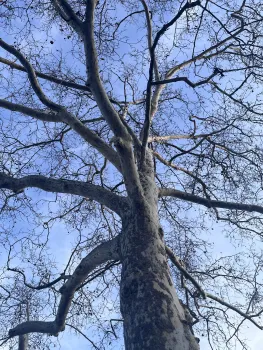
The winter months bring us a special opportunity: it is to look up, with wonder, at all the trees that have shed last year’s leaves.
This is perhaps especially true in Chico, an official City of Trees. Chico shares that distinction with a number of other cities in California that are known for the quantity and variety of their trees. Sacramento was designated the first City of Trees in 1855, and other California cities have followed, including Woodland, Burlingame, Arcadia, and Goleta.
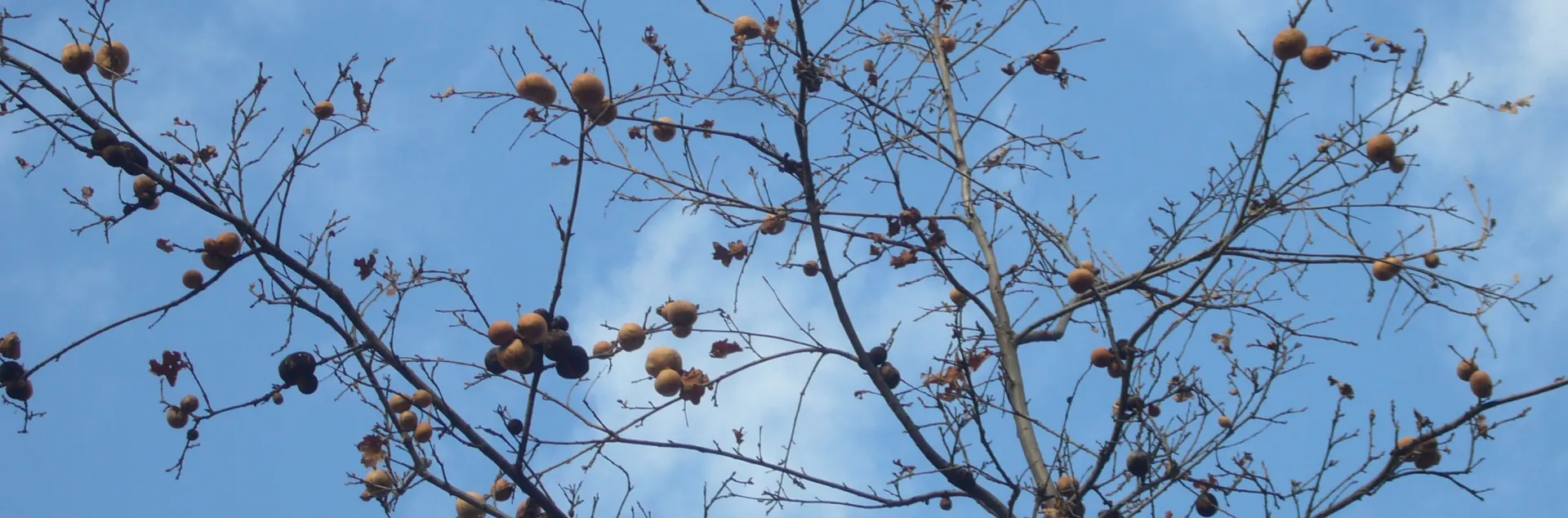
It is not hard to notice examples on every street in town: long leafless branches reaching high into the sky, a growth pattern that allows trees to access as much sunlight as possible for nourishment and growth. Now that the embellishment of their leaves is gone, we can see and appreciate that upward reach.
To survive in Chico, trees need to be able to thrive in both cool wet winters and very hot dry summers. That rules out a lot of tree species and yet, look at the diversity in size, shape, trunk, and bark that our trees have. Just walking along a street in winter can be an education and an inspiration, if you look up.
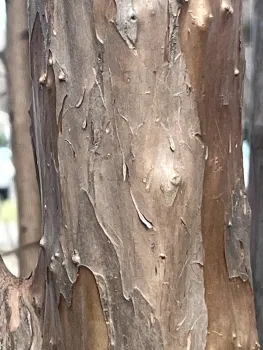
For example, there are the soaring Western Sycamore (Platanus racemosa is the California native) and the American Sycamore (Platanus occidentalis), immediately recognizable by their bright, light bark (and, in summer, their huge, leathery leaves). On the list of notable Chico street trees, add the jaunty Ginkgo (Ginkgo biloba), known as the oldest surviving tree on earth (its fossils date back to over 200 million years), and the graceful smooth-barked Crepe Myrtle (Lagerstroemia) with its high tolerance of our extreme summer heat.
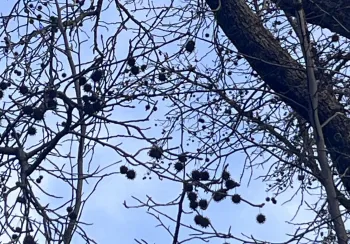
Here in our northern corner of the Sacramento Valley live many varieties of oaks, including the magnificent Valley oak (Quercus lobata).
The Valley oak is easily distinguished by the craggy, gnarly shape of its branches that sometimes take the oddest sideways direction. This is attributed to the fact that they are fast growing. If they meet an obstacle, they quickly find a way around it. They look like the kind of trees that would grow in the forest where Hansel and Gretel get lost.
In Chico, Valley oaks can be seen in many neighborhoods, including on the Chico State Campus, in the Avenues, and in Bidwell Park. They line highways and schools, or stand magnificently alone; you will see many on the Skyway from Chico to Paradise. Once one knows how to identify them it’s like meeting an old friend when we catch sight of another one. Valley oaks were here when the Maidu and the Mechoopda were the only inhabitants of this valley and when the first white settlers arrived. Amazingly, these majestic oaks can live to be 600 years old: just imagine what a Valley oak has witnessed in its lifetime.
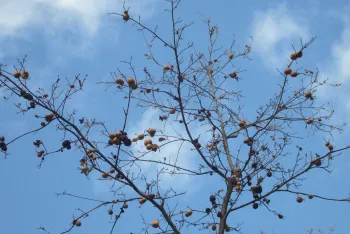
There once were stands of Valley oaks lining the Sacramento River for miles. More recently they have been removed to clear fields for crops and homes and their numbers are decreasing. Nowadays the Valley oaks are more slow-growing and smaller, although, under the right conditions they can grow to be 100 feet high.
The Valley oak is of benefit to both people and wildlife. In the heat of summer their widespread branches provide precious cool and shade. They are homes for birds and squirrels. Their acorns were of great value as a nutritional source to native peoples as well as local wildlife.
Besides ornamental landscape trees within our towns, the valley is home to great swaths of agricultural land planted in orchards. There are the seemingly endless rows of fruit and nut trees in the orchards, whose blossoming is eagerly awaited. Almonds are the primary crop, fast being supplanted by walnuts. Almonds are well known for their beautiful and very early bloom, which happens while the calendar says it’s technically still winter. Less common, but no less beautiful in bloom, are peach and plum orchards.
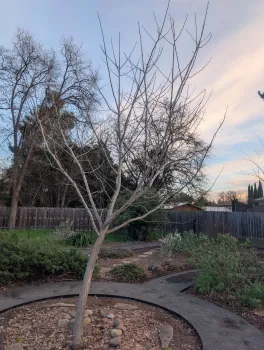
Whether a tree is ornamental, native, commercial, or perhaps a personal favorite in your own backyard, don’t forget to look up and appreciate how bare branches allow the winter sun to warm and light our days. We value that as much as we do the shade in the heat of summer.
Winter Garden Talks: On the morning of February 7th at Chapman Park Teaching Garden, The UC Master Gardeners of Butte County are offering a morning of winter-related garden talks, part of our Seasonal Garden Series in partnership with the Chico Area Recreation and Park District (CARD). These talks are free of charge, but registration is required. There are two sessions, each with a choice between two talks.
Session One begins at 9 am, with a choice between How to Use our 3-Year Garden Guide and Journal and Winter Planting and Seed Starting. Session Two begins at 10 am, and offers a choice between a talk on Composting and a one on Growing Through Winter and Protecting Outdoor Plants and Trees.
And the Master Gardeners Spring Workshop Series begins February 3, with a workshop on Seed Starting. The series runs until early June and consists of 17 workshops on a wide variety of gardening topics.
All Garden Talks and Workshops are free, but registration if required. For more information, and to register, visit our website.
UC Master Gardeners of Butte County are part of the University of California Cooperative Extension (UCCE) system. To learn more about us and our upcoming events, and for help with gardening in our area visit our website. If you have a gardening question or problem, email the Hotline at mgbutte@ucanr.edu or leave a phone message on our Hotline at 530-552-5812. To speak to a Master Gardener about a gardening issue, or to drop by the MG office during Hotline hours, see the most current information on our Ask Us section of our website