

By Anne Ryder.

A visit to the Master Gardeners Demonstration Garden at this time of year is a bit like a scavenger hunt: a little bit of searching may be required. For example, try to find two plants in bloom; identify some plants that are still completely dormant as winter marches on; look for any signs that spring is around the corner; discover a plant with an intriguing name; find a plant producing something edible that is ripe right now.
The Demo Garden is located on the grounds of Patrick Ranch at 10381 Midway, between Chico and Durham. When you turn off the Midway onto the long entrance drive, slow down so you can appreciate the magnificent bare-branched Valley Oak (Quercus lobata) in the center of the circular drive in front of the Patrick Ranch Visitor Center. When you walk up to the Demo Garden’s entrance gate, you will see a low-growing, compact plant with grassy foliage and small purple flowers on the left. This is Iris unguicularis, more commonly known as Winter Iris, a drought-resistant perennial that flowers from late fall into early spring; its colors are a very welcome sight at this time of year.
While many plants and trees are still in their winter dormancy, just inside the gate on the left there is a White Yarrow (Achillea millefolium) which is clearly starting its march toward spring as new leaves appear from beneath last year’s undergrowth. Yarrow is easy to grow and comes in several colors, making it a great addition to any bouquet. Yarrow blooms make great dried flowers as well.
In the left corner of the Garden you will notice a profusion of orange blooms that have lasted through the fall and winter. Red-hot Poker Lily (Kniphofia hybrid), has an orange and yellow elongated flower. Just behind it is Lion’s Tail (Leonotis leonurus) -- easily recognizable because its bright orange blossoms resemble a small lion’s tail.
All of the nearby fruit trees are standing bare and brown, except for one: the Burgundy Plum (Prunus salicina) which shows heartening signs of early spring in motion. Its branches are covered with small clusters of green buds, that will flower and eventually produce juicy sweet plums.
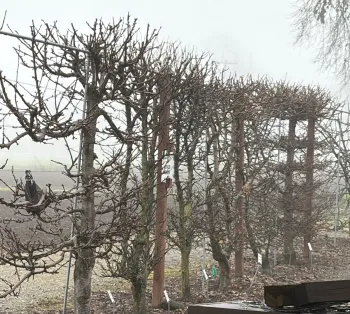
The espaliered fruit trees are lined up sentinel-like in a long row, waiting until longer and warmer days encourage their branches to bud. If you follow the row of espaliered trees you will come upon the Edible Garden. The varieties of plants there offer something to eat throughout the year. For instance, right now the celery looks delicious. And there are rows of harvestable chard, kale, and bok choy; the broccoli, having produced over the past few months, are now beginning to go to seed. The berry bushes are waiting for warmer days to come.
Thriving Vinca and Pitcher Sage almost cover the sign for the Wildlife Habitat Garden. On the other side of the garden the emerging leaves of a Yellow Bush Snapdragon (Keckiella antirrhinoides) are evident. But flowers are on their way! And nearby the evergreen Holly Leaf Mountain Lilac (Ceanothus ‘Blue Jeans’) is beginning to show signs of spring growth. This is another drought resistant native that produces lavender/violet flowers that cover its branches from springtime through summer.
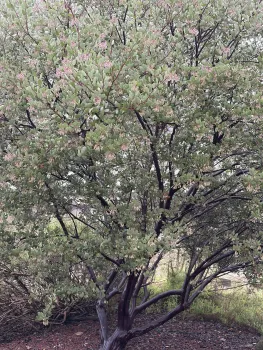
A beautifully tended flowering Manzanita tree of the genus Arctostaphylos is covered with small pink clusters of blooms right now. Its smooth red bark makes it easily identifiable, as well as a lovely structural addition to any winter garden. It will produce small apple-like berries (manzanita is Spanish for “little apples”) in summer and fall, providing food for wildlife.
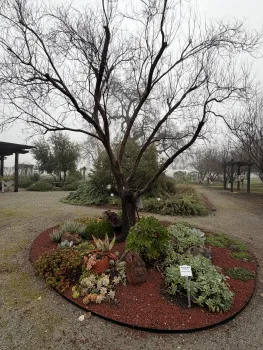
Finally, find the Succulent Garden and take a step back to view it in its entirety. In the center is a graceful Desert Willow (Chilopsis linearis). While its branches are bare right now, it will produce purple blooms through the spring and summer. There are also varieties that flower in pink or white. Not technically a willow, the Desert Willow does not require a lot of water, making it a popular low-maintenance tree. Surrounding the Desert Willow are various succulents that demonstrate some of the many colors and textures to be found in this group of plants. Plump and refreshed by winter’s cold temperatures and rain, they will store this season’s moisture to draw upon in the hotter months of the year.
Even in winter a stroll through the Demonstration Garden can provide useful ideas and inspiration for one’s own home garden. And it’s a lovely way to spend some time outdoors!
Winter Garden Talks: On the morning of Saturday, February 7th at Chapman Park Teaching Garden, The UC Master Gardeners of Butte County are offering a morning of winter-related garden talks, part of our Seasonal Garden Series in partnership with the Chico Area Recreation and Park District (CARD). These talks are free of charge, but registration is required. There are two sessions, each with a choice between two talks.
Session One begins at 9 am, with a choice between How to Use our 3-Year Garden Guide and Journal and Winter Planting and Seed Starting. Session Two begins at 10 am, and offers a choice between a talk on Composting and a one on Growing Through Winter and Protecting Outdoor Plants and Trees.
And the Master Gardeners 2026 Spring Workshop Series has begun! In February we are offering three new workshops (on flower gardening, plant selection, and garden planning with care and maintenance in mind), along with a returning workshop on native plants. March workshops focus on pollinator gardens, vegetable gardening and firewise land stewardship; registration for February and March is now open. The series runs until early June and consists of 17 workshops on a wide variety of gardening topics.
All Garden Talks and Workshops are free, but registration if required. For more information, and to register, visit our workshop webpage.
UC Master Gardeners of Butte County are part of the University of California Cooperative Extension (UCCE) system. To learn more about us and our upcoming events, and for help with gardening in our area visit the UC Master Gardener Website. If you have a gardening question or problem, email the Hotline at mgbutte@ucanr.edu or leave a phone message on our Hotline at 530-552-5812. To speak to a Master Gardener about a gardening issue, or to drop by the MG office during Hotline hours, see the most current information on our Ask Us section of our website.