

The growing season has started with a spike in nitrogen fertilizer prices which are much higher than last year, and the highest since 2022. Although nitrogen fertilizer still represents a small portion of the total expense of growing vegetables, avoiding unnecessary fertilizer applications can lower production costs and help the environment by minimizing the loss of nitrate to ground and surface water supplies.
One of the best tools to help you manage nitrogen more efficiently are nitrate sensitive test strips which can be used to evaluate the amount of plant available nitrogen in your soil. The same strips can also be used for measuring the nitrate concentration in irrigation water. Groundwater containing nitrate can be a significant source of nitrogen for crops, and both sources of nitrogen can substitute for fertilizer.
The benefit of the quick test is that you do not need to wait for a result from a laboratory analysis to decide how much fertilizer to apply. You can do the test in the field or bring the soil sample back to your office for analysis and have a result for the next day.
Measuring nitrate concentration in soil
Several short instructional bulletins and online videos are available which explain how to conduct the soil nitrate quick test using nitrate test strips. I recommend reviewing the online instructions provided by the California Department of Food and Agriculture Fertilizer Research and Education Program (CDFA FREP) and past blog articles. The basic procedure involves:
1. Collect a representative soil sample from the field
2. Add a subsample of the soil to a weak calcium chloride extractant in a plastic centrifuge tube at a 1:3 ratio
3. Thoroughly shaking the capped tube for a few minutes
4. Let the suspended soil particles settle out of solution to the bottom of the tube
5. Dip the test strip into the clear supernatant and after the specified reaction time compare the color of the test strip to the pallet of colors on the container corresponding to different nitrate concentrations (Fig. 1).
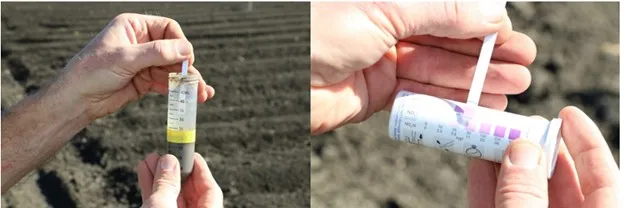
Figure 1. The test strips can be used to measure the concentration of nitrate in soil by dipping the strip into the soil extract and comparing the strip color with the pallet key on the side of the container.
6. Convert the solution nitrate value to a soil nitrate value using factors in Tables 1 or 2 that account for soil texture and moisture content. Table 1 is for strips calibrated to ppm nitrate and Table 2 is for strips calibrated to ppm nitrate-N.
Table 1. If reading the nitrate strip in parts per million (ppm) nitrate divide the strip value by the factors below to adjust for soil texture and moisture content.
Adjustment factor | ||
| Soil Texture | Moist | Dry |
| sand | 2.3 | 2.6 |
| loam | 2.0 | 2.4 |
| clay | 1.7 | 2.2 |
Table 2. If reading the nitrate strip in parts per million (ppm) nitrate-N multiply the strip value by the factors below to adjust for soil texture and moisture content.
Adjustment factor | ||
| Soil Texture | Moist | Dry |
| sand | 1.9 | 1.7 |
| loam | 2.2 | 1.8 |
| clay | 2.6 | 2.0 |
7. Convert the soil nitrate value from ppm nitrate-N to pounds of N per acre per foot of depth by multiplying by factors in Table 3.
So for example in a loam soil with a nitrate concentration of 20 ppm N, the pounds of N in the top foot of soil would be equal to:
20 ppm nitrate-N x 4.1 = 84 pounds of N/acre/ft
Table 3. Multiply the ppm concentration of N in soil by the factor below to convert to pounds of N per acre per foot of soil depth (lbs N/acre/ft).
| Soil Texture | Bulk density | Conversion factor |
g/cc | ||
| sandy loam | 1.6 | 4.3 |
| loam | 1.5 | 4.1 |
| clay loam | 1.3 | 3.5 |
| clay | 1.2 | 3.3 |
Tips for accurately using the soil nitrate quick test
Although the procedure appears straightforward, there are a few details to keep in mind so that the measured soil nitrate values are as accurate as possible.
Use the right tools to collect a composite soil sample: Use a sturdy sampling probe to collect soil cores and one gallon plastic buckets to separate the composite cores for each depth (Fig. 2). It is helpful to label the buckets with the sampling depth and mark the sample depths on the probe with a permanent ink pen or with tape.
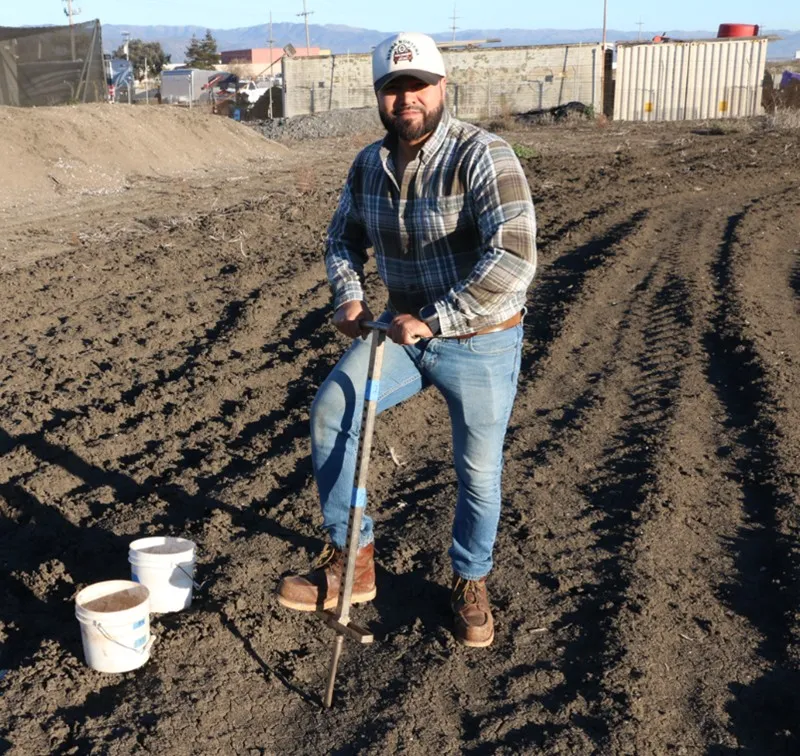
Figure 2. Use a sturdy sampling probe and one-gallon buckets to collect soil cores from various locations and depths within a field.
Collect a representative soil sample: Sample soil cores from 10 or more locations within a field. Sampling only from a few spots will bias results to a small region. Add cores from similar depths to the same bucket. Follow a “W” or diagonal pattern as you collect soil samples across to represent different locations and avoid bias. Sample soil from depths representative of the current rooting depth of the crop. For young vegetables I recommend collecting cores from the 1 to 12-inch depth, and sample 1 to 12-inch and 12 to 24-inch depths as the crop matures. I also recommend discarding the top inch of the upper 12-inch core as the soil on the surface can accumulate nitrate due to evaporation and therefore may not accurately represent the overall nitrate concentration. Also avoid sampling in locations where fertilizer was previously applied such as a side-dress band. I typically sample from just outside the plant row at about a 15-degree angle towards the center of the bed (Fig. 3).
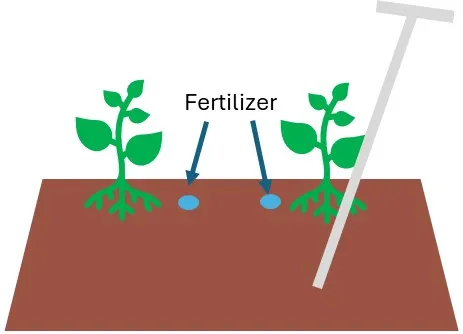
Figure 3. Collect soil samples in a consistent manner relative to the plant rows and avoid sampling near previous applications of fertilizer. Here the sampling probe is angled slightly toward the center of the bed from the outside plant row.
Keep the nitrate test strips cool: Left in the heat, the test strips will become less accurate over time. It is best to store the strips in a refrigerator and transport them in a small cooler with blue ice if you plan to use the strips in the field.
Keep soil samples cool until they are extracted: If you are not going to analyze the soil samples in the field, then place them in sealed plastic bags and store them in a cooler with blue ice until they can be analyzed. This will prevent them from losing moisture and heating up which can alter the nitrate concentration.
Thoroughly combine soil cores from the same depth together: The best way to combine and homogenize cores together is to pass them through a sieve or screen. This works well for clay loam to sandy textures. Screens with 2 to 4 millimeters openings are large enough that the soil can be quickly sieved, even when moist. Clay soil can be difficult to sieve. Pinching off small pieces from various cores is another way to create a representative subsample to add to the extractant solution.
Add the correct volume of soil to the extractant solution: The soil nitrate quick test is calibrated for a 1:3 ratio of soil to calcium chloride extractant. We recommend purchasing 50 ml polypropylene centrifuge tubes that have markings in 10 milliliter (ml) increments on the outside. Fill the tubes with 30 ml of extractant and add soil until the solution reaches the 40 ml mark.
Read the test strip after the prescribed color development time: Most nitrate test strips have recommended color development times of 30 or 60 seconds. After quickly dipping the strip into the extractant solution, shake of the solution, and start your timer so that you are ready to compare the strip color to the pallet colors at the correct time. Not waiting long enough or too long can lead to inaccurate readings.
Periodically check the accuracy of the test strips: Keep some standard nitrate solutions in a refrigerator so that periodically you can check that the strips are still giving accurate readings. This is also a great way to check that you are accurately reading the color of the strips.
Measuring nitrate concentration of irrigation water
So now that you are up to speed on measuring soil nitrate, how do you use the test strips to measure nitrate concentration in water? It is actually much simpler than measuring soil nitrate.
Briefly dip the end of the strip into a water sample, shake off the water, and read the color after the prescribed development time. If the strip is calibrated to ppm nitrate you will need to divide the value by 4.43 to convert to units in ppm nitrate-N. To calculate the pounds (lbs) of N applied per acre-inch depth of applied water use the equation:
ppm nitrate-N × inches of water applied × 0.227 = lbs N/acre
For example, applying 2 inches of water with a nitrate-N concentration of 20 ppm would equate to about 9 lbs of nitrogen per acre:
20 ppm nitrate-N × 2 inches × 0.227 = 9.1 lbs of nitrogen per acre
Determining how much nitrogen to apply
Once you know how much nitrogen is in the soil and how much nitrogen will be supplied from the irrigation water you will be in much better position to decide the right amount of fertilizer to apply to meet the demand of the crop. Often after the first vegetable crop of the season there is sufficient nitrogen available from the soil and water to greatly reduce the fertilizer applications of the second crop.
How much of the nitrogen in the soil to credit for your crop is a judgement call that depends on several factors. Irrigation management affects the availability of soil nitrate since over irrigating can leach a portion of the nitrate below the reach of roots. Also, the crop stage is a factor to consider. Because young plants have a lower N uptake rate than rapidly growing older plants, you may be more comfortable with low concentrations of soil nitrate during the early phase of the crop but desire a higher concentration in the soil as the crop transitions to rapid growth. The rate of nitrogen mineralization from soil organic matter can also make up a portion of the nitrogen needs of the crop. For low organic matter soils (< 2% organic matter) approximately 0.3 to to 0.5 pound of N per acre per foot per day can mineralize during the summer.
Online decision support tools such as CropManage can help you integrate all these factors together to determine the optimal fertilizer rate to apply. CropManage can evaluate the nitrogen demand of a crop at a specific growth stage and credit for N available in soil and water. CropManage also can provide recommendations for how long to irrigate based on weather conditions and the stage of crop development so that the right amount of water is applied to match crop use.
Another online tool that can also help with making the soil nitrate calculations from the quick test results is the Soil Nitrate Quick Test Web Tool. This tool will help you factor in the soil texture of your field so that the estimates of soil nitrate are as accurate as possible, and includes step-by-step instruction on using the soil nitrate quick test.
Finally, if you need advice or guidance on using the nitrate test strips or interpreting the results, please do not hesitate to reach out to us. Myself and my staff are happy to help!