
Article by Sue Fitz -
The bi-annual UC Master Gardener-Yolo plant sales at Woodland Community College (WCC), have been occurring for almost twenty years. Partially a fund raiser for the college and Master Gardeners, it also aims to be an inexpensive source of waterwise and pollinator friendly plants for the public.
The preparation for each sale begins about five months before the sale date. The propagation team meets to choose what plants to offer for the upcoming sale. To keep things interesting, species and varieties are rotated frequently, to keep selection fresh. Propagators keep an eye out at all times to spot new material that can be added to the list of offerings.
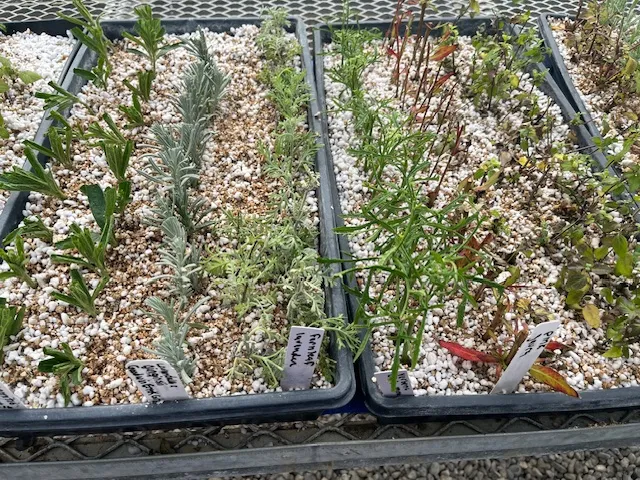
Four months out from the sale, equipment is disinfected and sterilized. Pots, soil, and labels are ordered, heat mats are unfurled, and the sterilized trays are filled with a fifty/fifty mix of perlite and vermiculite. Seed pans are filled with either regular potting soil or cactus mix (used for starting native plant seeds), and everything is placed in readiness in the WCC greenhouse.
Three and a half months out, actual propagation commences. The team comes together biweekly with cuttings and seeds to fill the trays over the next few weeks. Plant material is usually collected from fellow Master Gardeners' own gardens, who, as you can imagine, often contain unusual, choice, or rare species and cultivars. It can take from two to six weeks for cuttings to root, or seeds to germinate and grow big enough to handle. The trickiest task during this time is to monitor the moisture levels in the trays, as things need to be kept moist, but not soggy. A small number of plants are propagated by division, and usually placed directly in their final quart pots, then kept in the greenhouse until they recover and show active growth.
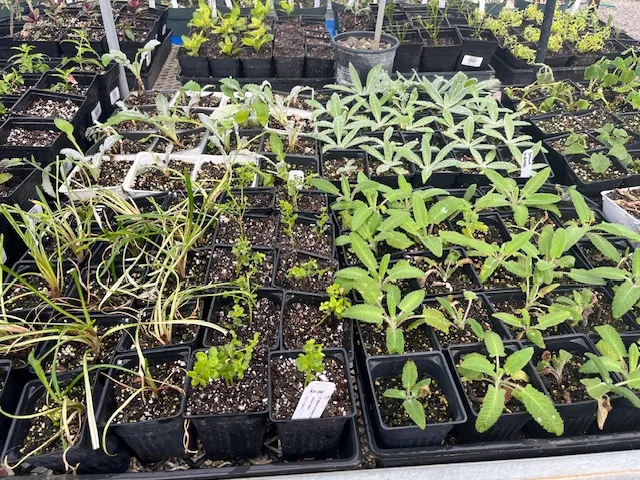
Two months out, cuttings have rooted, and seedlings are big enough to transplant. Depending on the vigor of the plant, they may be placed into three-inch ‘starter’ pots, or potted up into the final quart-sized pots in which they will be sold. It’s amazing to see how quickly they grow at this point! Woodland Community College’s specially blended potting soil seems to have almost magical powers. It’s exciting to watch how the plants double and triple in size in just a few weeks. Native plants lag behind a bit, since they’re planted in cactus mix to maximize drainage, and the lower fertility they prefer does not result in rapid growth. Buyers at the plant sales may notice natives are a bit smaller than the regular plants, but the plants are focused on root growth over top growth when they are young. At this point, the plant list for the sale is finalized, and publicity starts.
One month out, everything that is not in a quart pot gets put in one, and the plants are pinched back so they will be full and bushy at sale time. Labels are inserted, and the plants begin to be transferred outside to the lathhouse, depending on their size and cold tolerance. A week before the sale, they all move outside for hardening off. Information signs are designed and produced for each plant species and cultivar, and the propagation crew breathes a sigh of relief for another sale ready for the public to enjoy.
Photos by Wilda Knoesen.
2026 Spring Plant Sale Information -
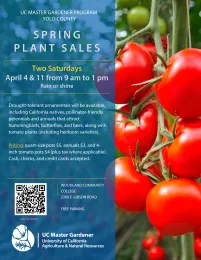
This spring’s sale will be on April 4th and 11th, between 9 am and 1 pm.
For a list of the California natives, drought-tolerant perennials, and pollinator-friendly annuals that will be available, click Spring 2026 Ornamental Plant Sale List.
For a list of the tomato varieties that will be available, click Spring 2026 Tomato Varieties Plant Sale List.
Tanya Kucak has also written two articles, Tomato Leaf Shapes and Sunscald, and Eleven New Varieties in Tomato Seedling Sale along with a 2026 Tomato Chart by Color and Size, all of which will help you decide which tomatoes you would like to try in your garden this year.