
Blackberry growers should note that the moderate rains taking place in ambient temperatures of 65 to 75 degrees F as is common in February and March on the Central Coast are excellent conditions for outbreaks of downy mildew.
Downy mildew is caused by the fungal pathogen Peronospora sparsa. This pathogen infests almost all of the proprietary blackberry varieties, Ollalieberry, and Boysenberry. Conversely, varieties such as Chester, Arapahoe, Apache, Navaho and the other so called “Native American named varieties” are fairly resistant, with very little disease appearing even in the most amenable conditions for disease development.
Downy mildew first appears as a yellow discoloration on the upper leaf surface, followed by a red to purple discoloration which is oftentimes framed and limited in growth by leaf veins, giving the lesions an angular appearance. These blotches will appear as light pink or tan areas on the leaf underside, often accompanied by whitish spore masses (see photos below). As favorable conditions persist and the disease advances, these lesions expand to cover the whole leaf, and eventually the whole leaf turns brown. Severely infested leaves may fall off the plant.
Infested flowers often result in fruit that is crumbly and not sound, while fruit infested with downy mildew at the green stage will shrivel and dry out. Fruit infested at the mature stage takes on a dull pallor, followed by similar shriveling and drying out. Downy mildew affected blackberry fruit will sometimes split into two parts.
The downy mildew pathogen is understood to overwinter as fungal mycelium in the plant roots, crowns and canes, in other words it becomes systemic. As new shoots emerge in the spring, the pathogen follows the growing point, infesting stems and new leaves. Given the right conditions of moisture and temperature, these infested leaves are then the primary sites for further infestation of the plant.
Practices which limit the duration of periods of moisture around susceptible blackberries will reduce risk of disease. Removal of weeds and excess suckers around the base of fruiting canes allows more air circulation and may limit disease establishment and spread.
The dryness of covering hedgerows with macro-tunnels is unrivalled in reducing the incidence and severity of downy mildew disease in blackberries.
The fungicide often used in controlling downy mildew is Aliette (fosetyl aluminum) as a foliar application. Growers planning on using Aliette should bear in mind the restriction of not being able to harvest fruit for 60 days after application of this material.
Phosphonate fungicides or fertilizers can be successful in limiting downy mildew in blackberries when applied preventively. They work by boosting the plant defense systems rather than directly suppressing pathogens. There are multiple phosphonate products, such as phosphorous acid or phosphite. Phosphorous acid, a solid compound, forms a highly acidic solution when dissolved in water. It should be neutralized or buffered with other compounds before being applied to plants. Phosphite is preferred over phosphorous acid because it is easier to handle. Phosphite is often registered only as a fertilizer,such as Phosgard, Nutriphyte and Fosphite.Furthermore, due to concerns of phytotoxicity, do not tank mix phosphonate products with copper compounds, surfactants, or foliar fertilizers.
There are fungicides and several other products mentioned for control of downy mildew in blackberries in this article. Before using any of these products, check with your local Agricultural Commissioner's Office and consult product labels for current status of product registration, restrictions, and use information.
For further information regarding these compounds, there is a very well done article written by colleague Ben Faber concerning the use of phosphonate compounds for control of oomycete fungi such as Phytophthora or downy mildew: https://ucanr.edu/blog/topics-subtropics/article/phosphorous-acid-confusion.The table below summarizes some phosphonate terminology mentioned above.
| Term | Description |
| Phosphorus | The P element |
| Phosphonate | Nomenclature for P(III) derivatives |
Phosphorous acid or Phosphonic acid | H3PO3 |
| Phosphoric acid | H3PO4 |
| Phosphite | Salt formed from phosphorous acid reacted with alkali. A common phosphite is potassium phosphite. |
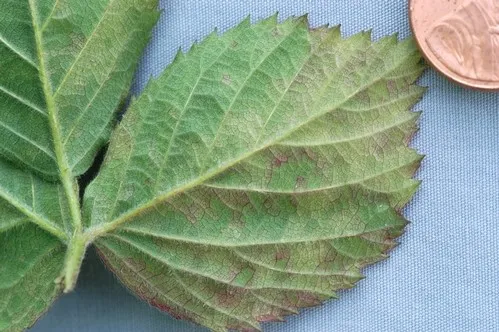
Downy mildew on underside of blackberry leaf. Note yellow discoloration, this is where the white spore fungal masses would be seen. Photo courtesy of Steven Koike
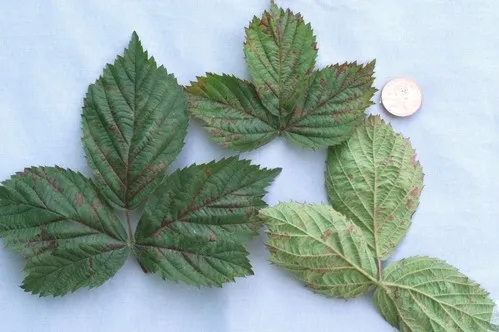
Downy mildew on surface of blackberry leaf. Note delimiting of purple blotches associated with the pathogen. Photo courtesy of Steven Koike
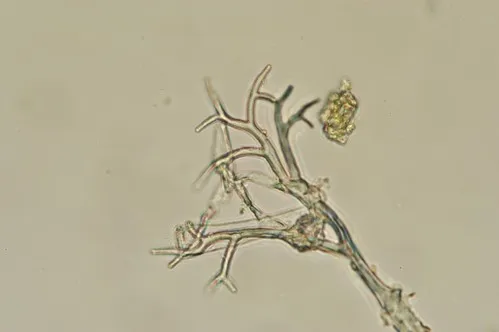
Microscopic view of downy mildew pathogen. Photo courtesy of Steven Koike.