
Authors: Valentina Roel-Rezk, Mark Lundy, Cameron Pittelkow
---
Recycled organic materials, such as compost, anaerobic digestate (AD), and hydrolysate, are increasingly used in California agriculture to improve soil health and reduce waste. Some key questions have recently emerged from this practice: how much nitrogen (N) do these amendments supply to the crop during the season, and can this offset inorganic fertilizer requirements? Organic amendments vary widely in carbon (C) and N content, meaning the mineralization of N to plant-available forms can be unpredictable. Such uncertainty can lead to both over-application of fertilizer (raising costs and pollution risk) and under-fertilization, which reduces yields. At the same time, growers are adopting new tools, like drone- and satellite-based remote sensing, which can rapidly assess crop N status and help guide fertilizer decisions.
In the 2022-23 season, we carried out field experiments at two field sites in Yolo and Solano counties, where we planted wheat and triticale. In both experiments, organic amendments were applied to large main plots and inorganic N fertilizer rates were assigned to subplots within each amendment. One aspect of our research aimed to determine whether remote sensing measurements can estimate N availability from organic sources in real time. The goal is to support improved management of combined organic + inorganic N fertilization programs.
Although the fields shared similar soils, were planted on the same day (November 21, 2022), and managed comparably, there were some important differences in background soil N and irrigation practices. The wheat field followed a tomato crop and had very high residual nitrate in the top foot of soil at the start of the season, whereas the triticale site followed a cover crop and had very low soil nitrate in the top foot. In addition, while the triticale field received no irrigation, the wheat field received a large irrigation application (approximately 6 in.) on 26 April when the crop was at the early heading growth stage. Across the growing season, the rainfall was approximately 150% of average. Yet less than 0.75 in. of rain fell after the beginning of April. As a result, the unirrigated triticale experienced terminal drought effects, while the wheat field did not.
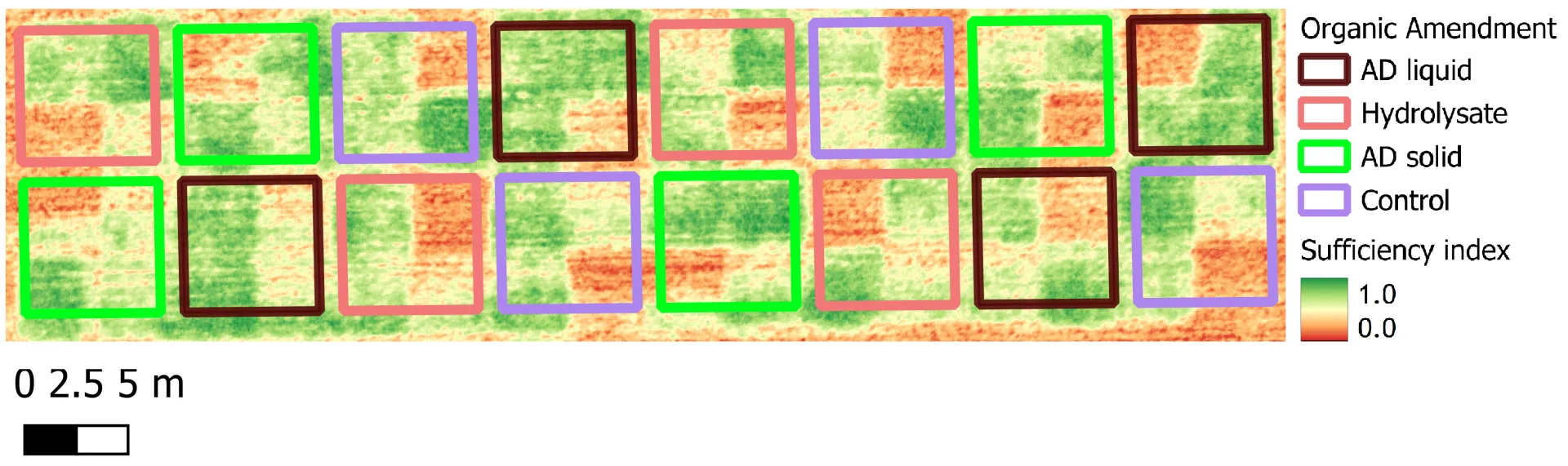
Figure 1: A multispectral UAV image of the triticale field experiment during stem elongation, showing differences in canopy reflectance among organic amendments (solid digestate, liquid digestate, and hydrolysate) and nitrogen fertilizer rates. Green areas represent higher SI values (indicating greater crop N status), while red areas indicate lower SI values. AD refers to anaerobic digestate derived from mixed organic waste (food and green waste). Main-plot amendments included AD liquid, AD solid, hydrolysate, and a urea-only control.
Throughout the season, we collected drone-based multispectral imagery to calculate the Normalized Difference Red-Edge Index (NDRE), which is strongly linked to leaf chlorophyll and crop N status. To standardize values within a particular day, we converted NDRE into a Sufficiency Index (SI), which expresses NDRE for each plot relative to the highest NDRE value measured on the same date. We paired the remote sensing data with crop yield, N uptake, and N recovery efficiency outcomes.
AD liquid became plant-available early in the season. This led to a higher SI at stem elongation and ultimately translated into 30lb/ac more crop N uptake and 0.75 more tons/ac than the unfertilized control (Figure 2). While the other organic amendments contributed plant-available N, it was not plant-available as early, and this was measurable both in the SI recorded at stem elongation and the eventual crop N uptake at the soft dough forage harvest (Figure 2).
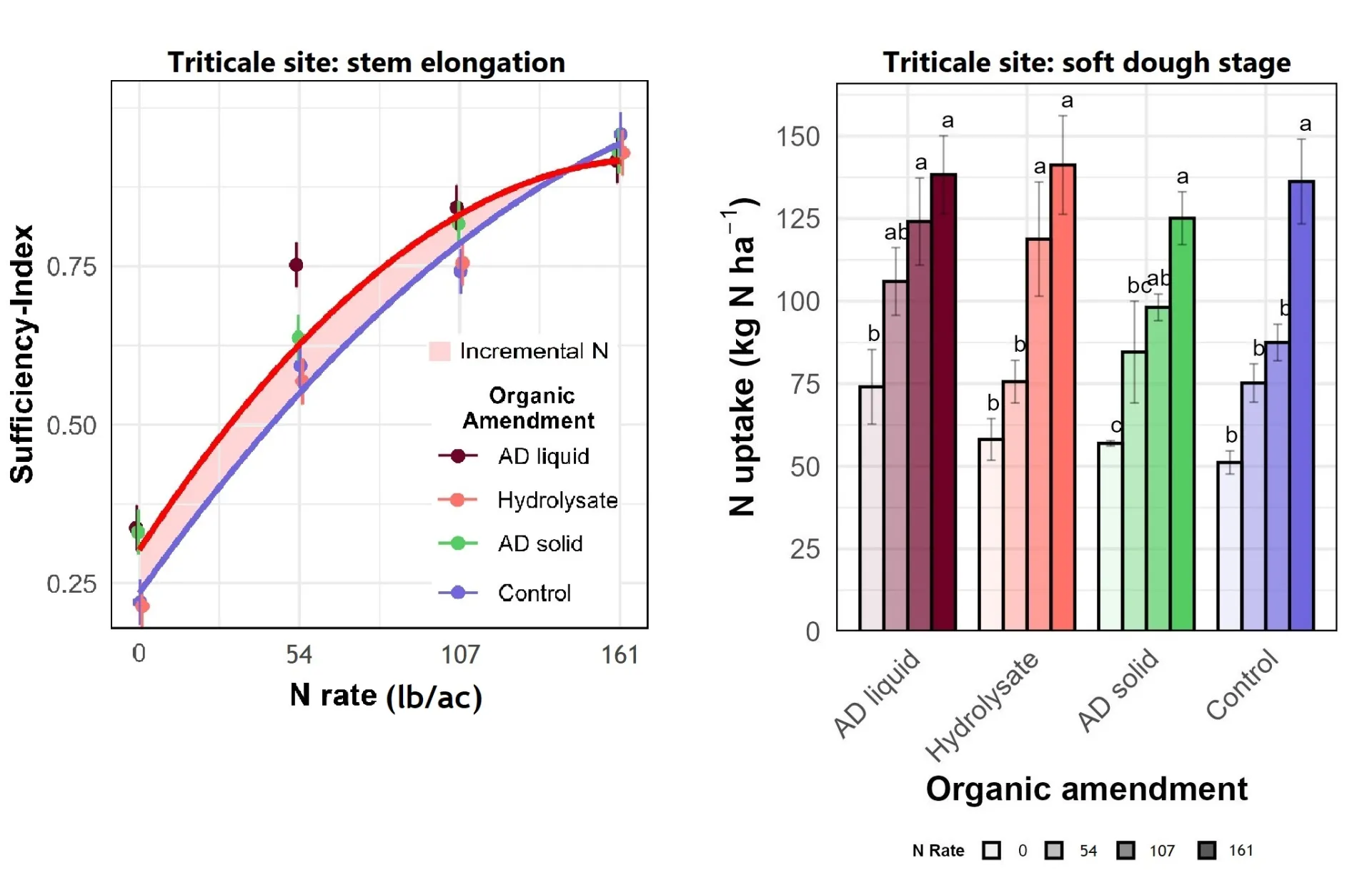
Figure 2: (left) Sufficiency-Index measured at stem elongation and (right) N uptake measured at soft dough forage harvest (kg N ha−1) at the triticale site displaying the organic amendment by N rate interaction . AD liquid consisted primarily of plant-available N (mostly NH₄-N) and was applied at 71 lb N / ac (about half of seasonal crop demand). AD solid was applied at 5 tons/ac (dry weight), providing ~12 lb/ac of available N based on inorganic N plus an assumed 5% mineralization of organic N in the first year. All amendments were surface-applied and incorporated before seeding. Subplots received urea at 0, 54, 107, or 161 lb/ac with one-third applied at sowing and two-thirds at tillering. In the left panel, the red curve shows the crop response to all organic amendments, while the purple curve shows the response of the urea control. The space between the curves represents the additional N supplied by the amendments compared to the urea control.
The contrast between the effects of the organic amendments at the two sites illustrates how remote sensing can provide insight into N mineralization dynamics. At the wheat site, soil nitrate levels were high prior to planting (66 mg kg−1 NO₃-N), and SI values at stem elongation were consistently high, with no differences regardless of the amendment types or fertilizer rate (Figure 3, left). Even in the absence of applied N, SI values exceeded 0.9, indicating that N was not a limiting factor. Neither organic amendments nor additional inorganic N increased SI, crop N uptake, or yield. In this case, the lack of treatment differences is itself an important result: remote sensing correctly indicated that N was not limiting, and fertilizer applications could have been avoided. In contrast, at the triticale site, SI measured at stem elongation clearly indicated that the availability of N supplied by the organic amendments was not meeting crop N demand at the lower fertilizer rates (Figure 3, right). This provided actionable information in a farming context. Specifically, SI showed that, even with the application of the organic amendment pre-plant, an in-season application of mineral fertilizer N would benefit crop productivity at that site.
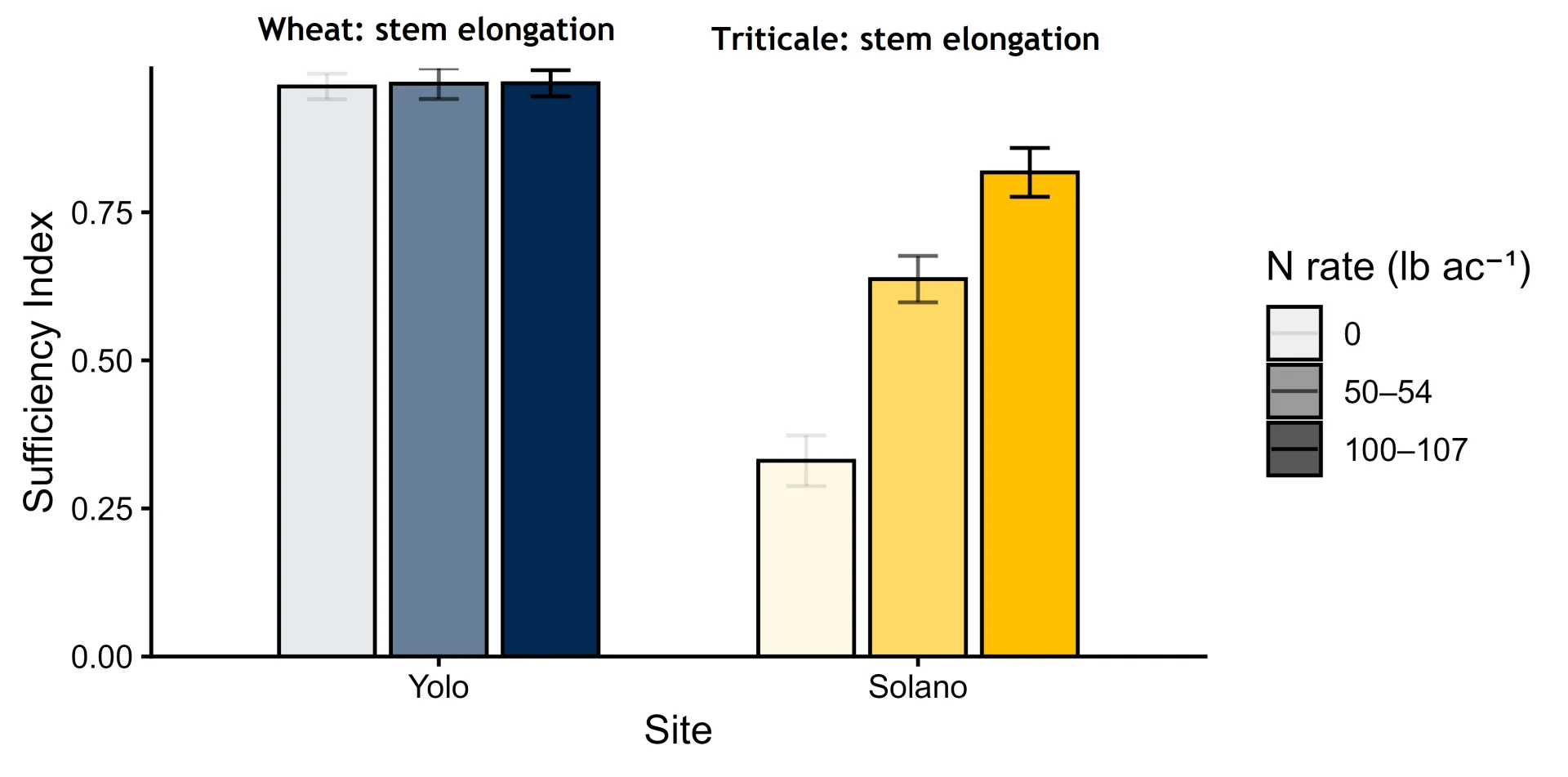
Figure 3: Sufficiency-Index measured at stem elongation in the AD solid treatment at the (left) wheat site and (right) triticale site.
Across two contrasting sites, this study highlights two key findings. First, organic amendments differed substantially in their ability to supply plant-available nitrogen: liquid digestate provided the greatest early-season N contribution, increasing crop N uptake by 30 lb/ac at low fertilizer rates and allowing maximum forage yields to be achieved with less inorganic N. Second, remote sensing effectively captured these differences within a site and across sites. In triticale, SI identified meaningful amendment-driven N contributions, while in wheat, uniformly high SI values correctly indicated that fertilizer inputs were unnecessary. Together, these results show that combining organic amendments with remote sensing-based diagnostics can inform growers regarding N mineralization variability from site-to-site or year-to-year and reduce unnecessary fertilizer use.