
Rohith Vulchi and Brad Hanson, Plant Sciences Department, UC Davis
Branched broomrape is a parasitic weed that continues to challenge processing tomato production in California. Nearly 70% of its lifecycle is completed underground; once it emerges, it can flower and set seed within just a few weeks. Current best management practice recommendations for broomrape management in conventional processing tomatoes includes a herbicide treatment regime to control early-stage broomrape at the time of root attachment and removal of emerged plants before they set seed. Starting chemigation applications too early or too late could miss the window where the herbicide can be effective. Similarly, mistimed rogueing operations could waste effort when few plants are present or removing plants after seed have already been produced and shed to the soil. Missing these short windows can significantly increase the amount of broomrape emerging in a field and increase the risk of seed production and spread within and among fields.
As part of our broader broomrape research and extension efforts, researchers at UC Davis collaborated to develop practical, science-based outreach tools to support processing tomato growers. One such tool is the Broomrape Growing Degree Day (GDD) Calculator, developed by the Mesgaran team at UC Davis based on recent research (see Hosseini et al. broomrape GDD modeling study). This web-based tool uses location-specific weather data to predict key broomrape developmental stages and help guide the timing of chemigation, scouting, and rogueing operations. Image attached below shows the GDD calculator icon for reference.
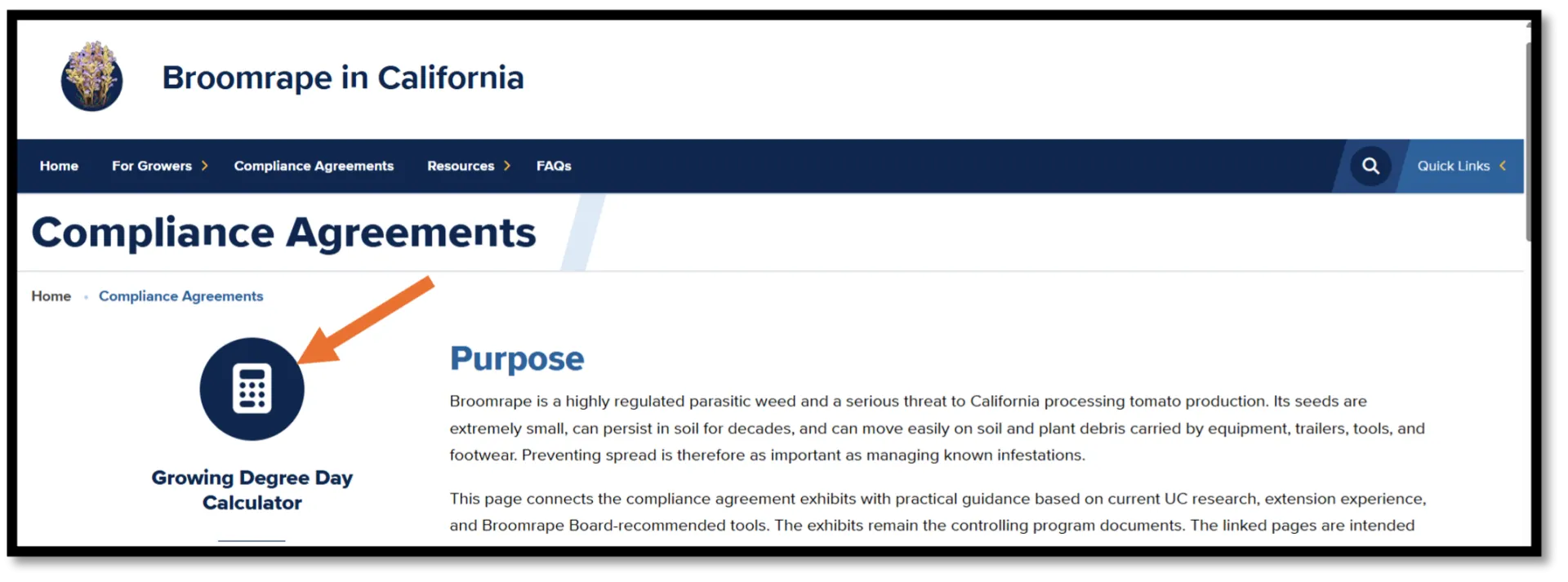
The main purpose of this tool is to help growers time chemigation and rogueing operations for most effective broomrape management. While the herbicide product label indicates starting the treatment regime around 30 days after transplant (DATr), our recent research shows that 20 DATr was more effective in some seasons, especially for later or warmer planting dates when heat accumulates more quickly. Using the GDD approach rather than days after transplanting takes the guesswork out of these seasonal variations and should allow much greater and consistent efficacy with the Matrix chemigation program.
To support adoption and use of the GDD tool, a new YouTube tutorial video (image below) has been released as part of our “Clean Machine” outreach series, demonstrating how to use the GDD calculator for field-level decision making.

Additional videos covering broomrape identification, scouting, herbicide chemigation and equipment sanitation are available on the UC Davis Broomrape Research YouTube channel, with more content currently under development. This integrated research and extension effort has been supported by the California Tomato Research Institute, the CDFA Broomrape Board, and the USDA-MBT grant program.