UC ANR is committed to providing an accessible and inclusive web experience for all users. If you encounter an accessibility barrier or need content in an alternative or remediated accessible format, please contact anraccessibility@ucanr.edu.
Valley carpenter bees are passionate about passionflower vines (Passiflora). You see these black bees foraging on the blossoms. Tiny grains of golden pollen, looking like gold dust, dot the thorax. Their loud buzz frightens many a person, but wait, they're pollinators.
UCCE Farm Advisor Gary Bender finally has his 14 chapter book on avocado history, botany and cultural practices on the San Diego County web site. Check it out: http://ucanr.
Introduction to the species: Abutilon theophrasti (commonly known as velvetleaf) is a summer annual weed native to Asia. For those not familiar with the species, plants are tall (to 1-2 m) and erect with green- or purple-colored stems that branch at higher leaf axils (Warwick and Black 1988).
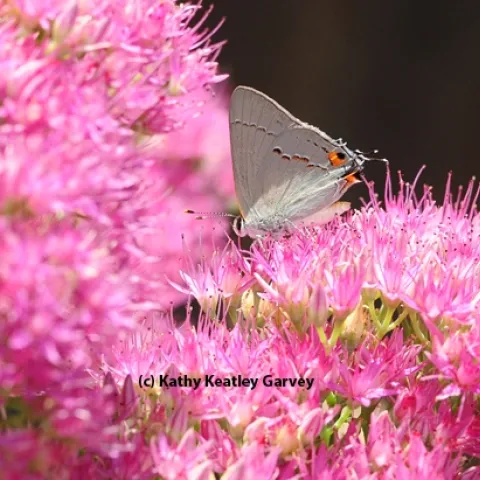
if it's a streak of gray, you don't wash it away. You welcome it. The gray hairstreak butterfly (Strymon melinus) is common on our sedum, a good fall plant for pollinators, including butterflies, honey bees, sweat bees and syrphid flies, aka hover flies or flower flies.
I don't mulch much but this caught my eye: using those big round straw bales that unroll behind the tractor as an easy way to put out a mulch. John Wilhoit & Timothy Coolong (2013).
Training At planting (preferably in spring), if trees have an unbranched trunk greater than 2 feet tall, the tree should be headed back. This procedure should induce other buds along the trunk to shoot. Always remove leaves at positions where new shoots are required.
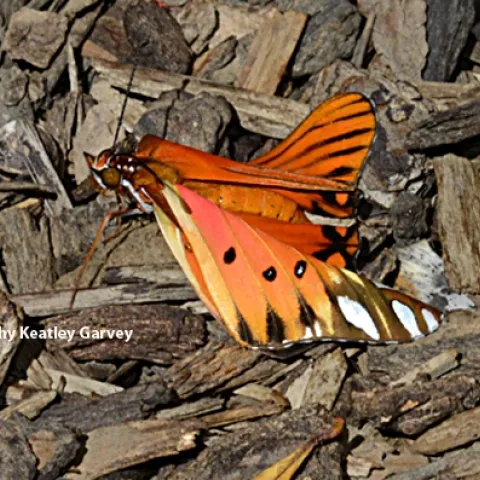
Call it serendipity. Call it a prize from the sky. Frankly, it's not every day that a newly emerged Gulf Fritillary butterfly, Agraulis vanillae, lands at your feet.
As summer nears its end, the honey bees are hungry. That's why Extension apiculturist Eric Mussen of the UC Davis Department of Entomology and Nematology advocates that we plant flowers for late summer and fall to help the bees.