A Natural Solution for California's Herds: African Catfish Peptides

California's cattle producers and agricultural communities are all too familiar with the rising challenge of antibiotic resistance, making common bacterial infections harder to treat in livestock. But imagine a future where we could tackle these infections with a natural, powerful alternative. Our research points to just that: antimicrobial peptides (AMPs) found in African catfish.

We're really excited about these peptides because African catfish thrive in pathogen-rich freshwater, naturally producing these robust immune compounds in their skin mucus as a defense. This natural origin makes them highly appealing alternatives to synthetic drugs.

Predicted Safety and Potent Action

One of the most compelling aspects of these AMPs is their predicted safety for mammals. Our initial computer analyses suggest that various catfish AMPs are generally recognized as safe (GRAS). We predict they'll be absorbed in the human intestine without causing liver, brain, or heart toxicity. Furthermore, lab tests on a promising peptide, NACAP-II, confirmed it was non-hemolytic, meaning it didn't damage rabbit red blood cells—a strong indicator of its potential safety for mammalian cells.

Beyond safety, these peptides demonstrate effectiveness against problematic bacteria. One study revealed NACAP-II's strong activity against Extended-Spectrum Beta-Lactamase (ESBL)-producing Escherichia coli—a critical concern for both animal and human health due to its resistance to many common antibiotics. Another peptide, ACAP-IV, also showed antibacterial activity against E. coli and Staphylococcus aureus. We believe these AMPs work by directly disrupting bacterial cell membranes, a mechanism that makes it harder for bacteria to develop resistance compared to how they resist traditional antibiotics.

Primary Image
Strawberry leaf spot on a strawberry plant off of the beach in Santa Cruz County. Note the white centers and purple margins. Photo Mark Bolda.
Strawberries and Caneberries: Article

Leaf spot in Strawberry

June 15, 2023
By Mark P Bolda
We've had some detections of leaf spot in strawberry these past few months, and while it's not expected to be of economic importance, it's still worth the while to talk about with strawberry growers.
View Article
Primary Image
Air pruning grow bag. Photos by Karen Metz
Under the Solano Sun: Article

Air Pruning

June 15, 2023
A year or so ago, I began growing potatoes in a special fabric container. I've enjoyed using my potato bags. It's easy to move them to get more sunlight or more water from the sprinklers. It's also easier to harvest the crop.
View Article
Article

UCPath planned downtime June 16-19

June 14, 2023
By Pamela S Kan-Rice
Starting Friday, June 16, at 3 p.m. through June 19, at 9 p.m., the UCPath system will be unavailable to all UC employees and applicants as UCPath implements its system upgrades as part of a June release.
View Article
Primary Image
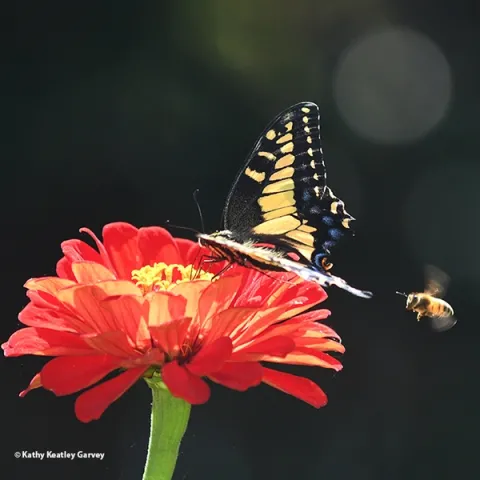
A clerk at McCormack Hall, Solano County Fair, displays two junior division photos: one of a honey bee by Jesse Means of Dixon, and the other of a orange-tip butterfly by Regan Van Tuyl of Dixon. (Photo by Kathy Keatley Garvey)
Bug Squad: Article

Solano County Fair, June 15-18: Bees, Butterflies and More

June 14, 2023
By Kathy Keatley Garvey
You might not expect to see Anthocharis sara sara in McCormack Hall during the 74th annual Solano County Fair, Vallejo, June 15-18. But you will. It's a photograph titled "Painted Wings" by Regan Van Tuyl, 13 of Dixon.
View Article
Primary Image
Weevil on leaf
Spill the Beans: Article

What's Eating My Hollyhocks?

June 14, 2023
by Saira Bates A few years ago, I found a couple of plants growing at the base of the bird house in my garden. At first, I thought they were weeds. I was tempted to pull them out, but I was also curious to see if there would be any flowers on this rapidly growing plant. I decided to let them grow.
View Article
Primary Image
heathers plants
Under the Solano Sun: Article

The Cottage Garden

June 14, 2023
My favorite style of gardens have to be cottage gardens. I see them as very colorful, various heights and an almost flowy or airy feel to them. In 2020, while we were under covid lock down, I was not able to get over to Annie's Annuals to get my usual springtime plants.
View Article