A Natural Solution for California's Herds: African Catfish Peptides

California's cattle producers and agricultural communities are all too familiar with the rising challenge of antibiotic resistance, making common bacterial infections harder to treat in livestock. But imagine a future where we could tackle these infections with a natural, powerful alternative. Our research points to just that: antimicrobial peptides (AMPs) found in African catfish.

We're really excited about these peptides because African catfish thrive in pathogen-rich freshwater, naturally producing these robust immune compounds in their skin mucus as a defense. This natural origin makes them highly appealing alternatives to synthetic drugs.

Predicted Safety and Potent Action

One of the most compelling aspects of these AMPs is their predicted safety for mammals. Our initial computer analyses suggest that various catfish AMPs are generally recognized as safe (GRAS). We predict they'll be absorbed in the human intestine without causing liver, brain, or heart toxicity. Furthermore, lab tests on a promising peptide, NACAP-II, confirmed it was non-hemolytic, meaning it didn't damage rabbit red blood cells—a strong indicator of its potential safety for mammalian cells.

Beyond safety, these peptides demonstrate effectiveness against problematic bacteria. One study revealed NACAP-II's strong activity against Extended-Spectrum Beta-Lactamase (ESBL)-producing Escherichia coli—a critical concern for both animal and human health due to its resistance to many common antibiotics. Another peptide, ACAP-IV, also showed antibacterial activity against E. coli and Staphylococcus aureus. We believe these AMPs work by directly disrupting bacterial cell membranes, a mechanism that makes it harder for bacteria to develop resistance compared to how they resist traditional antibiotics.
Fresno County 4-H: Article

May 2023 Guidelines

May 5, 2023
In This Edition 2- Committee & Council Mtgs. 2- Club Attendance Winner 2- Record Book Reminders 3- 4-H Fair 3- Sheep & Goat Camp 3- Color Me Green Run 4- Clover Fest 5- Summer Camp 5- 4-H Sheep & Goat Show 6- Horse Project Updates .
View Article
Primary Image
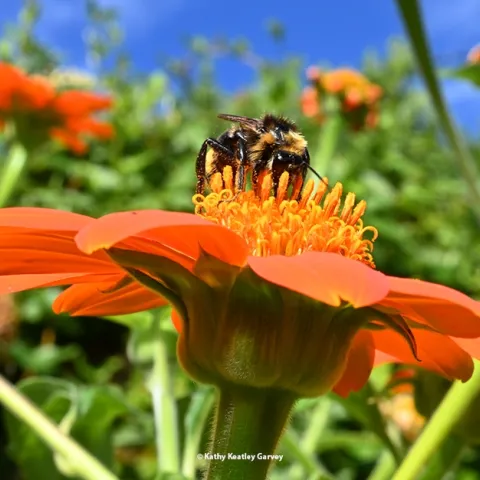
A squash bee, Peponapis pruinosa, pollinating a squash. (Photo by Kathy Keatley Garvey)
Bug Squad: Article

Pollination Ecologist Neal Williams: The Importance of Native Bees

May 5, 2023
By Kathy Keatley Garvey
Did you know that California is home to more than 1600 species of undomesticated beesmost of them nativethat populate and pollinate our gardens, fields, and urban green spaces?--Source: California Bees and Blooms, a Guide for Gardeners and Naturalists.
View Article
Primary Image
A yellow-faced bumble bee, Bombus vosnesenskii, leaves a foxglove. (Photo by Kathy Keatley Garvey)

Native Bees Part of California Honey Festival, Too

May 5, 2023
By Kathy Keatley Garvey
Native bees will join the celebrated honey bees at the California Honey Festival. The annual event, free and family friendly, takes place from 10 a.m. to 5 p.m., Saturday, May 6 in downtown Woodland.
View Article
Primary Image
lemon cold wet exposure
Topics in Subtropics: Article

Wet Roots

May 5, 2023
By Ben A Faber
I recently harvested 'GEM' avocados and found that some of the fruit was splitting. The split fruit was just turning from a bright green to one with dark tinges. There were also gobs of snails and slugs on the fruit.
View Article
Glenn County: Article

Sacramento Valley Walnut Newsletter Glenn County - Spring 2023

May 5, 2023
In This Issue New Orchard Advisor Walnut Management Considerations Healthy Orchards with a Careful Approach to Irrigation Thinking About Skipping or Shorting Nitrogen This Year? Prioritizing Sprays When You Cant Afford Them All Strategies for orchard weed management hard economic situations.
View Article
UCCE Central Sierra: Article

May 2023

May 5, 2023
Regional Meat Supply Meeting | Roots of Change | Organic Livestock Parasite Study | Free Anaplasmosis Herd Testing | Forest Stewardship Workshop | Cone & Seed Collection Webinar | Forest Legacy Program Webinar | Top 10 Tools for New Forest Landowners | Preserving Forestland | Forest Stewardship Fiel...
Archived
View Article
Primary Image
A group of people look up at leafy tree canopies.
Green Blog: Article

Tribal Engagement at the Hopland Research and Extension Center

May 5, 2023
By Adina Merenlender
The Hopland Research and Extension Center is situated on the traditional, ancestral and unceded lands of the Shqowa and Hopland People, whose historical and spiritual relationship with these lands continues to this day and beyond (for more on the Land and people history of the site, see this story m...
View Article