A Natural Solution for California's Herds: African Catfish Peptides

California's cattle producers and agricultural communities are all too familiar with the rising challenge of antibiotic resistance, making common bacterial infections harder to treat in livestock. But imagine a future where we could tackle these infections with a natural, powerful alternative. Our research points to just that: antimicrobial peptides (AMPs) found in African catfish.

We're really excited about these peptides because African catfish thrive in pathogen-rich freshwater, naturally producing these robust immune compounds in their skin mucus as a defense. This natural origin makes them highly appealing alternatives to synthetic drugs.

Predicted Safety and Potent Action

One of the most compelling aspects of these AMPs is their predicted safety for mammals. Our initial computer analyses suggest that various catfish AMPs are generally recognized as safe (GRAS). We predict they'll be absorbed in the human intestine without causing liver, brain, or heart toxicity. Furthermore, lab tests on a promising peptide, NACAP-II, confirmed it was non-hemolytic, meaning it didn't damage rabbit red blood cells—a strong indicator of its potential safety for mammalian cells.

Beyond safety, these peptides demonstrate effectiveness against problematic bacteria. One study revealed NACAP-II's strong activity against Extended-Spectrum Beta-Lactamase (ESBL)-producing Escherichia coli—a critical concern for both animal and human health due to its resistance to many common antibiotics. Another peptide, ACAP-IV, also showed antibacterial activity against E. coli and Staphylococcus aureus. We believe these AMPs work by directly disrupting bacterial cell membranes, a mechanism that makes it harder for bacteria to develop resistance compared to how they resist traditional antibiotics.
Primary Image
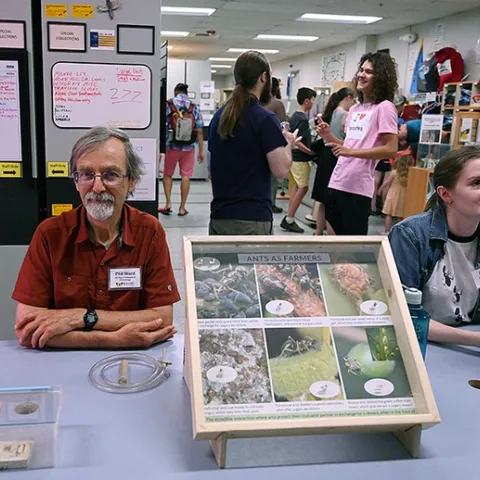
Professor Louie Yang in his Briggs Hall office, UC Davis Department of Entomology and Nematology. (Photo by Kathy Keatley Garvey)
Bug Squad: Article

Congratulations, UC Davis Professor Louie Yang: Outstanding Mentor

March 7, 2023
By Kathy Keatley Garvey
Congratulations to community ecologist Louie Yang, an innovative professor in the UC Davis Department of Entomology and Nematology, and the 2023 recipient of the Distinction in Student Mentoring Award, sponsored by the Pacific Branch, Entomological Society of America (PBESA).
View Article
Primary Image
UC Master Gardeners Mary Jo Corby and Barbara Siegel check plants before a past GTPS while other CoCoMGs set up. Photo by Fletcher Oakes.
UC Master Gardener Program of Contra Costa County: Article

Great Tomato Plant Sale 2023!

March 7, 2023
By Mary Jo Corby and Robin Moore Hello UC Master Gardeners, We are very excited to be back to in-person sales for both Walnut Creek and Richmond this year! The past two years sales have been online-only, and while many of our customers really enjoyed ordering their plants via the online system, we m...
View Article
Primary Image
Liz Rottger and Liv Imset work in the Pollinator Garden at the Water Conservation Garden. Photo by Fletcher Oakes.
UC Master Gardener Program of Contra Costa County: Article

If You Plant It, They Will Come

March 7, 2023
By Liz Rottger It was a late afternoon in early April 2022 when I arrived at Pacific Oaks Community Garden to pick up the gardens key. UC Master Gardeners finally had a formal agreement with the community garden to take over its operations.
View Article
Primary Image
A carpenter bee robs nectar from a California fuchsia, piercing the blossom at the base and drinking the nectar. Photo by JKehoe_Photos.
UC Master Gardener Program of Contra Costa County: Article

Plant California Fuchsias Now for Hummers, Bees, and Fall Color

March 7, 2023
By Robin Mitchell There are so many reasons to love California fuchsias! They are drought tolerant, fast-growing, small to mid-size perennials that deer generally find unpalatable. They are easy to grow, and they tolerate garden conditions well.
View Article
Primary Image
Roots Damaged by Alcohol. https://journals.ashs.org/horttech/view/journals/horttech/16/2/article-p294.xml
UC Master Gardener Program of Contra Costa County: Article

What is the Effect of Pouring Alcohol Into the Yard

March 7, 2023
By Terry Lippert Clients question: Can you tell me anything about pouring out old alcohol into the yard/garden/dirt? We have some cases of wine, champagne, & spirits. Terry Lipperts reply: Thank you for contacting our UC Master Gardener Help Desk.
View Article
UC Master Gardener Program of Contra Costa County: Article

Call before you dig?!

March 7, 2023
By Lisa Bramblet Yes, thats right. It's a good idea to find out what you may be digging into before you start. If your garden site has been occupied for 20+ years and there have been various projects conducted on the site (i.e.
View Article