A Natural Solution for California's Herds: African Catfish Peptides

California's cattle producers and agricultural communities are all too familiar with the rising challenge of antibiotic resistance, making common bacterial infections harder to treat in livestock. But imagine a future where we could tackle these infections with a natural, powerful alternative. Our research points to just that: antimicrobial peptides (AMPs) found in African catfish.

We're really excited about these peptides because African catfish thrive in pathogen-rich freshwater, naturally producing these robust immune compounds in their skin mucus as a defense. This natural origin makes them highly appealing alternatives to synthetic drugs.

Predicted Safety and Potent Action

One of the most compelling aspects of these AMPs is their predicted safety for mammals. Our initial computer analyses suggest that various catfish AMPs are generally recognized as safe (GRAS). We predict they'll be absorbed in the human intestine without causing liver, brain, or heart toxicity. Furthermore, lab tests on a promising peptide, NACAP-II, confirmed it was non-hemolytic, meaning it didn't damage rabbit red blood cells—a strong indicator of its potential safety for mammalian cells.

Beyond safety, these peptides demonstrate effectiveness against problematic bacteria. One study revealed NACAP-II's strong activity against Extended-Spectrum Beta-Lactamase (ESBL)-producing Escherichia coli—a critical concern for both animal and human health due to its resistance to many common antibiotics. Another peptide, ACAP-IV, also showed antibacterial activity against E. coli and Staphylococcus aureus. We believe these AMPs work by directly disrupting bacterial cell membranes, a mechanism that makes it harder for bacteria to develop resistance compared to how they resist traditional antibiotics.
Primary Image
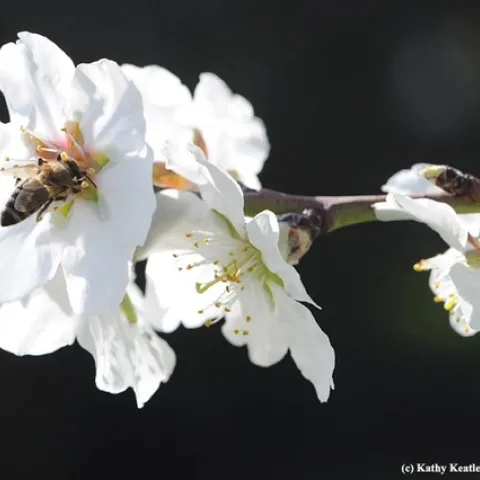
Honey bee pollinating an almond blossom. (Photo by Kathy Keatley Garvey)
Bug Squad: Article

Mid-Winter Beekeepers' Feast

December 1, 2014
By Kathy Keatley Garvey
"It is the middle of winter," writes Amina Harris, director of the UC Davis Honey and Pollination Center. "Pink and white buds are just peeking out on the burnished branches of the almond trees all over central California. It is just the beginning of spring.
View Article
Primary Image
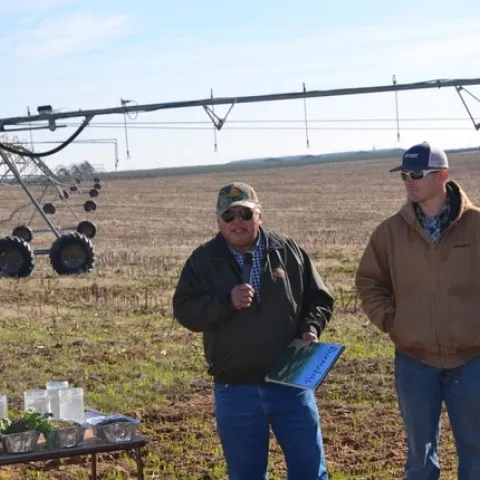
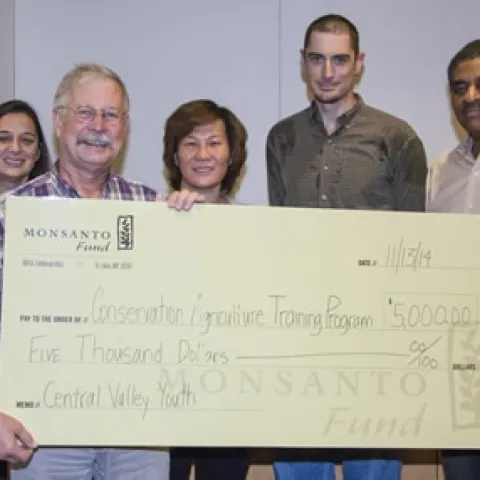
Jeff Mitchell receives $5,000 grant from Monsanto.
Conservation Agriculture: Article

Grant funds new high school ag sustainability courses

December 1, 2014
By Diana Nix
Plant Sciences' Jeff Mitchell received a $5,000 grant recently from the agricultural biotechnology company Monsanto to support a program of high school activities aimed at sustainability.
View Article
Primary Image
A Painted Lady (Vanessa cardui) nectaring on lantana on Black Friday. (Photo by Kathy Keatley Garvey)
Bug Squad: Article

Black Friday? No, Butterfly Friday

November 28, 2014
By Kathy Keatley Garvey
What did you do on Black Friday? Did you spend the night camped out in front of a store? Or did you join the throngs of people who left home in the wee hours of the morning for the doorbuster deals or stayed on your computer for the online onslaughts?
View Article
UC Weed Science (weed control, management, ecology, and minutia): Article

Pre-irrigation and weed control in melons

November 27, 2014
Irrigation is crucial for the production of melons in California. It facilitates seed germination, it is essential for crop growth and fruit production, and, for growers that apply pre-emergence herbicides, it is necessary for product activation.
View Article
Primary Image
On Thanksgiving, we're grateful we're not a bee, this bee. (Photo by Kathy Keatley Garvey)
Bug Squad: Article

We're Thankful We're Not a Bee

November 27, 2014
By Kathy Keatley Garvey
Today is Thanksgiving. As we give thanks and reflect on a day set aside to be grateful, we realize that not all is great in the world of haves and have-nots, the generous and the greedy, and troublemakers and peacemakers. Miscommunications turn into misunderstandings.
View Article
UC Weed Science (weed control, management, ecology, and minutia): Article

The evolution of weeds: De-domestication?

November 26, 2014
This blog was originally supposed to be an interesting article on Thanksgiving foods; specifically, a discussion about crops (i.e. squashes, onion, corn, carrots, parsnips, etc...) that traditionally accompany our Thursday turkey, as well as their weedy relatives.
View Article
Primary Image
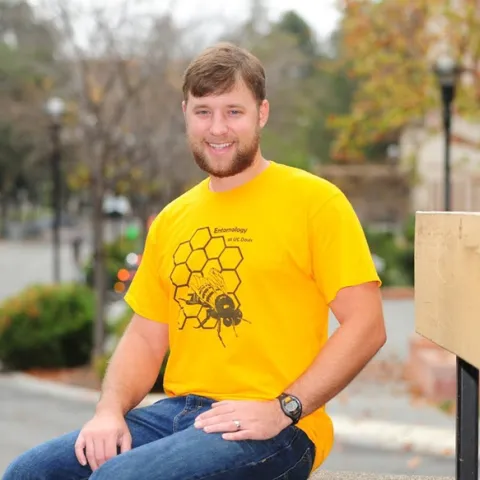
Graduate student Danny Klittich with his prize-winning design. (Photo by Kathy Keatley Garvey)
Bug Squad: Article

Winning T-Shirt Design Spotlights the Honey Bee

November 26, 2014
By Kathy Keatley Garvey
Apiculturists and beekeepers will love this T-shirt. So will anyone else who has an avid interest in honey bees, or even a passing interest. It's all the buzz.
View Article
Primary Image
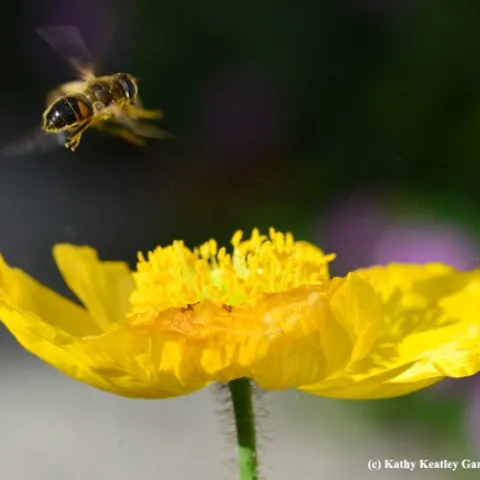
A drone fly, aka hover fly and syrphid fly, engaging in a little acrobatics over an Iceland poppy. (Photo by Kathy Keatley Garvey)
Bug Squad: Article

Drone Acrobatics

November 25, 2014
By Kathy Keatley Garvey
The drone fly, aka European hover fly, aka syrphid fly, doesn't get as much press as the other drone, the unmanned aircraft. But the drone fly (Eristalis tenax), about the size of a honey bee and often mistaken for a honey bee, makes for great in-flight photos.
View Article
Primary Image
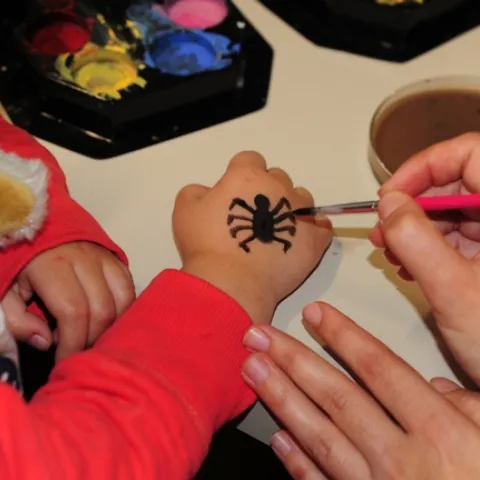
The beginning of a black widow spider tattoo, compliments of entomology Jessica Gillung of the Bohart. (Photo by Kathy Keatley Garvey)
Bug Squad: Article

Eighteen Myths About Insects and Spiders

November 24, 2014
By Kathy Keatley Garvey
Oh, the myths about insects and spiders! It was a fun and educational afternoon when the UC Davis Bohart Museum of Entomology hosted an open house last Sunday. Visitors checked out the displays, asked the entomologists and staff questions, and looked over the list of myths.
View Article