A Natural Solution for California's Herds: African Catfish Peptides

California's cattle producers and agricultural communities are all too familiar with the rising challenge of antibiotic resistance, making common bacterial infections harder to treat in livestock. But imagine a future where we could tackle these infections with a natural, powerful alternative. Our research points to just that: antimicrobial peptides (AMPs) found in African catfish.

We're really excited about these peptides because African catfish thrive in pathogen-rich freshwater, naturally producing these robust immune compounds in their skin mucus as a defense. This natural origin makes them highly appealing alternatives to synthetic drugs.

Predicted Safety and Potent Action

One of the most compelling aspects of these AMPs is their predicted safety for mammals. Our initial computer analyses suggest that various catfish AMPs are generally recognized as safe (GRAS). We predict they'll be absorbed in the human intestine without causing liver, brain, or heart toxicity. Furthermore, lab tests on a promising peptide, NACAP-II, confirmed it was non-hemolytic, meaning it didn't damage rabbit red blood cells—a strong indicator of its potential safety for mammalian cells.

Beyond safety, these peptides demonstrate effectiveness against problematic bacteria. One study revealed NACAP-II's strong activity against Extended-Spectrum Beta-Lactamase (ESBL)-producing Escherichia coli—a critical concern for both animal and human health due to its resistance to many common antibiotics. Another peptide, ACAP-IV, also showed antibacterial activity against E. coli and Staphylococcus aureus. We believe these AMPs work by directly disrupting bacterial cell membranes, a mechanism that makes it harder for bacteria to develop resistance compared to how they resist traditional antibiotics.
UC Weed Science (weed control, management, ecology, and minutia): Article

NEW PUBLICATION // Weed Pest Identification and Monitoring Cards

January 8, 2014
By Gale Perez
Based on the bestselling Weeds of California and Other Western States, the Weed Pest Identification and Monitoring Cards is the perfect pocket-sized companion for anyone working in the field. These 48 cards cover the most common weeds, grouped into 8 categories for easy identification.
View Article
Colusa County: Article

Tomato Production Meeting, 1/9/14 8:00-12:00 in Woodland

January 8, 2014
The South Sacramento Valley Processing Tomato Production Meeting will be held tomorrow, 1/9/2014 from 8AM to 12 noon at the Woodland Community Center (2001 East St., Woodland 95776). The agenda is attached along with PCA/CCA credit information.
View Article
Primary Image
image 20039
IGIS: Article

Dense cities contribute less GHG

January 8, 2014
By Maggi Kelly
A CoolClimate Map of the SF Bay Area's carbon footprint by zipcode tabulation area shows a pattern typical of large metropolitan areas: a small footprint (green) in the urban core but a large footprint (orange and red) in surrounding suburbs.
View Article
Primary Image
Bee breeder-geneticist Michael "Kim" Fondrk works the Page bees in a Dixon almond orchard. (Photo by Kathy Keatley Garvey)

It All Began at UC Davis

January 7, 2014
By Kathy Keatley Garvey
It all began at UC Davis. The highly acclaimed research published in Current Biology that cracked the 200-year secret of complementary sex determination in honey bees is rooted right here, right here at UC Davis. Arizona State University Provost Robert E. Page, Jr.
View Article
UC Weed Science (weed control, management, ecology, and minutia): Article

JOB OPENING // Pest Management Guidelines Coordinator

January 7, 2014
By Tunyalee Martin
Full-time position with UC IPM, located in Davis, CA: Senior Editor Pest Management Guidelines Coordinator Application instructions and a full position description are available on the UC Agriculture and Natural Resources employment web site (ucanr.edu/sites/anrstaff/Employment_Opportunities).
View Article
UC Weed Science (weed control, management, ecology, and minutia): Article

2013 Tulelake Onion Weed Control Study- Making the most with a limited toolbox

January 7, 2014
By Robert G Wilson
Happy New Year! Its too cold in Tulelake for field work, so Im busy summarizing 2013 research results. Today I posted a progress report on the Intermountain Research and Extension Center (IREC) website summarizing results for our 2013 onion weed control research.
View Article
Primary Image
A solo almond blossom blooming Jan. 5, 2014 in Benicia. (Photo by Kathy Keatley Garvey)

An Early Bloomer

January 6, 2014
By Kathy Keatley Garvey
You've heard of late bloomers. How about early bloomers? A trip to the Benica (Calif.) State Recreational Park on Sunday yielded quite a surprise: a solo blossom on a bare almond tree. Almonds don't usually start blooming until around Valentine's Day. Almonds are big business in California.
View Article
UC Weed Science (weed control, management, ecology, and minutia): Article

Melon Herbicide Trial 2013: Looking Back and Moving Forward

January 6, 2014
By Brad Hanson
Introduction: According to the most recent statistics, the United States (US) was the world's sixth largest producer of melons, with a significant proportion (>50%) of the country's production occurring in California.
View Article
Primary Image
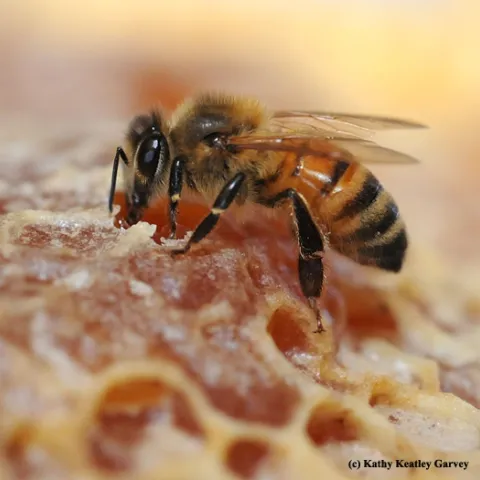
Bee on honey. (Photo by Kathy Keatley Garvey)

A Taste of Honey--and Mead....and That's Not All...

January 3, 2014
By Kathy Keatley Garvey
It's not just the taste of honey. It's the taste of honey AND mead--coupled with a gourmet dinner on the UC Davis campus. The UC Davis Honey and Pollination Center is sponsoring the Mid-Winter Beekeepers Feast: A Taste of Mead and Honey on Saturday, Feb. 8 from 6:30 to 9:30 p.m.
View Article