A Natural Solution for California's Herds: African Catfish Peptides

California's cattle producers and agricultural communities are all too familiar with the rising challenge of antibiotic resistance, making common bacterial infections harder to treat in livestock. But imagine a future where we could tackle these infections with a natural, powerful alternative. Our research points to just that: antimicrobial peptides (AMPs) found in African catfish.

We're really excited about these peptides because African catfish thrive in pathogen-rich freshwater, naturally producing these robust immune compounds in their skin mucus as a defense. This natural origin makes them highly appealing alternatives to synthetic drugs.

Predicted Safety and Potent Action

One of the most compelling aspects of these AMPs is their predicted safety for mammals. Our initial computer analyses suggest that various catfish AMPs are generally recognized as safe (GRAS). We predict they'll be absorbed in the human intestine without causing liver, brain, or heart toxicity. Furthermore, lab tests on a promising peptide, NACAP-II, confirmed it was non-hemolytic, meaning it didn't damage rabbit red blood cells—a strong indicator of its potential safety for mammalian cells.

Beyond safety, these peptides demonstrate effectiveness against problematic bacteria. One study revealed NACAP-II's strong activity against Extended-Spectrum Beta-Lactamase (ESBL)-producing Escherichia coli—a critical concern for both animal and human health due to its resistance to many common antibiotics. Another peptide, ACAP-IV, also showed antibacterial activity against E. coli and Staphylococcus aureus. We believe these AMPs work by directly disrupting bacterial cell membranes, a mechanism that makes it harder for bacteria to develop resistance compared to how they resist traditional antibiotics.
Cooperative Extension Ventura County: Article

April 2012 Clover Lines

April 2, 2012
In this issue... Volunteer Week, Ormond Pointe Walking Path Grand Opening, Super Field Day, Council Corner, All-Star Applicants Wanted, and much more.
View Article
Primary Image
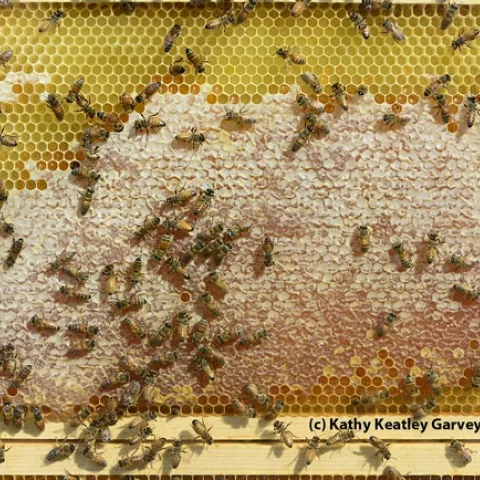
A thriving honey bee colony. (Photo by Kathy Keatley Garvey)

Neonics Creating Quite a Buzz

March 30, 2012
By Kathy Keatley Garvey
The neonicotinoid pesticides are creating quite a buzz in the bee world. Research published this week in the Science journal zeroed in on the effects of the neonics on honey bees and bumble bees.
View Article
Primary Image
View of the Davis Bee Sanctuary. (Photo by Kathy Keatley Garvey)

They Want the Weather to 'Bee Nice'

March 29, 2012
By Kathy Keatley Garvey
"The rain in Spain falls mainly in the plains, according to a signature song in the musical, My Fair Lady. Dont tell that to Derek Downey, who has been trying to schedule the grand opening of the Davis Bee Sanctuary now for the past two weeks.
View Article
Primary Image
Pollen-covered honey bee on brittlebush, Encelia californica (as identified by Ellen Zagory), in back of the UC Davis Lab Sciences Building. (Photo by Kathy Keatley Garvey)

Aloe, There!

March 28, 2012
By Kathy Keatley Garvey
Those attending the California Center for Urban Horticulture (CCUH) public workshop on "Your Sustainable Backyard: Pollinator Gardening" on Saturday, April 28 at the University of California, Davis, will, no doubt, leave with a better understanding of how we can all do our part to support healthy be...
View Article
Primary Image
Honey bee sipping honey in the Harry H. Laidlaw Jr. Honey Bee Research Facility, UC Davis. (Photo by Kathy Keatley Garvey)

A Taste of Honey

March 27, 2012
By Kathy Keatley Garvey
Honey! Today at the Harry H. Laidlaw Jr. Honey Bee Research Facility at the University of California, Davis, we borrowed a plastic spoon and offered a taste of honey to newly emerged honey bees. It was their sisters' making and now it was theirs. And soon, they will be making their own.
View Article
UC Weed Science (weed control, management, ecology, and minutia): Article

Roundup Ready Canola as a Weed

March 27, 2012
By Douglas Munier
Previously in this blog Brad Hanson discussed some of the research Kent Brittan (UCCE Yolo) and I have done with Roundup Ready canola as a crop and then evaluating it as a weed because of its seed dormancy characteristics.
View Article
Primary Image
Extension apiculturist Eric Mussen (left) of UC Davis with California State Beekeepers' Association president Bryan Ashurst of Westmorland. (Photo by Kathy Keatley Garvey)

Land of Milk and Honey

March 26, 2012
By Kathy Keatley Garvey
At the entrance, the recent California Agriculture Day celebration on the west lawn of the State Capitol looked like the land of milk and honey. The first booth, operated by the Dairy Council of California, handed out milk.
View Article