A Natural Solution for California's Herds: African Catfish Peptides

California's cattle producers and agricultural communities are all too familiar with the rising challenge of antibiotic resistance, making common bacterial infections harder to treat in livestock. But imagine a future where we could tackle these infections with a natural, powerful alternative. Our research points to just that: antimicrobial peptides (AMPs) found in African catfish.

We're really excited about these peptides because African catfish thrive in pathogen-rich freshwater, naturally producing these robust immune compounds in their skin mucus as a defense. This natural origin makes them highly appealing alternatives to synthetic drugs.

Predicted Safety and Potent Action

One of the most compelling aspects of these AMPs is their predicted safety for mammals. Our initial computer analyses suggest that various catfish AMPs are generally recognized as safe (GRAS). We predict they'll be absorbed in the human intestine without causing liver, brain, or heart toxicity. Furthermore, lab tests on a promising peptide, NACAP-II, confirmed it was non-hemolytic, meaning it didn't damage rabbit red blood cells—a strong indicator of its potential safety for mammalian cells.

Beyond safety, these peptides demonstrate effectiveness against problematic bacteria. One study revealed NACAP-II's strong activity against Extended-Spectrum Beta-Lactamase (ESBL)-producing Escherichia coli—a critical concern for both animal and human health due to its resistance to many common antibiotics. Another peptide, ACAP-IV, also showed antibacterial activity against E. coli and Staphylococcus aureus. We believe these AMPs work by directly disrupting bacterial cell membranes, a mechanism that makes it harder for bacteria to develop resistance compared to how they resist traditional antibiotics.
Colusa County: Article

April 2012

March 26, 2012
Poultry Fun Day, Camp Application Link, Fair News, Link to Scholarship, All Star and Merit Applications and more.
View Article
UC Weed Science (weed control, management, ecology, and minutia): Article

Video on Alternative Cultivators available

March 26, 2012
By Richard F Smith
A video entitled, "Alternative Cultivators for Organic Vegetable Production" is now available on YouTube.
View Article
Primary Image
Honey bee swarm in the North Hall/Dutton Hall complex at UC Davis. (Photo by Kathy Keatley Garvey)

Bee Swarm!

March 23, 2012
By Kathy Keatley Garvey
Bee swarms are absolutely fascinating. Several years ago, when bee breeder-geneticist Susan Cobey was teaching a queen- rearing class at the Harry H. Laidlaw Jr. Honey Bee Research Facility at UC Davis, her students received an extra bonus: they witnessed a bee swarm.
View Article
Primary Image
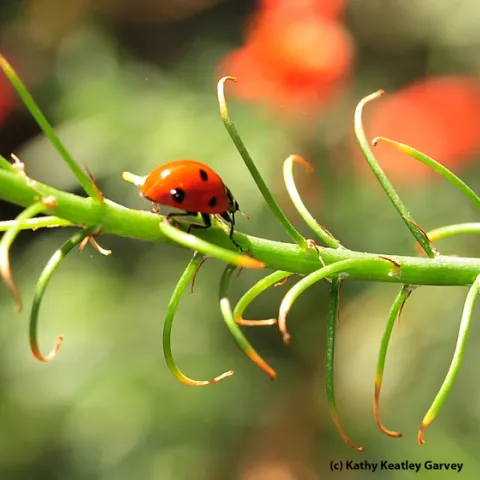
Ladybug devouring an aphid on a rose bush. (Photo by Kathy Keatley Garvey)

Ladies (and Men) in Red

March 22, 2012
By Kathy Keatley Garvey
Two ladybugs, aka lady beetles, circled their little house, a 1.5-inch plastic container punctured with air holes. Up. Down. Down. Up. In a way, they seemed like hamsters on a treadmill. I don't know how long they'd been in the container, but they were anxious to leave.
View Article
UC Weed Science (weed control, management, ecology, and minutia): Article

Methyl iodide (Midas) registration to be suspended in US market

March 22, 2012
By Brad Hanson
I just read about an interesting development in the methyl iodide (Midas) controversy - the fumigant is being pulled from US use by the manufacturer. While the decision is not altogether surprising in California, I admit that I didn't expect a US-wide registration withdrawel.
View Article
Primary Image
Count the insects! Ladybugs, a European paper wasp, blow fly and aphids are all over the fava beans in the Haagen-Dazs Honey Bee Haven. (Photo by Kathy Keatley Garvey)

Insect Diversity in the Fava Beans

March 21, 2012
By Kathy Keatley Garvey
The first day of spring--Tuesday, March 20--yielded a diversity of insects in the fava beans planted in the Hagen-Dazs Honey Bee Haven, a half-acre bee friendly garden adjacent to the Harry H. Laidlaw Jr. Honey Bee Research Facility on Bee Biology Road, University of California,Davis.
View Article
UC Weed Science (weed control, management, ecology, and minutia): Article

Sacramento Valley Walnut News (and weed management tools)

March 21, 2012
By Brad Hanson
The Spring 2012 edition of the Sacramento Valley Walnut News was recently made available at the Sutter-Yuba Cooperative Extension office. It's available here and is attached at the bottom of this post.
View Article
Primary Image
Derek Downey checks out a birdhouse filled with bees. The bees swarmed March 30 and are now established in a once-vacant bee box in the sanctuary. (Photo by Kathy Keatley Garvey)

Davis Bee Sanctuary: The Place to 'Bee'

March 20, 2012
By Kathy Keatley Garvey
(Note: Due to a forecast of heavy rain, the grand opening originally scheduled March 24 is now Saturday, March 31. The blog below reflects the change.) The Davis Bee Sanctuary is the place to "bee" on Saturday, March 31.
View Article
Primary Image
Airplane
UC Rice Blog: Article

Foundation Seed Available for 2012

March 20, 2012
By Luis Espino
Kent McKenzie, Rice Experiment Station (RES) Director, has announced that foundation rice seed produced in 2011 has been cleaned and sampled for germination and purity evaluations. The price of foundation seed will be $40.00 per cwt in 2012.
View Article