A Natural Solution for California's Herds: African Catfish Peptides

California's cattle producers and agricultural communities are all too familiar with the rising challenge of antibiotic resistance, making common bacterial infections harder to treat in livestock. But imagine a future where we could tackle these infections with a natural, powerful alternative. Our research points to just that: antimicrobial peptides (AMPs) found in African catfish.

We're really excited about these peptides because African catfish thrive in pathogen-rich freshwater, naturally producing these robust immune compounds in their skin mucus as a defense. This natural origin makes them highly appealing alternatives to synthetic drugs.

Predicted Safety and Potent Action

One of the most compelling aspects of these AMPs is their predicted safety for mammals. Our initial computer analyses suggest that various catfish AMPs are generally recognized as safe (GRAS). We predict they'll be absorbed in the human intestine without causing liver, brain, or heart toxicity. Furthermore, lab tests on a promising peptide, NACAP-II, confirmed it was non-hemolytic, meaning it didn't damage rabbit red blood cells—a strong indicator of its potential safety for mammalian cells.

Beyond safety, these peptides demonstrate effectiveness against problematic bacteria. One study revealed NACAP-II's strong activity against Extended-Spectrum Beta-Lactamase (ESBL)-producing Escherichia coli—a critical concern for both animal and human health due to its resistance to many common antibiotics. Another peptide, ACAP-IV, also showed antibacterial activity against E. coli and Staphylococcus aureus. We believe these AMPs work by directly disrupting bacterial cell membranes, a mechanism that makes it harder for bacteria to develop resistance compared to how they resist traditional antibiotics.

Primary Image
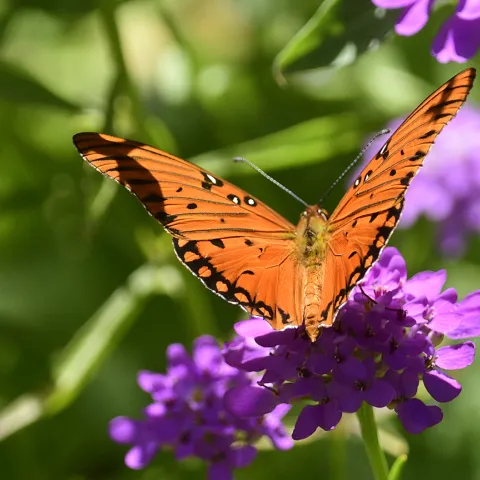
A Gulf Fritllary butterfly on a butterfly bush. (Photo by Kathy Keatley Garvey)
Bug Squad: Article

The Insects of Summer

June 25, 2025
By Kathy Keatley Garvey
 Some folks consider mosquitoes, flies and cockroaches and other pests as "the insects of summer."No, the "insects of summer" include a flame skimmer dragonfly perched on a bamboo stick, a honey bee foraging on a blanket flower, a lady beetle (aka ladybug) devouring aphids, and a Gulf Fritillary…
View Article
UCCE Livestock Antimicrobial Stewardship: Document

A Natural Solution for California's Herds: African Catfish Peptides

California's cattle producers and agricultural communities are all too familiar with the rising challenge of antibiotic resistance, making common bacterial infections harder to treat in livestock. But imagine a future where we could tackle these infections with a natural, powerful alternative. Our research…
View Document
Primary Image
Defoliation
UC Rice Blog: Article

Don't let your guard down against armyworms

June 25, 2025
By Luis Espino
I've been looking at some fields this week and I'm seeing high worm populations. These are fields where armyworms have been a problem in the past. I would say this year the numbers I am seeing are much higher than the last three years. In one field in particular, defoliation is close to threshold (25%). …
View Article
Primary Image
Photo of eucalypts on the Tasmania coast.
The Savvy Sage: Article

California Eucalypts: Should We Love Them or Hate them?

June 25, 2025
By Deborah Cunningham
 Article by Peg Smith - First a quick ramble through California’s history…Why does California history have anything to do with eucalypts? It gives perspective to the increasing human presence in California and an example of the subsequent effects and changes in original flora and fauna of…
View Article
UCCE Livestock Antimicrobial Stewardship: Page

Contact

18830 Road 112, Tulare, CA 93274(559) 688-1731vmtrc.ucdavis.edu
View Page
Primary Image
Controlled Burn Training
ANR Contracts & Grants Updates: Article

Cal Fire Wildfire Prevention Grants Program

June 25, 2025
By Kendra T Rose
The California Department of Forestry and Fire Protection (CAL FIRE) is now accepting proposals for its Wildfire Prevention Grants Program which funds local projects that focus on increasing the protection of people, structures, and communities. Activities include hazardous fuels reduction, wildfire…
View Article
IWP Training: Page

Provisioning Users to Your Group (Sites and Blogs)

Group Admins are the only users able to provision users for Group Types of Sites and Blogs.  Follow the steps below for adding access.  For more information on specific user permissions, please refer to the User Roles.1. Once logged into IWP and on your group, select Members tab. 2. On this…
View Page