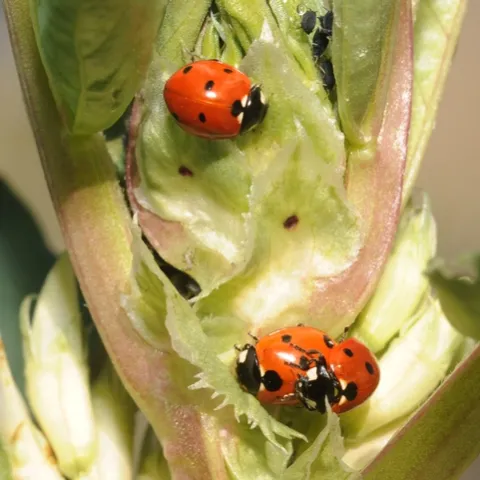
If you spot a ladybug, don't just start reciting "Ladybug, ladybug, fly away home." Aim, click and shoot. With a camera, that is. Agricultural Research Service scientists and entomologists at Cornell University, Ithaca, N.Y.
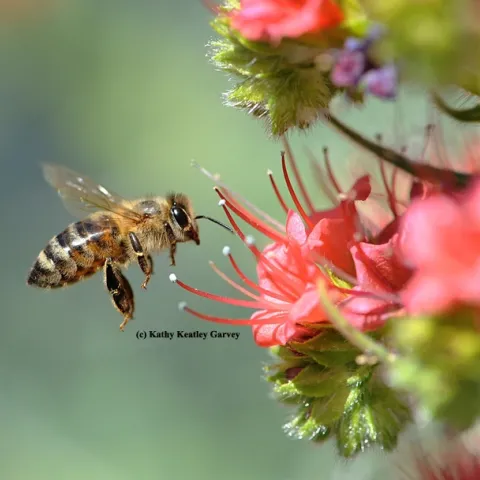
They danced in it, rolled in it, and bathed in it. The honey bees just couldn't get enough of the rock purslane (Calandrinia grandiflora). Last week when we visited Vacaville's El Rancho Nursery and Landscaping. nursery, owned by Ray and Maria Lopez, it was like a free-for-all at the French Laundry.
If you love pomegranates, you can thank a honey bee. If you love capturing images of pomegranates, you can thank a honey bee. And, if you love juicing them and making pomegranate jellyas I doyou can thank a honey bee. The honey bee makes it all possible.
So, you want to become an entomologist... Entomologists, future entomologists and others interested in science are looking forward to the fall seminars sponsored Oct. 1 through Dec. 3 by the Department of Entomology, University of California, Davis.
It's all about the bees. When A. G. Kawamura, secretary of the California Department of Food and Agriculture, and the newly selected State Apiary Board meet from 10 a.m. to 4 p.m. on Friday, Oct. 3 at the Harry H. Laidlaw Jr.
Quick! How long have insects inhabited this earth? If you're taking a biology or an entomology course, you'll be asked that question on an exam. If you're attending the Entomological Society of America conference Nov. 16-20 in Reno, you probably already know that. A good answer: 400 million years.
It's tough being a drone honey bee this time of year. The drones, or male bees, don't survive the winter. Bee breeder-geneticist Susan Cobey of the Harry H. Laidlaw Jr. Honey Bee Research Facility at UC Davis admits to having a soft spot for drones.
Ever wonder why the stink bug stinks? The stink bug, from the family Pentamodae, is a shield-shaped insect that tomato growers would love to ban from the face of this earth. Some 50 species exist in California. The adults are either brown or green. Most stink bugs are plant feeders.
Okay, everybody in the pool! That means bees, too? It does. Sweat bees. You may have noticed the tiny bees--common name sweat bees from the family Halictidae--in your swimming pool or pollinating your flowers. They're attracted to perspiring skin (thus the name sweat bees).
Some folks wear their heart on their sleeve. Others wear a dragonfly on their chest. As part of its public outreach education program and to showcase the world of insects, the Bohart Museum of Entomology at the University of California, Davis, has created t-shirts featuring a California dragonfly.