Ongoing research

Primary Image
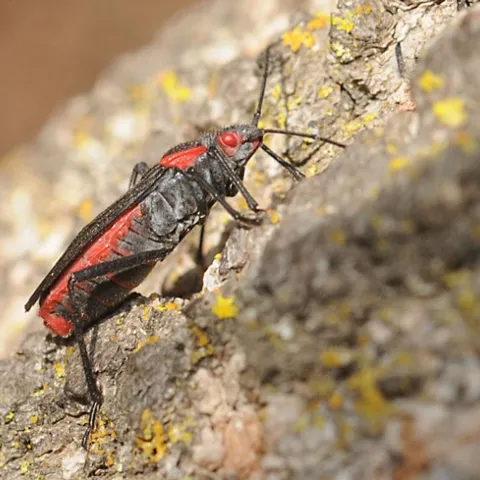
KATYDID foraging on a rose in a UC Davis rose garden. (Photo by Kathy Keatley Garvey)
Bug Squad: Article

Never Promised Her a Rose Garden

October 29, 2010
By Kathy Keatley Garvey
Up close, the katydid looks as ferocious as a scary Halloween trick-or-treater. Its stance is firm. Its eyes glow menacingly. Its attitude: "Don't mess with me." We spotted this katydid on a rose in a UC Davis rose garden.
View Article
Primary Image
BEE SCULPTURE, titled "Miss Bee Haven," graces the Haagen-Dazs Honey Bee Haven at the Harry H. Laidlaw Jr. Honey Bee Research Facility, UC Davis. It is the work of noted artist Donna Billick. The ceramic tiles on the bench and the bee hive columns (back) are the work of the UC Davis Art/Science Fusion Program. (Photo by Kathy Keatley Garvey)
Bug Squad: Article

Tribute to the Bees

October 28, 2010
By Kathy Keatley Garvey
A gigantic bee sculpture and bee hive columns are major attractions at the Hagen-Dazs Honey Bee Haven at the Harry H. Laidlaw Jr. Honey Bee Research Facility at the University of the California, Davis. The grand opening of the half-acre bee friendly garden took place Sept.
View Article
Primary Image
PURPLE ASTERS bloom brilliantly at the Harry H. Laidlaw Jr. Honey Bee Research Facility at the University of California, Davis. In the back are the bee boxes. (Photo by Kathy Keatley Garvey)
Bug Squad: Article

Gearing Up for Winter

October 27, 2010
By Kathy Keatley Garvey
There's a magnificent purple aster blooming in the bee yard at the Harry H. Laidlaw Jr. Honey Bee Research Facility, University of California, Davis. The aster, a late-bloomer, makes for a picture-perfect apiary scene...white bee boxes in the background...purple aster in the foreground...
View Article
Conservation Agriculture: Article

Nominate no-till farmers for 'Responsible Nutrient' award

October 27, 2010
By Jeannette Warnert
Frank Lessiter, editor of No-till Farmer, announced that the magazine is seeking nominations for the third class of no-tillers to be named "Responsible Nutrient Management Practitioners." Winners will be honored at the 19th annual National No-Tillage Conference in Cincinnati, Ohio.
View Article
Primary Image
A HONEY BEE, resting in the folds of a rose, appears to be playing hide and seek with another insect. Those antennae belong to a spotted cucumber beetle. (Photo by Kathy Keatley Garvey)
Bug Squad: Article

Stop and Smell the Roses

October 26, 2010
By Kathy Keatley Garvey
Do bees stop and smell the roses? Maybe. Honey bees gather nectar and pollen from a variety of flowers, including their favorites, the salvias, mints and lavenders. They also forage on wild roses, but usually not on commercially grown roses.
View Article
Primary Image
TINY walnut twig beetle, in association with a fungus, is wreaking havoc on black walnut trees. It's found in California, seven western states and now Tennessee. (Photo by Kathy Keatley Garvey)
Bug Squad: Article

Beetles, Termites, Mites and More!

October 25, 2010
By Kathy Keatley Garvey
When the Northern California Entomology Society meets Thursday, Nov. 4, the menu will include walnut twig beetles, mites, drywood termites and Oriental fruit moth parasitoids. And also barbecued marinated ball tip and chicken quarters with barbecued beans and salad.
View Article
Primary Image
IPM SPECIALIST Frank Zalom checks out an almond tree. He was just named the 2010 recipient of the "Award for Excellence in Integrated Pest Management" from the Entomological Society of America. (Photo by Kathy Keatley Garvey)
Bug Squad: Article

Our IPM Expert

October 22, 2010
By Kathy Keatley Garvey
Good news. Integrated pest management specialist Frank Zalom (right), professor of entomology at UC Davis, is the 2010 recipient of the "Award for Excellence in Integrated Pest Management from the Entomological Society of America (ESA), a 6000-member worldwide organization.
View Article
Primary Image
EYESPOTS on the wings of a buckeye butterfly. (Photo by Kathy Keatley Garvey)
Bug Squad: Article

The Eyes Have It

October 21, 2010
By Kathy Keatley Garvey
The eyespots--they're almost hypnotic. And that's what makes the buckeye butterfly (Junonia coenia) so easily recognizable--the bold pattern of eyespots on the wings, bold enough to startle and scare away prey. This buckeye (below) fluttered along the grounds of the Harry H. Laidlaw Jr.
View Article