Ongoing research

Primary Image
ORB WEAVER at work. The end product is nature's lace and an engineering feat, and, if she's lucky, a feast tonight. (Photo by Kathy Keatley Garvey)
Bug Squad: Article

Nature's Lace

August 5, 2009
By Kathy Keatley Garvey
A spider web is nature's lace, a symmetrical work of wonder. Well, a sticky, deadly trap if you're an insect. Then you become just another tasty morsel for the predacious, albeit artistic, spider.
View Article
Primary Image
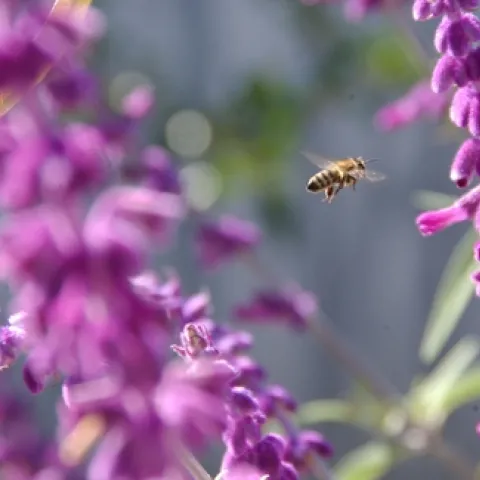
MALE CARPENTER BEE, Xylocopata tabaniformis orpifex, robbing nectar from sage. (Photo by Kathy Keatley Garvey)
Bug Squad: Article

Catching up with the Carpenters

August 4, 2009
By Kathy Keatley Garvey
Catching up with the carpenters is not always easy. Not the construction workers--the carpenter bees. They move fast as they buzz from flower to flower. California is home to three carpenter bee species, says native pollinator specialist Robbin Thorp, emeritus professor of entomology at UC Davis.
View Article
Primary Image
BUMBLE BEE (Bombus bifarious) nectaring coastal goldfields at Bodega Bay. This species is the second most common bumble bee species at Bodega Bay. This is a worker or female. (Photo by Kathy Keatley Garvey)

Bumble Bees at Bodega Bay

August 3, 2009
By Kathy Keatley Garvey
Thars gold in them thar hills. And also bumble bees. If you visit the Sonoma County coastal town of Bodega Bay, and drive up to Bodega Head overlooking the ocean, youll see a carpet of gold flowers known as coastal goldfields or Lasthenia minor.
View Article
Primary Image
CLASSIC RETINUE--A queen bee is surrounded by her royal attendants--the retinue. (Photo courtesy of Susan Cobey, Harry H. Laidlaw Jr. Honey Bee Research Facility, UC Davis)
Bug Squad: Article

Hail to the Queen

July 31, 2009
By Kathy Keatley Garvey
Oh, to be a queen bee... Her Royal Highness (HRH) is quite pampered. She's always surrounded by her royal attendants, called the retinue. They tend to her every need. They feed and groom her. They keep her warm or cool, depending on the temperature inside the hive.
View Article
Colusa County: Article

July 2009

July 31, 2009
Panicle initiation and differentiation, herbicide programs for resistant late watergrass, managing nitrogen fertilization for early season drains...
View Article
Primary Image
CABBAGE WHITE BUTTERFLY(Pieris rapae) nectars catmint. (Photo by Kathy Keatley Garvey)
Bug Squad: Article

Lady in White

July 30, 2009
By Kathy Keatley Garvey
The cabbage white butterfly (Pieris rapae) looks like a Lady in White when she perches on catmint. The colors are striking: A long, flowing white gown nestled among the rich lavender blossoms and earthy green leaves.
View Article
Primary Image
ZAIN SYED, chemical ecologist at UC Davis, holds a bag of 2000 Culex mosquitoes he trapped between Davis and West Sacramento. He is using them for his research. (Photo by Kathy Keatley Garvey)
Bug Squad: Article

Mosquito Heaven

July 29, 2009
By Kathy Keatley Garvey
Chemical ecologist Zain Syed of the Walter Leal lab, University of California, Davis, knows just where to find mosquitoes for his research. Rice fields. He's been collecting up to 3000 mosquitoes a night along the Yolo Causeway, located on Interstate 80 between Davis and West Sacramento.
View Article
Primary Image
This 14-million-old fossil, unearthed in Nevada, is a honey bee, proving that North America did have a honey bee before colonists brought the European honey bee here in 1622. (Photo courtesy of Michael Engle)
Bug Squad: Article

First Native American Honey Bee

July 28, 2009
By Kathy Keatley Garvey
Amazing. An article posted on the ScienceNews Web site today indicates that North America did, too, have a honey bee. For nearly 400 years, we've been told that the honey bee (genus Apis) did not exist on this continent until 1622. That's when the colonists brought it over from Europe.
View Article
Primary Image
BLOOD-FED MOSQUITO--Culex quinquefasicatus after feeding on a non-treated DEET arm in the lab of chemical ecologist Walter Leal, UC Davis Department of Entomology. (Photo by Kathy Keatley Garvey)
Bug Squad: Article

Skeeter Season

July 27, 2009
By Kathy Keatley Garvey
Camping season is upon us, and with it came the news of California's first confirmed human case of West Nile virus (WNV). The San Diego County Health and Human Services Agency (HHSA) announced today that a 76-year-old man contracted WNV, but "he did not acquire the virus locally.
View Article
Primary Image
NATIVE BEE, a sweat bee (Halictus ligatus) nectars Agapanthus. This is a ground-nesting bee. (Photo by Kathy Keatley Garvey)
Bug Squad: Article

Ogling the Agapanthus

July 24, 2009
By Kathy Keatley Garvey
Seems like many folks assume that all bees are "honey bees." They're not. If you look around you, you'll see bees of all shapes, colors and sizes nectaring flowers.
View Article