

2024 Blackeye Bean Regional Variety Trial Results
Academics invited to see demo of iThenticate on May 21 at 2 pm
Use passive and active protection strategies to safeguard your home from wildfires
Marin no longer has a “fire season.” Like many other areas, our fire season is now year-round due to climate change and other factors.
Southern California’s recent horrific fires underscore the urgent need to make our gardens ready for wildfire. “Create passive protection by careful garden design, and actively maintain your landscape. These strategies will make your property fire adapted, helping your home survive a wildfire,” recommends Kathleen Cutter, UC Marin Master Gardener co-lead of the Fire-smart Landscaping Team and Marin Wildfire’s Senior Wildfire Mitigation Specialist.
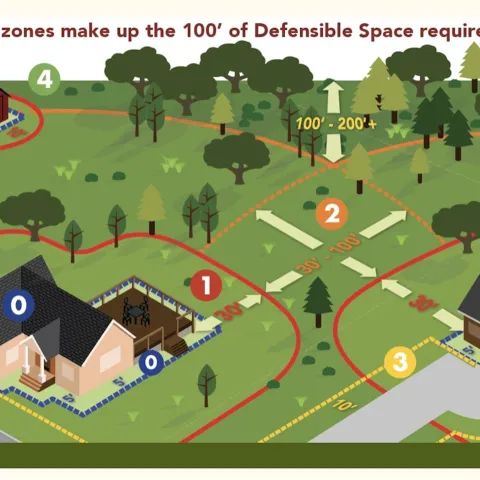
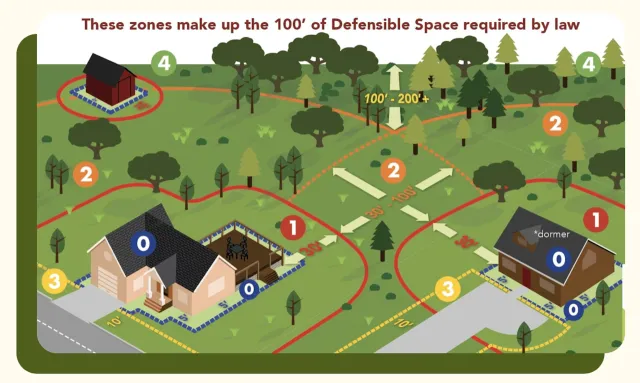
Passive protection means using thoughtful design. Start with the three defensible space zones and work out from your house (and other structures, including attached decks):
- Zone 0, 0’-5’ from your house: Your goal is no combustibles, which is best practice because “60-90% of homes ignite from embers,” says Ms. Cutter. Removing organic materials, or combustibles, on the ground in the first 5’ perimeter around your home “eliminates the receptive ember bed, increasing the chance your house will survive a wildfire.” (Your roof and gutter must also be free of leaves and other debris.) Use inorganic mulch (rock, gravel, pebbles); eliminate all plants; remove all other combustibles (e.g., firewood, garbage bins, wicker furniture, cushions, propane tanks). Trim tree limbs 10’ from your chimney and 5’ from your roof.
- Zone 1, 5’-30’ from your house: Your goal is to keep fire from spreading from plant to plant. Group plants in islands separated by fuel breaks such as hardscape, dirt, rock swales or seating areas. Trees should be 18’ apart. Create space for firefighters to defend your home.
- Zone 2, 30’ and beyond: Again, group plants in islands. Keep native grasses well hydrated and no higher than 4”. Limb up trees (6’-10’ from the ground, or 1/3 the tree's height). Keep tree canopies 12’ apart to prevent fire from jumping from tree to tree.
Plant choice is also critical. Look for plants with an open structure so embers fall through the canopy to the ground instead of igniting the plant. Densely structured plants (e.g., juniper, Italian cypress) trap embers and contain dead material inside, making them easier to ignite. Choose plants that are low growing and slow spreading for easier maintenance. Good choices are plants with minimal shedding to reduce debris (avoid bamboo and eucalyptus) and those with needles or feather-like leaves. Plants with high moisture content, such as succulents or with wide leaves, are good choices. Marin fire departments recommend avoiding plants with high resin or volatile oils because they may be more likely to ignite. Don’t overcrowd plants; consider a plant’s size at maturity before purchasing.
Active protection means consistently maintaining your plants and landscape. Visualize how a wildfire would travel through your garden, and then take steps to help prevent or slow it:
- Check the condition of your plants: Be sure they are well hydrated, remove all dead plants, and prune out dead materials. Larger plants should be further away from your house; Ms. Cutter recommends that “the closer to the house, the lower the plant.”
- Avoid tightly structured plants which hold debris and dead materials.
- Remove ladder fuels to prevent wildfires from spreading up from the ground into vegetation and then into tree canopies.
- If you have hedges, prune them to open them up and remove dead material inside.
Slopes present unique challenges. Flames travel uphill more quickly, preheating the vegetation above, making it more likely to ignite. More separation is needed between plants on hillsides. You can also install a low wall (stucco, rock) to act as a fuel break and deflect heat.
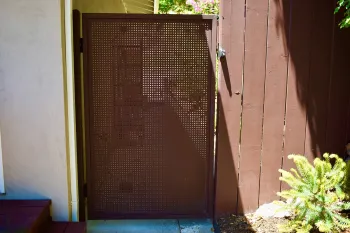
Finally, consider your privacy without increasing risk. Avoid a continuous line of plants that would act as a fire conveyor. Stagger plants and install noncombustible fence panels (metal, stone, stucco) between plants. Install non-wood fencing in the last 5’ from structures.
Now is the time to create passive and active protection to make your property fire adapted and help your home survive wildfires throughout the entire year. To learn more about Fire-smart Landscaping, please visit https://marinmg.ucanr.edu/BASICS/FIRESMARTLANDSCAPING/.
By Julie McMillan, May 3, 2025

