vegetables
UC Marin Master Gardeners

Maintenance

How to Maintain an Edible Garden

Image
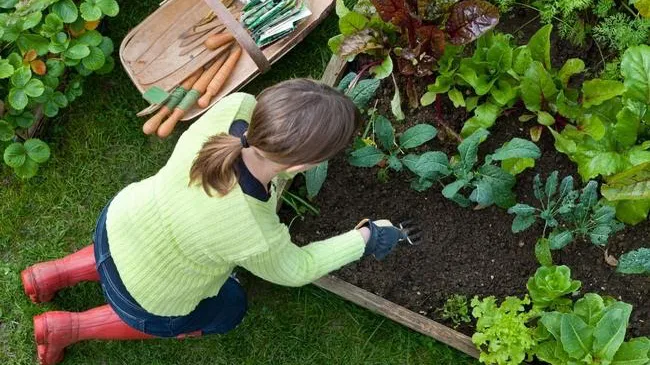
Monitor the garden for pests and diseases as you maintain it. Photo: Courtesy UC Regents

Once the fruit trees, berries, herbs and vegetables are planted, the magic begins. Even seasoned gardeners marvel at how the seed becomes the plant that produces a vegetable that appears on a plate. But abundant growth and harvest don’t "just happen." To have a successful edible garden, a gardener must be a midwife, a caregiver, and a coaxer. Here's how to care for your edible garden.
 

Ongoing maintenance

• Spend time in the vegetable garden. Become an astute observer. Look for signs of trouble, such as wilting or eaten leaves or stunted growth. 
• Monitor for pests.
• Monitor for disease.
• Check soil for moisture.
• Keep vertical plants supported.
• Taste for ripeness and harvest when just right.
• Pull weeds.
• Replenish mulch.
• Check irrigation and adjust as the season progresses.
• Add plant waste to the compost pile. 
Prune fruit trees.

Recommended: keep a garden journal to chronicle your successes and learning moments.


Monthly reminders

Use this Edible Garden Monthly Planting and Maintenance Schedule to keep your garden in tip top shape all year. 

> MONTHLY PLANTING & MAINTENANCE 
 

BACK TO EDIBLES
> What Edible Gardens Need
> Best Choices for Marin
> How to Prepare
> How to Plant
> Edibles in Containers
> Planting Calendar
> Grow & Care Sheets for Vegetables, Herbs & Fruits
> Tips & Techniques
> How to Maintain
> Fruit Trees
> Top 20 Edible Garden Problems
> Cover Crops & Soil Enhancements in the Off-season
> Conserving Water

•••••••••

Visit our EDIBLE DEMO GARDEN at IVC Organic Farm & Garden


Primary Image
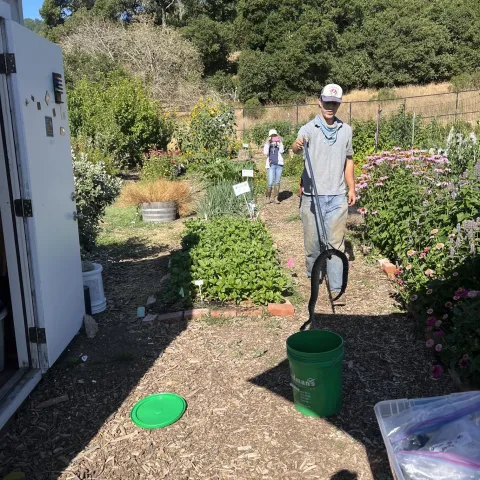
snake being captured and placed in a bucket
UC Marin Master Gardeners: Article

This is an Active Rattlesnake Year. Take Precautions.

July 20, 2026
While the main focus of the EDG (Edible Demonstration Garden) is growing edibles and sharing that knowledge with the public, we cannot forget the health and safety of our gardeners.Rattlesnakes have been particularly active this year with daily sightings all over the farm and in the EDG.  Protective…
View Article

Ergodynamic Hügelkultur at the Edible Demonstration Garden

Primary Image
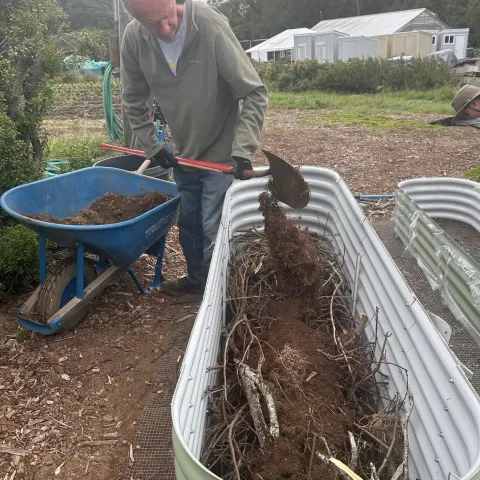
filling raised bed with sticks on the bottom and soil on top
Body

At the EDG Row 1 and 2 are closest to the hedge that is home to rabbits, squirrels, quail and numerous other creatures that love to devour our crops. Our tried and true methods for protecting our tender seedlings with hardware mesh on the bottom and protective netting on the top have been regularly defeated. 

So this spring we installed 4 new raised beds in row 1 & 2. All are 7 feet long by 2 feet wide. Two of them are 15 inches high and two of them are 29 inches high. We are looking forward to planting in these without having to get down on our hands and knees or bed over. 24-36 inches is recommended as the best height for raised beds.  And the 2 foot wide width eliminates back issues when reach across the bed. 

But a lot of soil is required for the tall beds, specifically 8 cubic feet.  We used a modifed form of  Hugelkulture  and filled the bottom half with sticks and branches that had recently been cut from the orchard on the farm.  For the two tall raised beds they each required 4 wheel barrels of native soil, 4 wheel barrels of  young compost and 4 wheel barrels of finished compost.  Thank you Eric D and Vanessa L for taking the lead. 

We may still have to use protective netting to keep the birds out, depending on the crop, but hopefully all the critters that live in the hedge next door won’t be able to easily get access.    

Article by Jean Christofferson

UC Marin Master Gardeners
Primary Image
A harvest of crisp, bright green lettuce is satisfying anytime of the year
UC Marin Master Gardeners: Article

Growing Lettuce Year-Round

December 3, 2025
Lettuce is generally considered to be a cool-season annual, but with a little advanced planning and some judicious plant selection, Marin gardeners can enjoy home-grown lettuce throughout the year. Our temperate climate makes it possible to modify the growing conditions for lettuce and enable the plants to…
View Article
Primary Image
Bank vole
UC Marin Master Gardeners: Article

July 2025: Vole Invasion

July 16, 2025
July 2025: Vole Invasion Protecting the growing plants from hungry critters is an ongoing challenge in the Edible Demo Garden. Wire mesh is used extensively under planting beds and around the straw bales to discourage gophers. Yards of protective netting keep the birds and rabbits from eating young…
View Article
Primary Image
Patio gardening
UC Marin Master Gardeners: Article

June 2025: Patio Gardening

May 26, 2025
By Melissa McLean
 This past month EDG volunteers created a small “patio” in the garden to demonstrate how edibles can be successfully grown in limited space. Too often gardeners are discouraged from growing edibles, believing that it takes a large back yard with room for long rows of plants. However, with the…
View Article
Primary Image
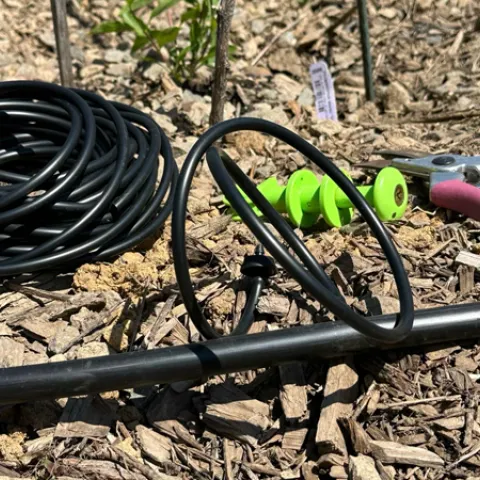
Plastic tubbing of drip irrigation system
UC Marin Master Gardeners: Article

May 2025: Drip Irrigation Troubleshooting

April 29, 2025
By Melissa McLean
 When the winter rains end, it’s time for gardeners to focus on providing spring and summer edibles with the water they need to grow and produce. While hand watering may be the simplest way to adjust watering to the needs of individual plants, it’s not the most efficient means for getting the right…
View Article

April 2025: The Joys of Selecting and Planting Seeds

Primary Image
Seed packets
Body
Image
Seed packets
Selecting from the many varieties of certified organic seeds is part of the fun in planning a summer garden.

It’s hard to find a gardener who doesn’t love checking out new seed varieties and anticipating the abundant and tasty harvest they promise. The photos and descriptions are tantalizing and the names intriguing. Who wouldn’t be curious about a pumpkin variety called ‘Abominable’, a pepper named ‘Frodo’, or a tomato tagged ‘Dancing with Smurfs’?  With so many seed varieties to select from, narrowing down the choices can be challenging. In January this year, a team of EDG volunteers had a lot of fun picking out varieties for our spring and summer crops.

How Seeds are Selected

Seed selection starts with a garden plan, taking into consideration the space available for each type of crop. Once decisions are made about which crops to plant and where to plant them, choosing the right varieties becomes the focus. The Demo Garden is the perfect place to try out some of those new and different seed options while continuing to plant those varieties that have proven to be reliable. Planting more than one variety of each crop makes it possible to directly compare them in terms of growth and productivity.

Time to maturity is important in determining which summer crop varieties to plant. The soil must be consistently warm (over 55 degrees) for the time specified in the variety description to produce a crop. The climate in the Indian Valley Organic Farm and Garden where the Edible Demo Garden is located provides a long enough growing time for most summer crops. However, varieties requiring more than 120 days to maturity may not achieve full production before the weather turns cool.

Seeds planted in the Edible Demo Garden must be organic certified. Organic seeds are from plants grown in compliance with federal standards which exclude the use of synthetic fertilizers, pesticides, and genetically modified technologies. Seed choices for the Demo Garden are often based on the descriptions provided by organic seed companies and it’s up to the volunteers to determine which varieties seem well suited for the garden conditions and promise the best taste.

Planting the Seeds
Planting seeds in seed flats
Seeds are planted in flats filled with starting soil mix. Vermiculite is added on top to control moisture.

On February 27th, the new MMG training class got hand-on practice in seed starting. Seeds are planted in a starting soil mix in flats of cells with 2 or 3 seeds per cell. Supervised by EDG volunteers, the trainees planted 60 cells of cucumbers (‘Armenian’, ‘Crystal Apple’, ‘Jin Yang’ and ‘Early Fortune’) and 90 cells of sweet peppers (‘Pusztagold’ and ‘Bacskai Feher’), along with 30 cells of green onions and 72 cells of lettuce. The class will have the chance to take some of the cucumber and pepper starts home to plant in their own gardens where they can assess how well they grow in our different microclimates. The planted seeds are now germinating in the greenhouse.

Seed flats in greenhouse
The controlled light, moisture, and heat in the greenhouse provides the perfect environment for the seeds to germinate.

Starting plants in the greenhouse gives them an advantage and allows better timing for optimum crop production. They are not ready for transplanting outside until they have developed at least one set of true leaves. The first set of leaves to appear are embryonic leaves called cotyledons. They look different from the plant’s typical foliage. True leaves are the more recognizable leaves that develop above the cotyledons. The time required for seedlings to be ready for transplanting varies. Beans can be ready in 3 to 4 weeks while peppers can take more than 8 weeks.

New Varieties in the Demo Garden
Sprouted seedlings
Seedlings are nurtured in the greenhouse until they develop at least one set of true leaves.

EDG volunteers look forward to growing the new seed varieties they have selected for the summer. The seeds have been ordered but not all have been planted. ‘Dancing with Smurfs’, an indigo-colored cherry tomato, along with ‘Altai Orange’ and ‘Woodstock’ are among the new tomato varieties. Two new melon varieties, ‘Sweet Freckles’ and ‘Farthest North Galia’ will be tried in the garden. The ‘Pusztagold’, and ‘Bacskai Feher’ peppers, now germinating in the greenhouse, are small, sweet Hungarian type peppers. Last summer’s pepper crop included an overabundance of hot peppers, so it’s sweet peppers in demand this year.

Starting with seeds is rewarding. There is the pleasure of choosing seeds from the many available varieties and the joy of nurturing them and watching them grow into tiny plants. It’s even better when the veggies and fruits turn out to be as yummy as the seed descriptions promise.


Click here for more information on planting from seeds.

UC Marin Master Gardeners

February 2025: Choosing the Right Garden Tools

Primary Image
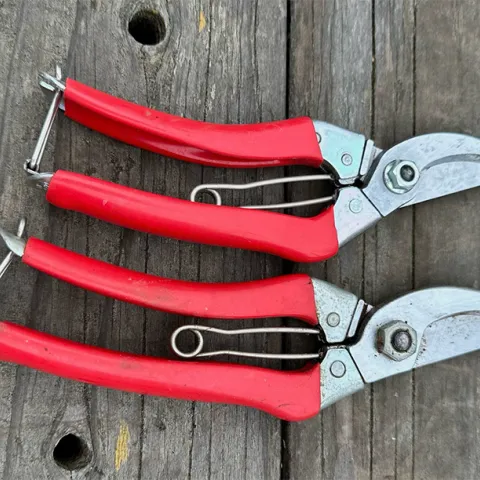
There are many choices in by-pass pruners with models that fit different hand sizes.
Body

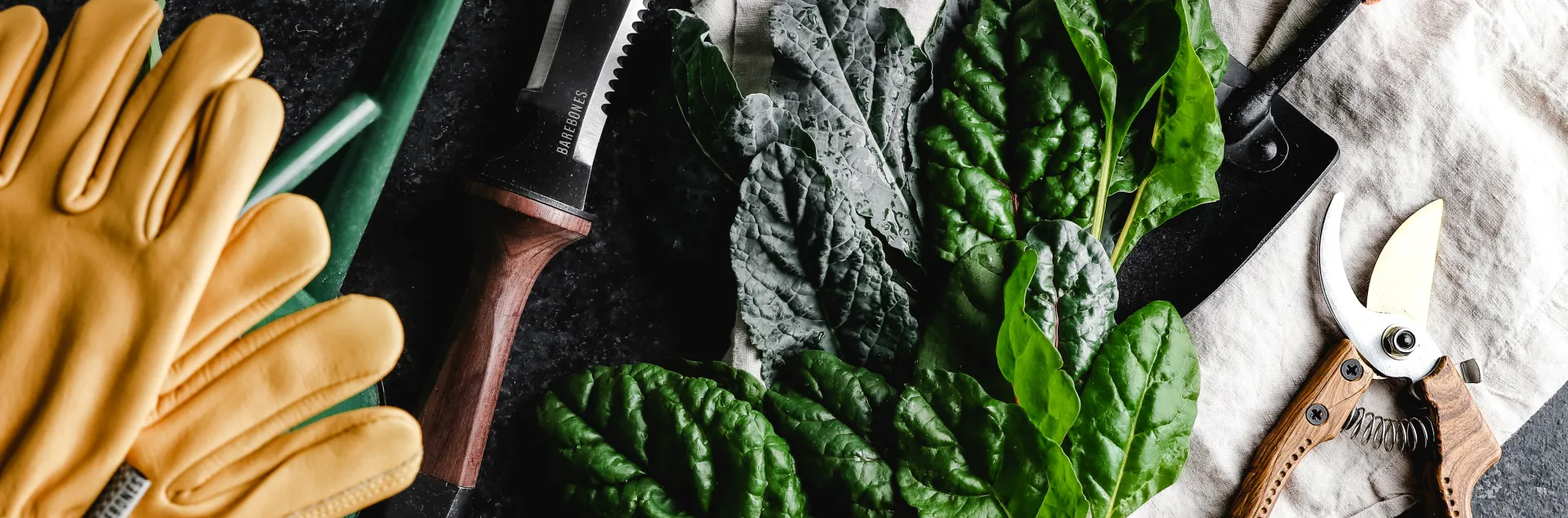
In January, the 2025 Marin Master Gardener training class was welcomed into the Edible Demonstration Garden for a discussion and demonstration on the use and care of garden tools. The right tools make the difference between gardening that is pleasurable and gardening that is a struggle. Your first experience with a garden tool might have been that pointed stick you used when digging in the dirt as a child. Now as a gardener, you are presented with an array of better tool choices, some essential for basic garden work and some designed for specific tasks. There are tools for pruning, tools for digging, tools for raking, and tools to make gardening easier. Here are some of the more popular tools in those categories.


Pruning Tools
  • Tools 1

    Hand pruners are the favorite tool for most home gardeners. They are the tools used most often for cutting and thinning small branches to maintain plant health and appearance. They are also used for cutting flowers and harvesting vegetables. By-pass pruners, which work like scissors, are best for making clean cuts on living plants. Anvil pruners crush branch tissue and are good for removing and cutting up dead branches.

  • Pruning saws are used to remove branches larger than what hand pruners can remove. They can have a fixed or folding blade.
  • Loppers are long-handled by-pass pruners that can help access higher and hard to reach branches. The long handles also provide leverage to enable pruning thicker branches.


Digging Tools
  • Tools 2

    Trowels are essential for digging, planting, potting, and weeding. A trowel is a spade-shaped hand tool with a slightly scooped blade.

  • Garden knives are a type of trowel with a sharp narrow blade and a pointed end. One blade edge is usually serrated. Hori-Hori garden knives are a Japanese design that has proven to be so useful for digging and weeding that the name is often applied to any type of garden knife.
  • Shovels and spades are long-handled digging and soil lifting tools with the shape of blade and the length of the handle determining their particular uses.


Raking Tools
  • Rakes are useful for cleaning up leaves, removing debris, and spreading out soil amendments like compost and mulch. Hand rakes are great for getting into small spaces. Rakes with flexible, fan-shaped tines work well for cleaning up lighter debris and are sometimes called leaf rakes. Garden rakes have larger stiff metal tines and are intended for heavier use in soil or larger debris.
  • Forks are used for raking out stones and weeds. Like a dinner fork, a garden fork has four strong tines which can push easily into the ground and enable it to double as a digging tool for loosening and turning over the soil.


Gardening Comfort Tools
  • Tools 3

    Gloves provide the hand protection every gardener needs. They are a barrier against pricks, cuts, abrasions, blisters, insect bites, and other skin irritations. While most gardeners don’t mind getting their hands dirty, getting jabbed with a nasty thorn is not only painful, but it can also lead to serious infections. There are many types of gloves to choose from depending on the type of protection required. Most important is that they fit well and are comfortable to wear.

  • Kneelers cushions protect the knees when planting, weeding, and performing other low to ground garden tasks. Kneelers made of rectangular shaped heavy foam are the simplest type. However, kneelers with handles that are lightweight and easy to fold up can make the up and down movements around the garden easier. Some even flip over to form a bench.
  • Ergonomically modified tools can help gardeners get more done with less effort by enabling good body alignment and reducing joint strain. Grips should be comfortable to hold and keep hands and wrists in natural positions. Handles should be the right length to enable good posture without excessive bending and twisting.


Tool Care

Tools need to be kept clean, sharpened, in good repair, and organized to keep them working well. Surface dirt and dried sap should be brushed or washed off after each use. Periodically applying a light layer of oil will reduce rust. Pruners need regular sharpening and should be sanitized with a 10% bleach solution following contact with diseased plant material. Storing tools in dry place where they can be easily accessed will ensure they are ready for work when you are.


Click here to learn more about choosing and caring for garden tools.

UC Marin Master Gardeners
Primary Image
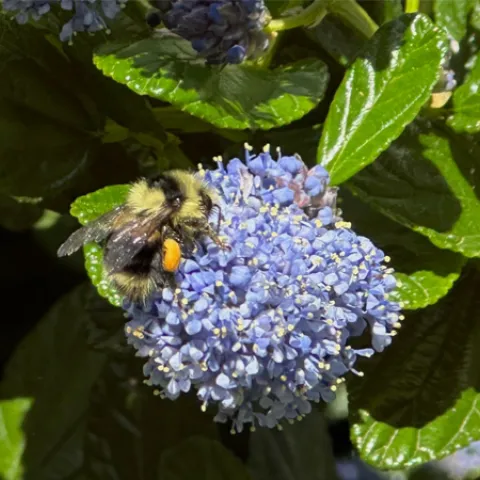
Ceanothus blossoms attract native California bumble bees.
UC Marin Master Gardeners: Article

January 2025: Natives in the Edible Garden

December 19, 2024
Natives are welcome in the Edible Demo Garden. As a joint project with the Native Plant Guild in October 2021, garden volunteers planted a variety of sun-loving, drought-tolerant California natives in a corner of the garden area...
View Article
Primary Image
Fava beans are an attractive and popular cover crop due to their nitrogen-fixing effects in the soil. Photo: Flickr
UC Marin Master Gardeners: Article

December 2024: Giving the Garden a Rest

November 22, 2024
After an especially busy summer and fall harvest season, it was time to consider what to plant next in the Edible Demo Garden. In Marin its possible to grow vegetables year-round, however...
View Article