
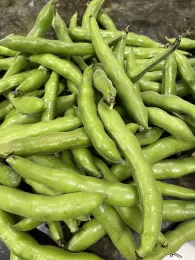
Fava beans (Vicia faba), sometimes called broad beans, grow well as a cool season crop in Santa Clara County. (Most other beans require warm weather.) Favas are also often grown as a cover crop because of their ability to add nitrogen to the soil.
Fava beans come in a range of sizes. The large-seeded varieties are generally the ones planted for eating. Favas grow on sturdy stalks and do not need supports, although you may want to corral tall stalks to keep them from leaning out into pathways.
Warning: Some people have a hereditary enzyme deficiency which can cause a severe reaction, called favism, to fava beans or pollen. According to the National Library of Medicine, the deficiency is more common in people of African, Mediterranean, or Asian descent.
Fava Beans, UC ANR Small Farms Network
Planting
- For producing pods to eat, direct seed 3 to 5 inches apart in February or in August to September, possibly into October depending on your microclimate. Thin to 8 to 10 inches apart.
- As a cover crop, favas can be planted at any time of year (though with no expectation of pod production). See Fava Bean Growing Guide for more details on optimum nitrogen production.
Harvesting
- Harvest pods for fresh shelling when beans are plump and the pods are green, thick, and have a glossy sheen. Fall-planted beans typically begin producing in early spring. February-planted beans will typically produce in late spring.
- Pods can also be harvested when small for eating whole.
- For dried beans, leave pods on stalks until dried, then shell.
- As a cover crop, cut down stalks when flowers appear, then chop up and dig into the soil.
Pest management
The most common pest for favas are aphids which typically appear as the weather warms in the spring. A wide variety of beneficial insects such as lady beetle larva and parasitic wasps often show up quickly to feast on them.
More links
- Fava Bean Growing Guide
- Video: Using a Cover Crop [2:56]
Recommended varieties for Santa Clara County*
| Robin Hood | Compact plants, produce well |
| Vroma | Tall plants, very productive, high nitrogen fixation as cover crop |
| Windsor | Classic variety |
* Many other varieties may also do well here in Santa Clara County. This list is based on UC Master Gardener trials, taste tests, and feedback from local growers.