
Every gardener knows that healthy soil is the foundation of successful gardening. But what exactly is soil, how do we know if it’s healthy and what can we do to cultivate healthy soil to ensure our plants will thrive?
What is Healthy Soil?
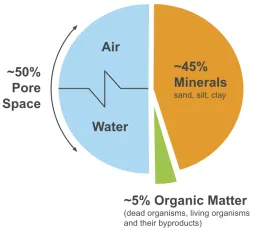
The ideal soil composition includes Minerals (~45%), Pore Space for Air and Water (~50%), and Organic Matter (~5%).
Minerals: The soil under our feet is ancient. It developed over geologic time. The parent rock was weathered and broken down by the elements into various sizes: boulders, then gravels and ultimately into finer particles of sand, silt and clay.
Air and Water: The microbial community and plant community are continuously changing the soil, organic matter builds in the soil over time due to plants and microbes. With plants and microbial life soil develops structure so air and water can move into the soil via pore space. Even though organic matter accounts for a small percentage, it is key to healthy soil.
Organic Matter: Microbes produce glues that bind the sand, silt, clay and organic matter together to form aggregates, which look like pebbles. When a soil is well aggregated it is said to have good soil structure. Soil that has good structure will feel spongy when you walk on it.
Soil Texture vs. Soil Structure
Soil structure and soil texture are often confused or used interchangeably but they are very different. Soil texture is the percentage of sand, silt and clay in your soil. Soil Structure is built by the microbial community. Bacteria in the soil glue the sand, silt, clay and organic matter together to form granules that look like pea gravel. Fungi help by weaving the granules together into aggregates, larger clumps of soil.
As a gardener there is little you can do about your soil texture, but there is so much you can do to support the development of soil structure in your garden. To ensure good biological soil structure, keep your soil protected from the sun, wind and rain with plants, mulch bare ground, define walkways, limit biocides and synthetic fertilizers and let the microbial community, with the support of plants, build soil structure.
You cannot practically change your soil texture because you would have to add so much sand, silt or clay to make a significant change in the texture of your soil. That change would only be relevant for the area that you incorporated the sand, silt or clay into. The good news is regardless of your soil texture you can open up the soil and have better drainage by adding organic matter to the soil.
- See Basic Soil Maintenance to learn more about ways to build your soil structure.
Our native soils are wonderful. California soils are young and contain most of the elements plants need. However, if you have soil compaction, very sandy soil or clay soil, you may feel discouraged. But do not despair. If you have compacted soil or sandy soil or clay soil, the addition of compost makes all the difference.
- Learn how Composting and Vermicomposting helps supply your soil with organic matter
Plants are Chemists
Photosynthesis

One cannot overemphasize the importance of photosynthesis. Life on earth is wholly dependent upon this process. Everything that any organism consumes is a direct or indirect result of photosynthesis. The process of photosynthesis drives plant development. It produces glucose, which along with water, minerals and other nutrients from the soil allows the plants to grow roots, stems and leaves, and produce flowers, fruits and seeds. Sugars are released from the roots into the soil feeding the microbial community and building carbon in the soil. Without photosynthesis, there would be no life on earth.
Soil pH
Soil pH is simply the relative acidity or alkalinity of the soil and the pH scale runs from 0 (highly acidic) to 14 (highly alkaline). Soil pH affects nutrient availability, each nutrient has an availability profile that is pH dependent.
- A pH between 6-7 allows most plants access to the essential elements they need to thrive.
- Applications of compost over time will bring many soils to a neutral pH of 6-7.
- Before adding lime or sulfur to adjust your pH, be sure to test for pH imbalances.
- Learn more about Soil Tests to Evaluate your Soil.
The Nitrogen Cycle

Nitrogen is a primary nutrient for plants. The earth’s atmosphere is approximately 78% nitrogen, but ironically plants cannot utilize this nitrogen. Atmospheric nitrogen needs to be processed by microbes into a form that plants can utilize. The nitrogen cycle is the rotation of nitrogen through various chemical forms that transforms the atmospheric form of this element, which plants cannot use, into nitrogen containing molecules that plants can utilize.
The addition of nitrate-based chemical fertilizers is detrimental to the soil life that supports the remainder of the nitrogen cycle, and is thus damaging to the entire soil food web. This is why it is so important to use organic fertilizers which feed all the soil life, rather than chemical or inorganic fertilizer, which has the very narrow activity of primarily feeding plants directly.
Nutrient Uptake
A variety of nutrients are required for the proper growth, development and productivity of plants. These nutrients can be classified as primary, secondary and micronutrients according to the amount of each nutrient a plant requires. The primary nutrients are carbon, hydrogen, oxygen, nitrogen, phosphorus, and potassium. Secondary nutrients include sulfur, calcium, magnesium. The micronutrients are: iron, manganese, boron, nickel, chlorine, copper, zinc and molybdenum. It is important to understand that all of these nutrients are required and thus are essential. Plant nutrients can reside in the air and in a variety of locations in the soil, such as: the water in pore spaces, bound to soil particles, in soil organic material or the bodies of soil organisms, and within the parent rock material.
Consider the nutrients that are naturally available in the soil to inform which plants will do well there. Edgewood Park in San Mateo County is an example of serpentine soil. Serpentine soils are low in nitrogen, phosphorus, potassium and calcium. They are high in nickel, chromium and cobalt. A native plant community has evolved to thrive within these conditions.
Watch Nutrient Cycling | Soil Food Web School (3:13), to learn how nutrients are cycled in the soil.
Microbial Community
Soil is full of microbial life – bacteria, fungi, protozoa, nematodes, earthworms, small and large insects and the roots of living plants. Some microbial organisms form relationships with plant roots. Plants feed microbes and microbes feed plants. In this process soil structure is built.
It is said that there are more soil microorganisms in a teaspoon of healthy soil than there are people on the earth. These microorganisms are constantly at work in our soil - decomposing, eating and being eaten among other functions.
Healthy soil depends on this interconnected ecosystem.
The Soil Food Web
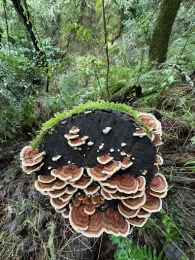
The soil food web plays a major role in cycling nutrients, building soil structure, and providing good water holding capacity.
As the sun shines down on the plants, plants use the energy from the sun to convert carbon dioxide into sugars. Some of the sugars are released through their roots as exudates. The bacteria and fungi feed on those exudates, as well as organic matter that is decomposing. Then predators, such as nematodes and protozoa, feed on the bacteria and fungi, which in turn get eaten by larger organisms.
When predators eat, they use the nutrients that their bodies need to survive and the excess is excreted into the soil, in a form that plants can consume. Imagine removing any one of these puzzle pieces, – suddenly the web falls out of balance with excesses in some places or deficiencies in others.
When all the parts of the soil food web are present and functioning properly, your plants will be healthy as they are fed the nutrients they need to thrive, and will be resistant to pests and disease.
Caring for Our Soil
Soil can be a reservoir for water when it is alive with microbial life. Healthy soil forms aggregates, water can easily move into the soil, be held in pore spaces and move underground recharging aquifers. Mulch and plant cover support living soil structure by protecting the soil from the drying effects of the sun, erosion from wind and compaction and erosion from rain. Our gardening practices make a big difference to the health of the soil. Frequent tilling breaks down soil aggregates, creating compaction so water and air cannot easily move into the soil. The simple practice of keeping the soil covered with a thin layer of compost and a cover of woody mulch or leaves will support microbial life in the soil and the plants in your garden.
Soil that is alive is open, water can infiltrate, move into the soil, be held in pores within the soil and move deeper down into the soil recharging aquifers.
When we till the soil we break up the soil aggregates. While a one time incorporation of organic matter into the soil can be helpful, if the soil is tilled on a regular basis it can lead to a compaction layer deeper in the soil. Repeated tilling will break down soil aggregates making it harder for air and water to move into the soil.
- Discover what you can do for Basic Soil Maintenance.
A mulch and plant cover protects the soil from the sun, wind and rain. If the soil is not protected by mulch and plant cover, then the sun will dry out the soil, the wind will blow dry soil away, rain falling on bare ground will compact the soil. Over time organic matter is lost, the soil becomes compacted and water runs off taking sand, silt and clay with it.
- Learn more about how to Address Common Soil Questions.
Header image courtesy of Pixabay. All images used with permission.