
It’s May and for many of us, our thoughts turn to gardening. If you’re looking for information about plants and planting — it’s everywhere! Everyone, it seems, has a special method or novel way to achieve amazing results! with plants. All of this information can be difficult to navigate and some of it won’t be good. As UC Master Gardeners, our mission is to help people in our communities garden successfully and sustainably by providing science-based information. In the course of our work, we frequently encounter misinformation and myths that need busting. Here is the second round of commonly held but mistaken beliefs gathered from my UC Master Gardener colleagues. Find out why they don’t work and what you can do instead.
Myth: “Drought tolerant plants don’t need to be watered.”
Fact: “Drought tolerant” doesn’t mean “drought proof” or “zero water.” Even the toughest plants require regular water until the root system is established, which is usually for the first year or so. After that, the amount of moisture needed for growth and maintenance will vary according to the plant and overall conditions in its location. In general, and with climate change pushing average temperatures higher, drought tolerant plants in the landscape (including California natives) will need deep supplemental watering once or twice per month. Providing a layer of mulch around drought tolerant plants will help preserve moisture, keep soil temperatures lower and add organic material to the soil.
Succulents can also fall victim to the idea that certain plants can exist without irrigation. Although they do have the unique ability to store moisture in their leaves, they do need some supplemental water. Make sure drainage is adequate and then, depending on variety, weather and location, give them a drink every 7-10 days.
Myth: “To loosen clay soil and improve drainage, add sand.”
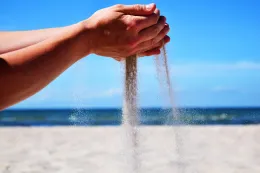
Fact: It’s a good idea--but only if you want to end up with concrete! This myth probably originated because clay soil particles are small and want to stick together vs. sand particles which are large and loose. One might think the problem could be fixed by mixing them together, but it will only make things worse. Here’s why: when sand is mixed with clay soil, the sticky clay particles fill in the spaces between the sand and bind everything together, making for very dense soil. It’s very similar to what happens when cement is mixed with gravel. More bad news: attempting to break up the soil by rototilling or other means will remove air pockets and make it even denser.
What to do instead? Add plenty of organic matter (compost, mulches) on a regular basis and let the microbes do their work. You can work it in lightly with a fork or simply layer it on top. This will improve both the drainage of clay soil and moisture retaining capacity of sandy soil while providing nutrients to the plants.
Myth: “Use coffee grounds to acidify the soil.”
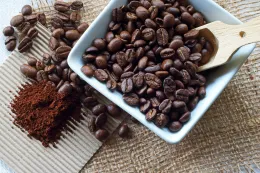
Fact: Coffee grounds are often added to garden soil because it is believed to be good for acid loving plants like blueberries and azaleas. Although using coffee grounds in the garden can be beneficial, soil pH will not be affected. Why? The coffee beans you grind to make your daily cup are considered acidic with a pH range between 4.85 and 5.10, but once brewed, the spent grounds are neutral in pH, between 6.5-6.8 and will do nothing to lower the pH of the soil. (Neither will dried pine needles!)
Acid-loving plants aside, coffee grounds contain only minor amounts of nutrients that plants require and putting them straight into the garden can cause several problems. First: uncomposted grounds will temporarily rob nitrogen from the soil (and your plants) as they break down. Second: any caffeine left in the grounds after brewing will suppress germination and slow the growth of young plants. Third: if spread too thickly, straight coffee grounds can form a compact layer that will interfere with water penetration and create other related problems. To avoid this problem, spread grounds thinly or mix with leaves or other organic material before applying to the garden.
Overall, coffee grounds are best at improving soil because they provide food for soil microbes. The best option by far is to compost them before adding them to your garden. Mixed with other organic materials, including paper coffee filters, they will decompose readily and be ready to do good things.
Myth: “Topping trees is a good way to control growth and make them easier to maintain.”

Fact: It’s a sight akin to a tragic haircut on a human but for a tree, the damage done by having its top cut off is far more than cosmetic. Topping is counterproductive and sets off a very unfortunate chain reaction.
“Tree topping” (also known as “hat-racking,” “heading,” “rounding over” and “tipping”) is the practice of cutting off the top of a tree to reduce its height. It is commonly done when trees grow so tall that they interfere with utility lines, block views and sunlight or pose a hazard to nearby structures. This method of height reduction is easier and cheaper than selective pruning so it might seem like an attractive choice. Sadly, it’s not and will end up costing a lot more in the long run.
Here’s what happens:
-Removing a significant portion of a mature tree’s canopy reduces its ability to manufacture food, thus starving the tree which weakens its roots and makes the tree less stable.
-Once topped, the tree sends out fast growing shoots or “suckers.” These are easily mistaken as a sign that the tree has been “invigorated,” but the new growth is weak and more susceptible to damage from weather, disease and insects. The tree will quickly reach its pre-topped height (requiring more “trimming”) but will never regain its natural shape and will become more susceptible to storm damage.
-Large pruning wounds created by “topping” do not heal over effectively and become entry points for decay, thereby diminishing the long-term health of the tree.
How can this be avoided?
By far the best way to have safe, healthy, beautiful trees is to choose the right tree in the first place. The size of the tree when it is fully mature should always be considered when choosing a location and trees should be pruned when they are young to assure a healthy shape as they grow.
For existing trees, there are alternatives to topping that will accomplish size reduction and other improvements but the work must be carried out by qualified professionals. Before hiring anyone to work on your trees, check their credentials and ask if they do tree topping. If the answer is, “yes,” keep looking!
If you see topping being carried out on public property, speak to local government representatives about the dangers of “topping.”
In case you missed it, see: Great Gardening Myths: Part 1
Do you have a piece of gardening advice you’d like to check out? Ask us! Contact the UC Master Helpline for all your gardening questions:
https://ucanr.edu/site/mgsmsf/ask-master-gardener
To learn more about tree topping:
https://ucanr.edu/sites/default/files/2016-08/246184.pdf
For more on soil: https://ucanr.edu/sites/default/files/2013-07/117122.pdf
For more on spring gardening https://ucanr.edu/site/mgsmsf/season-spring-your-garden
Author: Maggie Mah
Maggie Mah is a UC Master Gardener of San Mateo and San Francisco Counties.
UC Master Gardeners of San Mateo-San Francisco County are volunteers who are trained under the auspices of the University of California to provide science-based information on plants, horticulture, soil, and pest management at no charge to the public. For more information and to find out about classes and events in your area, visit our website where you can also sign up for our newsletter and contact our Helpline: https://ucanr.edu/site/mgsmsf