
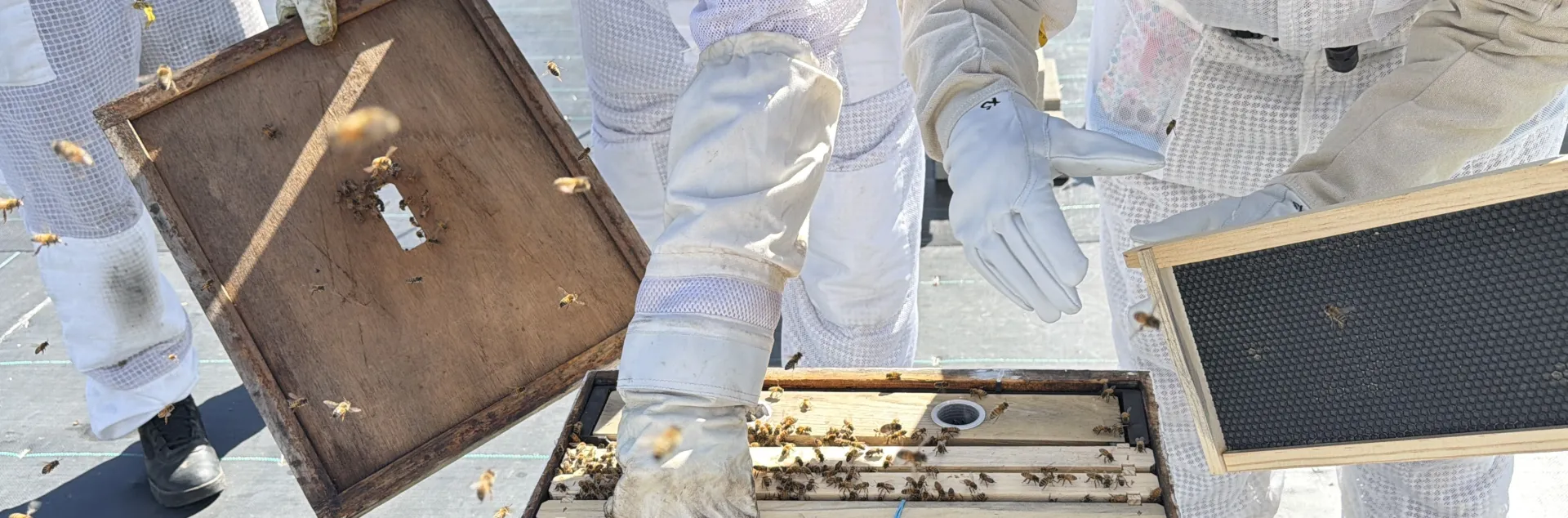
The buzzing starts before the box is opened.
In front of me, a colony of more than 12,000 bees moves without pause. I’m fully suited in protective gear, following each instruction carefully. There’s little room to speak — only to observe, listen and learn.
Entering the bees’ space
Before we begin, there are clear rules
“You never work in front of the hive entrance,” says Karine Pouliquen, a volunteer leader and educator with the California Master Beekeeper Program at UC ANR’s South Coast Research and Extension Center. She has more than two decades of experience working with bees.
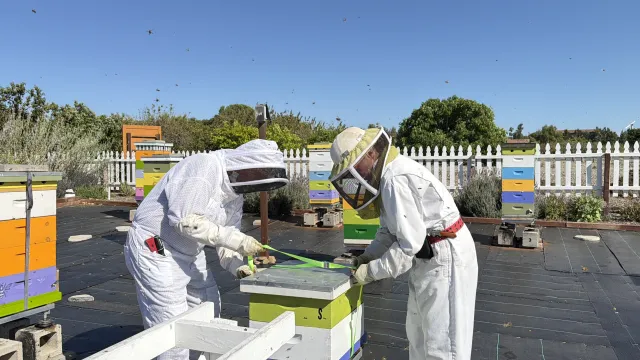
That space is the bees’ flight path — their constant route in and out of the hive. Interrupting it can disrupt their behavior and put people at risk.
Every step matters.
A queen not yet part of the colony
The queen arrives in a small cage. She is not related to the more than 12,000 bees in the colony, making her introduction a delicate process.
These colonies are transported in “packages.” Although the queen has spent several days with them during transit — about four days — her acceptance is not guaranteed.
The future of the hive depends on it.
Keeping her alive
Before anything else, there is one essential instruction: keep the queen warm.
She is carefully placed in a pocket—the safest place to avoid being crushed. Before that, her handlers make sure she is alive. It’s a simple step, but a critical one.
Opening the box
The next step is releasing the bees into the hive.
A container of syrup — their food during transport — is removed, and then the box is opened.
“They’re going to fly. Don’t be afraid.”
And they do.
Thousands of bees fill the air, circling the space. The buzzing is constant, enveloping. For a moment, everything seems to move at once.
I feel disoriented, but not afraid.
At one point, Lindsey Pedroncelli, interim director of the South Coast Research and Extension Center, asks if I’ve done this before. I tell her no. She says she has done it several times — and that she finds the sound surprisingly calming.
The instinct is to react. But the instruction is clear: stay calm. Breathe. Step back if needed.
An organized and delicate system
The queen is not released directly into the hive.
Inside her cage is a sugar plug — known as “candy” — that allows worker bees to release her gradually from the outside. The process can take hours, giving the colony time to recognize her scent and accept her.
Even here, details are critical.
The cage must be placed upright. If it becomes blocked — for example, by dead bees inside — the queen may not be able to get out.
She doesn’t free herself.
The other bees release her, slowly.
Management, science and community
At this teaching apiary, hives are more than a source of honey — they are a tool for learning.
Training happens in the field.
During the session, Pedroncelli helps place the bee packages into the hive, a key step before introducing the queen. Among the group, one volunteer is experiencing it for the first time. The mix of nerves and focus is a reminder that spaces like this serve as an entry point for new beekeepers.
Pouliquen leads the session, guiding each step. There are also decisions to make: in a teaching apiary, some colonies can become defensive, requiring intervention to keep the group safe.
“We’re all volunteers,” someone says.
The work is not just technical. It is shared.
More than an experience
Introducing a new queen is not routine. It typically happens once a year and requires preparation, knowledge and coordination.
When it’s over, the buzzing remains.
But it no longer sounds like noise.
It becomes a system — complex, organized, purposeful — where each bee plays a role.
What comes next
Once the queen is established, the colony’s work continues.
Bees leave the hive to gather nectar and pollen. Inside, that nectar is transformed into honey — the result of a collective process carried out by thousands of bees working together.
Bringing science to the community
Experiences like this are part of UC ANR’s effort to connect science with the community through hands-on learning.
But beyond the process, something else becomes clear.
The buzzing doesn’t stop.
Inside the hive, a new queen begins to shape the future of thousands of bees. Outside, the movement continues — steady, precise.
And for a moment, watching that balance — so fragile, yet so organized — changes how you understand what it means to care and to belong.