

Advice to Grow By
UC Master Gardeners of San Diego County
Hotline (858) 822-6910
www.MasterGardenerSD.org
What's Special About Butterflies?
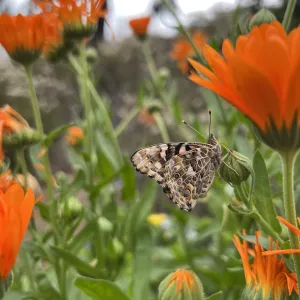
Credit: Joelle Kohn
- Pollinators are critical to our landscape, food supply and economy.
- Pollinators include: Birds, bats, bees, butterflies, beetles, and other small mammals that spread pollen within a plant or plant to plan, and help plants reproduce themselves and produce food for others.
- Pollinators are responsible for bringing us one out of every three bites of food.
- Pollinators also sustain our ecosystems and agricultural economies.
- Our food supply and surrounding landscapes would collapse without the actions of pollinators.
How Can I Help?
- Understanding the life cycle, needs andthreats is key to preserving and protecting pollinators.
Major Threats
- Major threats to all pollinators include:
- Habitat degradation and loss
- Non-native species and diseases
- Pollution
- Pesticides
- Climate change
Butterfly Facts
- Butterflies belong to the order Lepidoptera. In Latin, Lepidoptera literally means ‘scale wings’, referring to the minute
scale-like structures on the wings of both butterflies and moths. - There are about 18,000 known species of butterflies, worldwide.
- Weight: 0.0001 ounce for the smallest to 0.1 ounce for the largest.
- Size: Butterflies range in size from 0.5 inch to almost 12 inches.
- Smallest - the Blue Pygmy has a wingspan of just over 0.5 inch.
- Largest - New Guinea’s Queen Alexandra's Birdwing, measures up to 12 inches.
- Groups of butterflies are called a ‘flutter’.
- "Puddle clubs" are groups of butterflies that gather at mud puddles to suck up minerals and nutrients.
- The state insect of California is the Dogface Butterfly (Zerene euryidice).
Full List of San Diego County Butterflies
https://www.sdnhm.org/science/entomology/SDbutterflies.html Click on “Checklist of Butterflies of San Diego County” link at bottom of page.
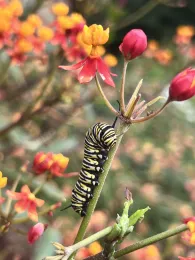
Credit: Joelle Kohn
Habits and Habitats
- Butterflies are cold-blooded. Hot or warm climates provide the best conditions for them to thrive. Butterflies cannot fly if their body temperature is below 86 degrees F.
- Antarctica is the only continent on which no butterflies have been found.
- A caterpillar’s first meal is its own eggshell. It will next eat the leaves of the plant on which it was hatched. This is called the “host” or larval plant.
- An adult butterfly uncoils its long, straw-like proboscis to sip nectar from flowers, juice from rotting fruit and water from puddles.
- Many butterflies can taste with their feet. They do this to find out whether the leaf they are on is good for laying eggs and is a good source of food for caterpillars.
- Butterflies have their skeletons on the outside of their bodies, called the exoskeleton. It protects the butterfly and keeps water inside its body so it will not dry out.
- Butterflies can see red, green, and yellow.
- The top butterfly flight speed is 12 miles per hour.
Predators and Threats
- Wildlife – Butterflies and their eggs are food for birds, snakes, toads, rats, lizards and frogs.
- Pesticides – Over-use or inappropriate use results in reduced numbers.
- Habitat Loss – Residential and commercial land development results in less space for butterflies.
- Weather – Cold weather causes them to weaken; and hot weather reduces the flowers that are their food source.
Butterfly Food and Nectar Sources (Partial List)
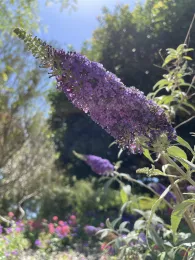
Credit: Joelle Kohn
Host Plants (Provide Food for Caterpillars):
Aspen, Aster, Birch, Carrot, Cassia, Citrus, Dill, Fennel, Legume, Mallow, Milkweed, Native Grass, Parsley, Penta, Passion Flower, Plumbago, Thistle, Willow, Verbena, Nectar Plants
Host Plants (Provide Food for Butterflies):
Asclepias (Milkweed), Buddleia (Butterfly Bush), Coreopsis, Echium fastuosum (Pride of Madeira), Escallonia, Hebe, Lantana, Lavender, Purple Coneflower, Salvia, Verbena, Zinnia
Detailed Plant Lists available at San Diego
Natural History Museum:
http://www.sdnhm.org/archive/exhibits/monarca/hostplants.html
http://www.sdnhm.org/archive/exhibits/monarca/nectarplants.html
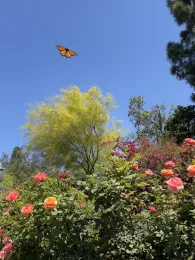
Setting Up a Butterfly-Friendly Garden
- Learn to recognize different butterflies, caterpillars and eggs.
- Plant butterfly friendly plants (see list above). Include native plants.
- Provide water, sunny locations and rocks for them to rest upon.
- Minimize pesticide spraying. Encourage beneficial insects to minimize problem insects.
- Lightly prune your garden plants. Butterflies like a natural looking garden.
Tips on Attracting Butterflies
Search the following topic:
Gardening for Butterflies – California Native Plant Society
Information for Kids About Butterflies
30 Butterfly Facts for Kids from Little Passports
The Master Gardener Association of San Diego County supports the University of California Master Gardeners of San Diego County. UCANR is an equal opportunity provider and employer.