
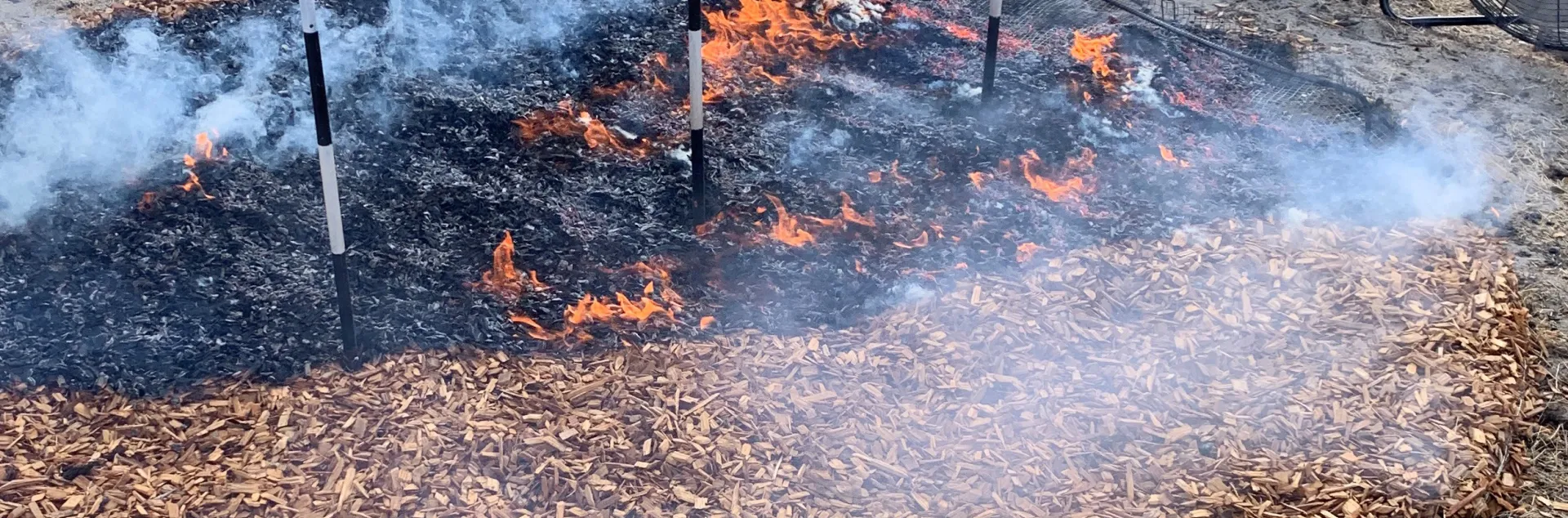
A common bit of advice from Marin Master Gardeners is “mulch, mulch, mulch” to help retain soil moisture and suppress weeds. Mulch can be inorganic and noncombustible, like rocks used for paths and to surround structures. Within the garden, however, many homeowners prefer to cover bare ground using organic mulch like wood chips in various sizes, shapes, and colors.
But wood burns.
If you live in a WUI (wildland urban interface) area, an area deemed to have substantial fire risk, or are simply concerned about fire, the best practice is to keep any type of wood mulch at least five feet from your house and other structures. In fact, new regulations will likely forbid wood mulch in this “zone zero” area.
Elsewhere, though, gardeners can use wood mulch. But, which type?
To answer that question, researchers working in Marin County evaluated the burn characteristics of two commercially available wood mulch categories: Composited and non-composited.
Composited mulch is made from chipped wood and bark piled on the ground and repeatedly turned over for several months, and this turning brings soil into the pile as it composts. Typically, you can see chunks of decomposed bark and wood particles in the final mix, although it can approach the consistency of soil.
Non-composited mulch is, as the name suggests, made of raw chipped wood and sometimes bark.
For the study, researchers sourced composited mulch from one provider in West Marin and another in San Jose. And they bought five types of non-composited mulch from Marin companies: Black Mulch, Forest Floor, Redwood, and two sizes of Fir Bark. Fir Bark A chips ranged from half to three-quarters of an inch. Fir Bark B, often called “Quarter-inch Fir Bark,” had chips smaller than a quarter-inch.
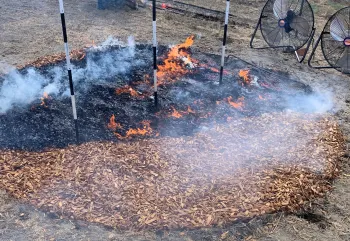
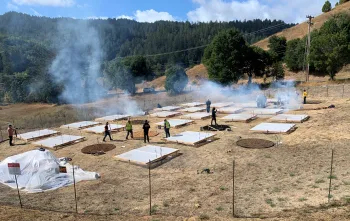
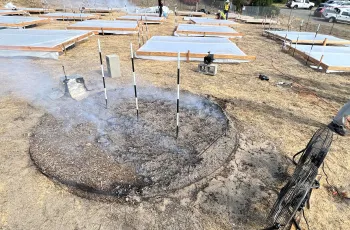
The mulch study took place at the Marin County Fire Department Admin Headquarters at the San Geronimo Golf Course from October 10-12, 2023. Ten different mulch plots, five each of composited and non-composited, were placed into 30 circular, three-inch deep surrounds, with each mulch type replicated three times. After being left to dry and weather for four months, researchers ignited the material and instruments recorded flame length, rate of flame spread, and radiant heat.
The result confirmed an earlier, smaller study done in Nevada.
“Basically, we found that the composited mulch does perform better from a fire perspective,” says UC Cooperative Extension Advisor Emeritus Stephen Quarles. “The products tended to smolder, meaning there was no flame to speak of. If you had needles, leaf debris, twigs, etc., blown into an area with smoldering mulch, it could easily transition into flame, so it isn’t totally safe. But, it’s safer.”
As for the non-composited mulch, two types produced the highest flames and thus could be most dangerous to use: Black Mulch and large Fir Bark A. Forest Floor and Redwood mulch also produced worrisome flames, although not as high. Only the Quarter-inch Fir Bark B had insignificant flames.
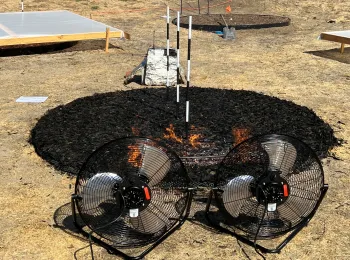
“The Quarter-inch Fir Bark acted a lot like the composited mulch,” Quarles says. “Composited mulch would be my first choice when considering fire, but if you don’t like that aesthetic, Quarter-inch Fir Bark would be your next best choice.”
Because the small Quarter-inch Fir Bark particles compact well, there is a lack of oxygen in the mulch. The other four non-composited mulch types don’t compact as well, which means oxygen can get inside and around the chunks and pieces of various sizes. That produces flames and more rapid flame spread.
“That’s what we worry about if you have mulch around vegetation,” Quarles says. “Flames igniting shrubbery and combustible siding.”
Funded by the Marin Wildfire Prevention Authority, the study was carried out by Quarles working with a team of other researchers led by Professor Michael Gollner at the Fire Research Lab at the UC Berkeley Mechanical Engineering Department. For more information check the FireSafe Marin website.
By Barbara Robertson, May 9, 2026