
In this blog post series, we discussed how collaborating with out-of-school-time education programs can help 4-H programs reach more youth. We’ve shared ideas for how 4-H staff can go about establishing effective and supportive working relationships with community partners. For community partners, one major benefit of working with 4-H is that we bring a research-informed approach to our programming. In this blog post, we discuss how to ensure that these partnerships support inclusive, inquiry-driven, hands-on learning for all youth participants.
Elements of an Engaged Group
We know that youth stay engaged when adult educators (and teen teachers) create a welcoming, predictable space for learning. Within these spaces, youth thrive with hands-on, social, and meaningful activities. Here are some things you can do to ensure engaging spaces for youth learners:
- Consistent educators. Adults and teen teachers can build trust and spark participation. Do what you can to ensure that youth develop supportive relationships with adult and teen leaders.
- Belonging signals. Sharing names, identifying roles, and practicing simple routines such as opening and closing circles can help young people feel safe and seen.
- Age-appropriate challenges. Activities should involve clear, achievable steps that can be adjusted to learners’ capacities. These help prevent boredom or frustration.
- Visible wins. Every session should produce a demo, share-out, or product that allows young people to show what they’ve learned. Including one “show what you made/did” moment per session can help young people connect to the class.
- Include teens as teachers when feasible. Teen involvement can boost rapport, capacity, and excitement among youth, and equip teens with greater confidence and skills (Arnold et al., 2016). A supportive adult coach and realistic recruitment and training plan can ensure success.
An Applied Example
It’s the first session of your afterschool program partnership, and the educators at the site are getting ready to deliver a Junior Master Gardener lesson called “Know and Show Sombrero”. In this class, the youth will learn how to make a newspaper hat decorated to represent the five things every plant needs to live: a place, light, air, nutrients, water, and soil. The supplies are ready, and you’ve checked in to make sure that the adult and teen teachers are feeling prepared. You’ve done the lesson together during the training, but this is their first time bringing this content to the kids, so everyone is excited and a little nervous!
The youth come into the hall, and the educators invite them to put their backpacks along the wall and to circle up. The adult and teen teachers introduce themselves, then invite the young people to go around the circle, sharing their names and their favorite plant to eat. Once everyone’s voice has been heard, one educator pulls out the Know and Show Sombrero that they made during the training, and puts it on their head with a flourish. The kids giggle and want to know what it is and whether they can touch it. The educator says yes, but first the kids need to answer some questions.
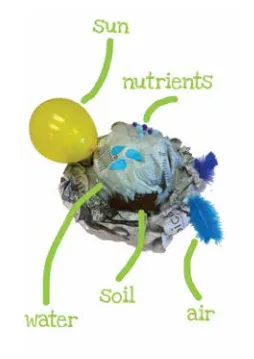
An educator invites the youth to raise their hands if they can think of something that humans need to live, calling on the quieter youth first and making sure that all youth get to share as equally as possible. A teen teacher writes down the youth suggestions on a piece of butcher paper. Once a list is brainstormed, the educator invites every young person to make a list of what plants need to live.
Next, the educators and teen teachers place two pieces of newspaper on each learner’s head, wrapping masking tape around and curling up the edges to make a hat. Once all youth have a hat, the educators instruct the youth to represent what a plant needs on each of their hats using only art and craft supplies, without words. Adults and teen teachers set out craft supplies and the kids get to crafting! Educators circle around the classroom to help in case anyone is getting stuck.
As young people finish their hats, they are invited to help other kids with theirs. Once every young person has completed their hat, one of the teen teachers invites youth to circle back up, and asks volunteers to raise their hands and share the elements on their hats. An educator takes notes on a piece of butcher paper. Once three youth have shared, the teen teacher points out which elements required by plants haven’t been named, and invites youth to add those missing elements to their hats. After ten minutes of hat crafting, the youth circle back up, and each young person gets to share their hat during the closing circle before getting picked up for the day.
After the lesson and the supply cleanup, you gather with the adult and teen teachers to chat about what went well, and whether there were any areas to keep in mind for next time. You confirm the next supply drop-off time and say goodbye. You won’t be on site for future lessons, but will have ongoing check-ins with program staff to make sure everything is going smoothly. As the program goes on, teen teachers will increasingly lead content delivery and classroom management, growing as young leaders in 4-H programming.