
(This article originally appeared in the May / June edition of California Gardens Magazine)
Few plants capture the drama of the California landscape quite like the Matilija poppy. Striking in its display of large “fried egg” blossoms and deeply tied to fire, drought, and cultural memory, this native plant is both a botanical marvel and a symbol of renewal.
Matilija poppies are members of the Romneya genus in the poppy family (Papaveraceae), which includes only species: Romneya coulteri and Romneya trichocalyx. The genus was named in honor of Irish astronomer John Thomas Romney Robinson, while the species coulteri commemorates Irish botanist Thomas Coulter, who first collected the plant in California in the early 1830s.
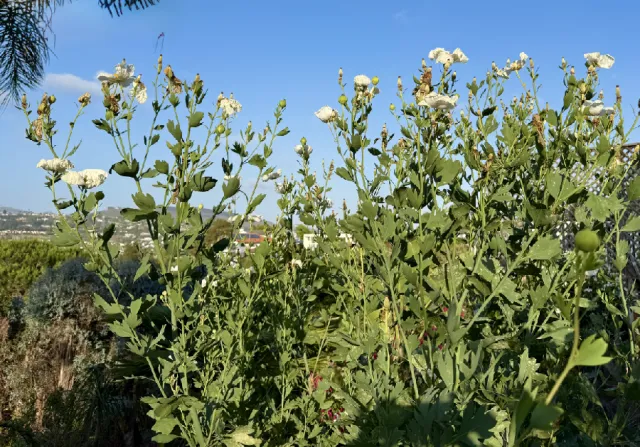
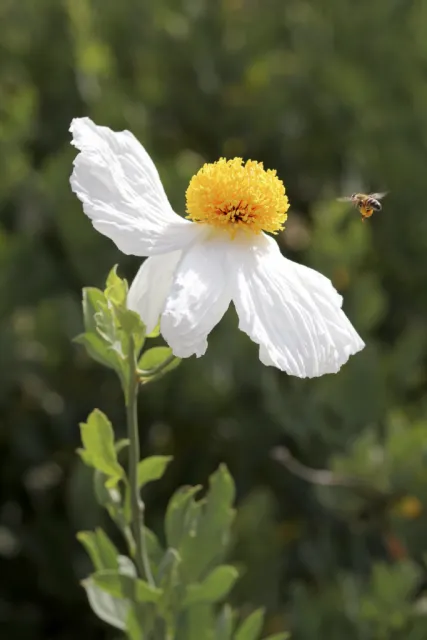
Often called the “fried egg flower,” the Matilija poppy earns that nickname from its brilliant yellow stamens set against crinkly white petals. In bloom from late spring into summer, a mature stand makes an unforgettable impression. We first saw Matilija poppies rising in an exuberant mass from a canyon in the San Diego Wild Animal Park twenty-five years ago and I knew immediately we had to have some in our garden. At the time we had plenty of room on 1/3 of an acre so we could accommodate their energetic spreading.
Matilija poppies are perennial subshrubs with an assertive growth habit. In the wild, they are famously known as “fire followers.” Their seeds lie dormant in the soil until triggered by the heat and chemical cues of wildfire smoke, which stimulate germination during the following rainy season. Endemic to California, Matilija poppies have a relatively small native range, occurring naturally in chaparral and coastal sage scrub habitats of Southern California and Baja California. Each winter, the above-ground growth dies back. In spring, new shoots emerge from roots and rhizomes. This makes Matilija poppies excellent for erosion control—but also means they can spread aggressively in a garden setting.
While the scientific name honors European scientists, the common name Matilija has Indigenous roots. It is associated with Chief Matilija of the Chumash peoples of present-day Santa Barbara and Ventura counties. According to Chumash oral tradition, recorded by descendant Julie Tumamait-Stenslie, the flower symbolizes a tragic love story between Chief Matilija’s daughter, Amatil, and her warrior lover. When her lover died in battle, Amatil laid upon his body and there she died. A beautiful flower with pure white petals and a shining yellow center, symbolic of their love, was all that remained.
The plant’s dramatic appearance has also made it a subtle but memorable presence in another tragic love story, the movie “Chinatown.” Set in 1937 Los Angeles, Matilija poppies are a favorite flower of Evelyn Mulwray, the doomed love of Jake Gittes, Jack Nicholson’s character. Matilija poppies reappear in “The Two Jakes,” the sequel to “Chinatown,” where Nicholson’s character encounters them again, first in a scene where he is reminded they were Evelyn Mulwray’s favorite flower and then in the final scene where poppy-shaped earrings reveal to Nicholson that the young woman he has been trying to help is actually Evelyn’s daughter. Although the movie takes liberty with accurate botanical details, the film’s dialogue emphasizes the Matilija poppy’s association with fire, memory, and tragic love.
In recent years, Matilija poppies have once again drawn attention as wildfires have reshaped Southern California. Following major burns such as the Eaton Fire in Altadena and the Palisades Fire, we hope these native plants will bloom in abundance as a result. Matilija poppies help stabilize soil, shade the ground, and restore visual beauty to charred hillsides. Community efforts like native seed restoration projects have embraced them as emblems of hope and ecological resilience. We look forward to their reappearance.
For gardeners, Matilija poppies are best suited to large, sunny spaces with well-drained soil. Once established, they are drought-tolerant and strikingly low-maintenance—but they need room. Their spreading rhizomes can overwhelm neighboring plants, so thoughtful placement is essential.
When given space, however, few plants reward the gardener with such grandeur. In full bloom, the Matilija poppy stands as a living reminder of California’s wild beauty—resilient, radiant, and reborn from fire.
Kathy McKee has been a Master Gardener since 2016 and still loves Matilija poppies although she limits herself now to seeing them in botanical gardens because her current garden size no longer accommodates them.