
Maria Giovanni, UC Master Food Preserver Online Program Volunteer
California has a diverse landscape, with altitudes ranging from 280 feet below sea level (Death Valley) to 14,500 feet (Mt. Whitney). The location of your kitchen is an important consideration in home food preservation. The first step is to determine your altitude, which you can do here. You may think you know your altitude but we encourage you to double check. You can also use this website if you are helping others with food preservation.
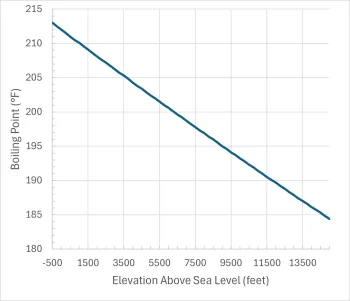
The boiling point of water as a function of elevation above sea level. (Plot by Henry Shaw, used with permission).
Why does altitude matter? Just like attitude, having an understanding of the “why” supports good practice. As we move from the coast to higher altitudes inland, the pressure exerted by air decreases, which means (in practical terms) that water boils at a lower temperature. At sea level, water boils at 212°F, whereas in Truckee (5820 feet), water boils at 200°F. A general rule of thumb is that water’s boiling point drops by 1°F for every 500 feet of elevation gain (see figure). The impact is that food takes longer to cook at higher altitudes, especially anything cooked in water, such as rice and pasta.
When canning for food preservation, it takes longer for the product in the center of a jar to reach the temperature needed to destroy microorganisms than it does for the edges of the jar. Similarly, larger jars take longer to reach the necessary internal temperature than smaller jars (thus, quart jars have a longer processing time than pints). At higher altitudes, water boils at a lower temperature than at sea level, so the processing time or processing pressure must be increased to ensure the destruction of spoilage organisms and pathogens.
[For you science buffs, at higher altitudes, less atmospheric pressure pushes down on liquid (and everything else), so less energy (heat) is needed to cause water molecules to move from the liquid to the vapor state. With less external pressure, the vapor pressure of the water matches the atmospheric pressure at a lower temperature, so it boils faster and cooler. In addition, the atmosphere is typically drier as altitude rises above 2,500 feet, so moisture evaporates more quickly. NOTE: If you use a steam canner at high altitude, as I do, be sure you start with the maximum amount of water in the canner because the water can evaporate faster.]
To compensate for the lower temperature in a boiling-water-bath canner or atmospheric steam canner at higher elevations, it’s necessary to increase the processing time. A good recipe will always specify the adjustments that should be made. If no adjustments are specified in the recipe, use the guidelines in Table 1.
Table 1. Adjustments for altitude in boiling-water and atmospheric steam canners1
Altitude Above Sea Level (feet) | Increase Processing Time by: |
1,001 – 3,000’ | 5 minutes |
3,001 – 6,000’ | 10 minutes |
6,001 – 8,000’ | 15 minutes |
8,001 – 10,000’ | 20 minutes |
A pressure canner gives us another “knob” besides processing time that we can use to modify the processing conditions—we can change the pressure inside the canner by using a heavier weight on a weighted-gauge canner or by running a dial-gauge canner at a higher pressure. Both methods increase the pressure in the canner, allowing the temperature to reach 240°F, the temperature needed to destroy Clostridium botulinum spores in a reasonable amount of time. If your recipe does not include altitude adjustments, use the adjustments in Table 2.
Table 2. Adjustments for altitude in pressure canning1
Pressure canner type | Altitude above sea level (feet) | Process at: |
Weighted-gauge | Below 1000’ | 10 pounds |
Above 1000’ | 15 pounds | |
Dial-gauge | Below 1000’ | 11 pounds |
2,001 – 4,000’ | 12 pounds | |
4,001 – 6,000’ | 13 pounds |
Remember: you must know your altitude and make the required adjustments specified in the recipe, which should be a tested recipe from a reliable source, such as a University Cooperative Extension, the National Center for Home Food Preservation (https://nchfp.uga.edu/ ), or the Ball Blue Book. If a recipe does not include altitude adjustments, this might indicate that the recipe is untested and potentially unsafe to use.
For more information about the impact of altitude on food preparation, see High Altitude Cooking.
Reference
1Fundamentals of Consumer Food Safety and Preservation: Master Handbook, California edition, 2018, WA State Univ. Extension and UC ANR.