Following initial reports of the black fig fly in spring/summer 2021, a series of research and extension projects were developed to provide fig growers with improved tools for monitoring and management. The Wilson Lab at UC Riverside (https://treecrops.ucr.edu/) is currently leading these efforts.
Black Fig Fly Phenology, Monitoring, Geographic Range and Management
Characterizing BFF Seasonal Phenology: From 2022-2024, McPhail-type traps baited with torula yeast lures were used to monitor the activity of the BFF at sites in San Diego and Ventura counties. Findings to date suggest that, on average, some low level activity of BFF adults could be observed as early as March 1. Populations increased substantially in mid-June to early July, and remained active through mid-October. Monitoring in Kern County was initiated in the spring of 2024 after a population established near Bakersfield. We will conclude this monitoring in December 2025 and then update this website with phenology from this region.
Developing Better Traps and Lures: An effective monitoring system is needed for BFF. The current strategy relies on McPhail-type traps baited with a torula yeast lure. While this is effective, it also attracts a lot of non-target organisms, which makes it difficult to separate out the BFF. As such, we are currently testing new experimental lures that are more selective for BFF, as well as pairing those new lures with improved traps (e.g. sticky cards). Studies are still underway at this time.
Evaluating Chemical Controls: The efficacy of some chemical controls will be evaluated against adult BFF populations. This includes products that are allowed for use in certified organic production. These studies are also still underway, so there is nothing to report at this time.
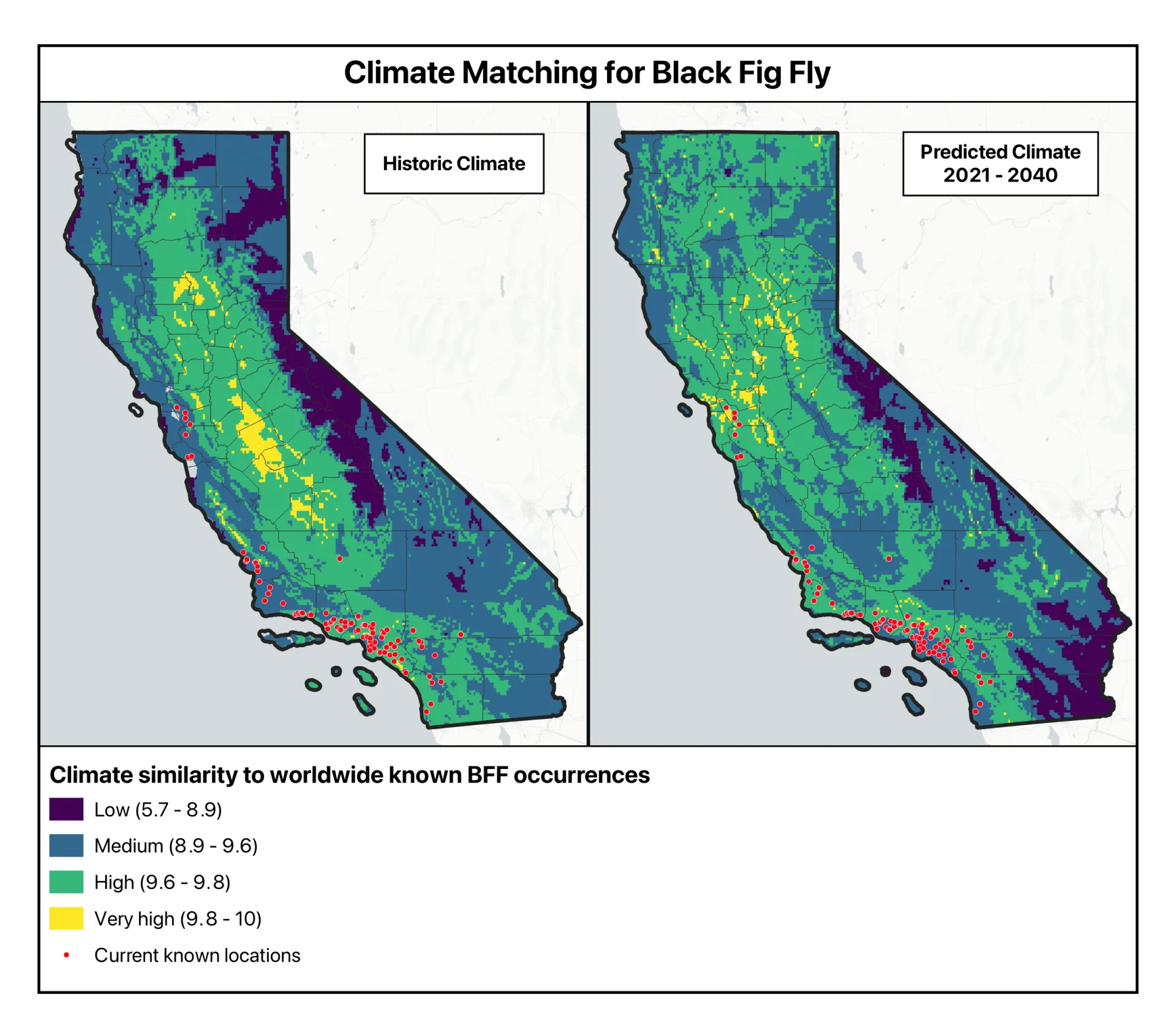
Potential Geographic Range of BFF: Little is known about the temperature thresholds and degree-day requirements for BFF. We partnered with Dr. Neil McRoberts at UC Davis to develop a habitat suitability model to estimate the potential range of BFF establishment in California. The output from that modeling effort is shown in the map below. A majority of the commercial fig production in California takes place in Madera and Merced counties, which are at high risk for BFF occurrence according to this model.