UC ANR is committed to providing an accessible and inclusive web experience for all users. If you encounter an accessibility barrier or need content in an alternative or remediated accessible format, please contact anraccessibility@ucanr.edu.
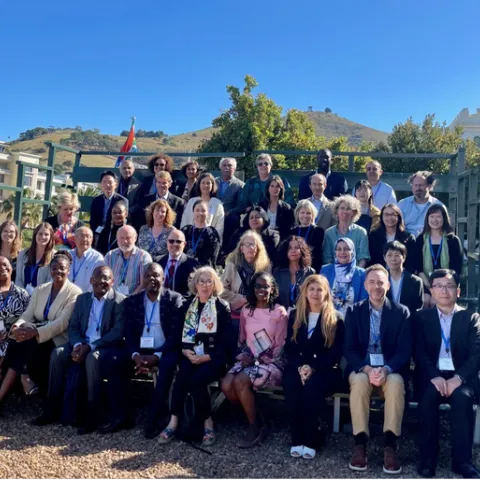
UC Davis distinguished professor Walter Leal is a newly elected trustee of the Royal Entomological Society (RES), the 13-member council that governs the 190-year-old international organization. He is the first UC Davis scientist to be elected a trustee.
An Anise Swallowtail, Papilio zelicaon, settles on a red zinnia in a Vacaville pollinator garden and begins sipping the nectar. A honey bee buzzes by. Was she just passing through or did she want the same nectar? The bee brushes the butterfly's wings. Okay! I'm leaving! Score: Bee, 1; butterfly 0.
Recently I [Matt] had a chance to interview 4-H Miner's Ravine Club President Ava from Placer County. The prior week, I had met Ava at the Placer County Gold Country Fair while helping 4-H volunteers set up pig pens. The following are Ava's responses to my questions.
Native to Texas and the Southeast, Turk's cap (Malvaviscus arboreus var. drummondii) gets its common name from the tightly twisted flowers that never fully open and resemble a Turkish turban or fez.
This spring I was amazed at how much my garden rebounded after several years of drought and I bet you might have been too! It has been such a joy to see the many shades of green and all the spring blooms.
The Invasive Pest Spotlight focuses on relevant or emerging invasive species in California. In this issue we are covering brooms, a group of invasive shrubs. Invasive Broom facts Brooms are upright shrubs in the legume family that typically produce small, yellow, pea-shaped flowers.
Many of our commonly cultivated house and garden plants contain toxins. During my 35-plus years in veterinary practice, I treated many patients for either known or suspected toxic plant ingestion. For the most part, plants that are poisonous to pets are equally dangerous to children.