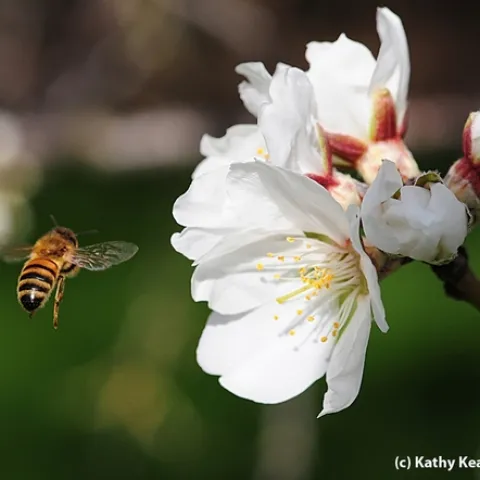
For years, uninformed folks have declared that honey is "bee vomit." It's not. These things are inequitably false. 1. The world is flat. 2. Einstein said that "if the bee disappeared off the surface of the globe, then man would only have four years of life left." 3. Honey is bee vomit.
How do you pin and spread a butterfly? Entomologist Jeff Smith, an associate at the Bohart Museum of Entomology, University of California, Davis, showed everyone from pre-schoolers to adults how to do just that at the Bohart's recent open house. It was all hands-on.
Methyl bromide fumigation kept the nutsedge in check for strawberry growers, and when methyl iodide came along it was an equally effective replacement, but both of these fumigants are now gone.
"Why do honey bees die when they sting?" That's the question PBS Newshour asked Extension apiculturist (retired) Eric Mussen of the UC Davis Department of Entomology and Nematology for its "Just Ask" feature.
Female (top), male and female in copulation (middle) and a mature nymph (bottom) of Bagrada bug on a dime. (Photo by Surendra Dara) Bagrada bug (Bagrada hilaris) is an invasive pest that was first reported in California in 2008 in Los Angeles County.
California's Conservation Agriculture Systems Innovation (CASI) Center, in partnership with Sustainable Conservation and the USDA Natural Resources Conservation Service, has prepared its survey of tillage management acreage for 2012.
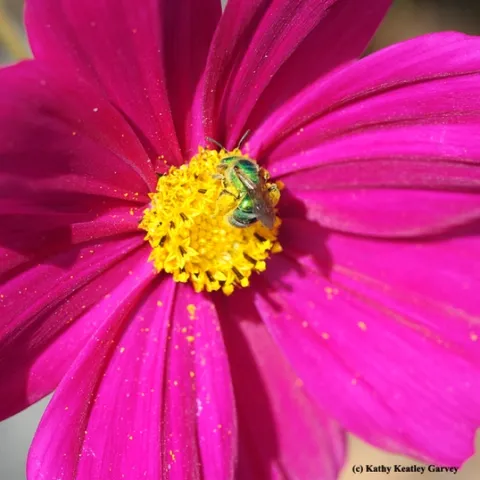
Give me an "A" (for excellence). Give me a "B" (for bee). Give me a "C" (for Cosmos). Watching honey bees collect nectar and pollen on the showy Cosmos (Cosmos bipannatus) is not to be missed.
Recent investigations conducted by UC's Conservation Agriculture Systems Innovation (CASI) Center shed light on opportunities farmers have for cutting production costs in their cropping systems by reducing tillage.